

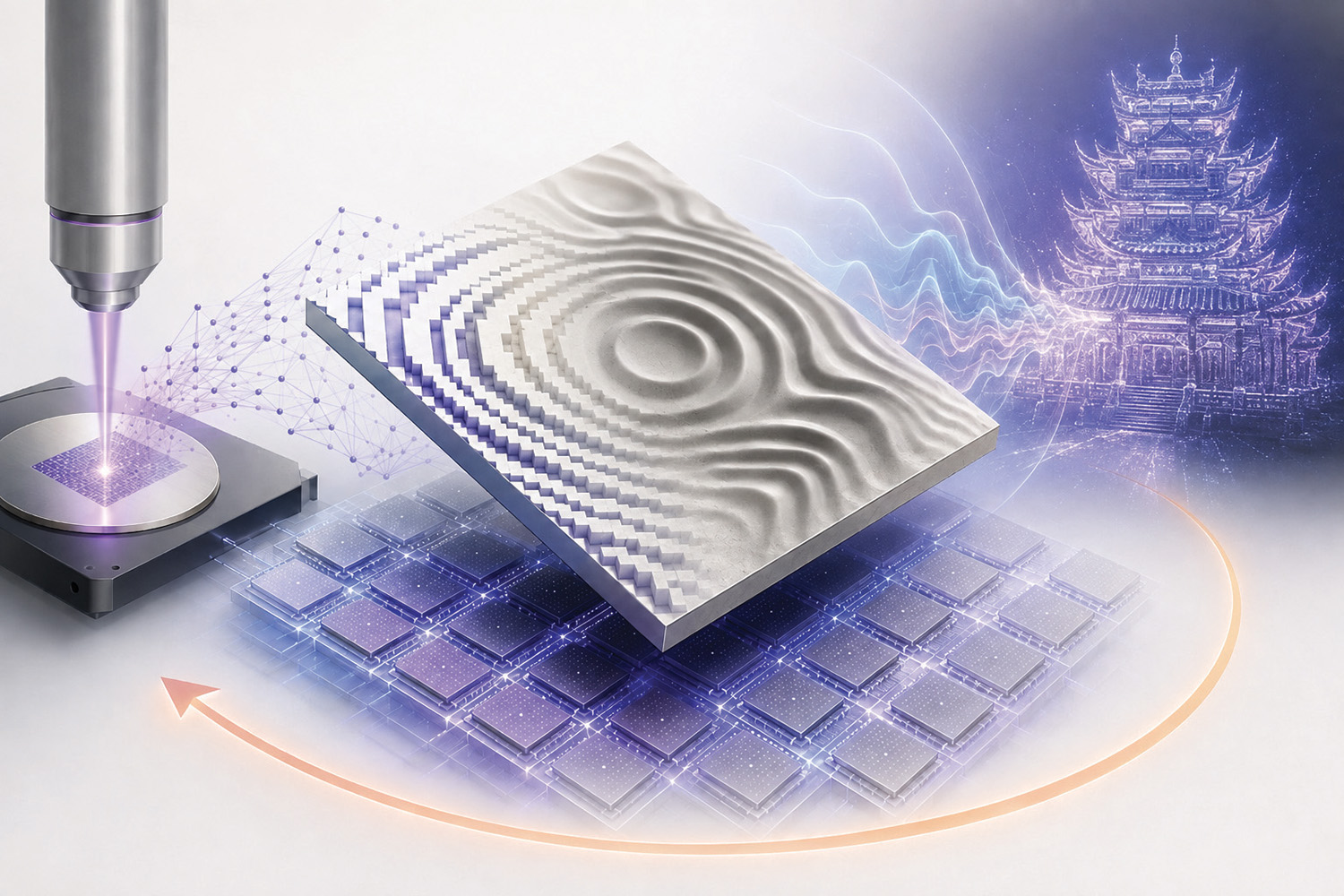
 [Enlarge image]Artist’s rendering of fabrication-aware, end-to-end design for large-area diffractive optics. A neural-lithography digital twin predicts the as-fabricated 3D surface, while tensor-parallel computation distributes high-resolution fabrication and wave-optics simulations across multiple GPUs.
Differentiable optics, an emerging paradigm that jointly optimizes optics and image-processing algorithms, has made many innovative optical designs possible across a broad range of imaging and display applications.1, 2 Many of these systems utilize diffractive optical elements (DOE) for holography, point-spread function engineering or wavefront shaping. Existing approaches, however, have mostly remained limited to laboratory prototypes, owing to a large quality gap between simulation and manufactured devices.
In recently published work,3 we have addressed this design-to-manufacturing gap with a fabrication-aware design framework. We developed a super-resolved neural lithography model—a digital twin that predicts the three-dimensional surface actually produced by direct-write grayscale lithography followed by nanoimprint replication, a route suited to inexpensive mass production. Incorporating this model into the optical optimization loop allows the design to be optimized for the as-fabricated device rather than an idealized layout.
Scaling this approach to practical apertures creates another challenge: computation. Fabrication-aware wave simulations of centimeter-scale DOEs require enormous numerical grids that cannot fit on a single graphics processing unit (GPU). We have therefore developed tensor-parallel methods that split the neural fabrication model and large wave-propagation calculations across multiple GPUs. This enabled wafer-scale design of DOEs as large as 32.16 mm × 21.44 mm on grids containing up to 128,640 × 85,760 samples.
We demonstrated the approach in holography, beam shaping and broadband color imaging, with simulations closely matching fabricated prototypes. In the imaging experiment, a camera consisting of only a single DOE and an off-the-shelf sensor produced high-quality images using a simple one-step reconstruction based entirely on the simulated optical response—without calibration or fine-tuning using measurements from the fabricated prototype.
By integrating fabrication physics and large-scale wave simulation into the same differentiable design loop, the approach addresses two key barriers to practical learned diffractive optics: manufacturability and scale. It points toward computational optical systems that can be designed at practical aperture sizes and replicated efficiently, rather than remaining one-off laboratory demonstrations.
Researchers
Kaixuan Wei (kaixuan.wei@kaust.edu.sa), Hector A. Jimenez-Romero, Hadi Amata, Qiang Fu and Wolfgang Heidrich, King Abdullah University of Science and Technology, Saudi Arabia
Jipeng Sun and Felix Heide, Princeton University, USA
References
1. G. Wetzstein et al. Nature 588, 39 (2020).
2. V. Sitzmann et al. ACM Trans. Graph. 37, 4 (2018).
3. K. Wei et al. ACM Trans. Graph. 44, 6, Article 243 (2025).
