

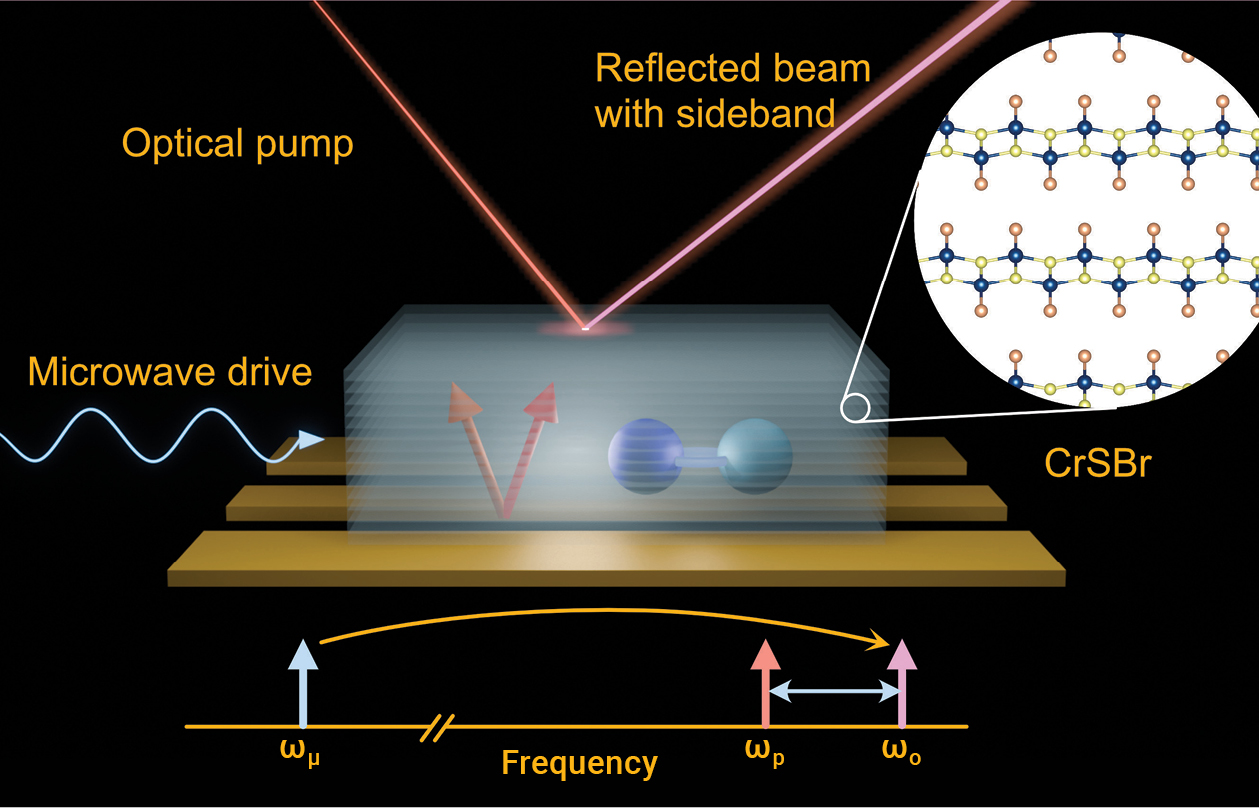
 [Enlarge image]Microwave-optical conversion in a chromium sulfide bromide (CrSBr) crystal on a coplanar waveguide. Microwave-driven magnons modulate exciton energies, generating an optical sideband offset from the reflected pump by the microwave frequency. Inset: layered crystal structure.
A quantum network must span four to five orders of magnitude in frequency: Superconducting processors operate at gigahertz frequencies, while low-loss fiber communications operate at hundreds of terahertz. Bridging this gap requires coherent microwave-optical transduction.1 Despite concerted efforts across electro-optic, optomechanical and atomic-ensemble approaches, combining high efficiency and low added noise with broad bandwidth and compact device integration remains a central challenge. Magnons—the collective spin excitations of magnets—offer broadband, magnetically tunable microwave dynamics. Yet their promise for transduction has been constrained by weak, off-resonant magneto-optical interactions. Coupling magnons to the strong excitonic resonances in a semiconductor opens a new route to conversion.
We realized this resonant connection in chromium sulfide bromide (CrSBr), a van der Waals (vdW) antiferromagnetic semiconductor.2 CrSBr brings microwave-frequency magnons and strong visible and near-infrared excitonic resonances together in a single material.3 Crucially, the exciton energies depend on the relative spin orientation of adjacent layers. Microwave-driven spin precession periodically changes this alignment, shifting the exciton energy and modulating the optical response. A reflected probe laser therefore acquires sidebands offset from its carrier by the magnon frequency.
We detected the optical sidebands by homodyne interferometry in bulk crystals on a coplanar waveguide at 2 K. The conversion spans a microwave frequency window of approximately 300 MHz without external cavity enhancement. The signal follows the field-tunable magnon resonance and strengthens near excitonic transitions. We also observed magnon-coupled signals at several exciton–polariton resonances—hybrid states of excitons and light confined within the crystal itself.4,5 The tunable light–matter composition of the polaritons offers a way to balance sensitivity against loss while broadening the optical operating range.
Our analysis reveals a single-particle coupling rate about three orders of magnitude larger than typical magneto-optical values in yttrium iron garnet. This coupling increases as the magnetic mode volume decreases. In the present bulk device, the optical probe samples only a small part of the extended magnetic mode, limiting conversion efficiency. The vdW structure offers a key advantage: Thin flakes can retain their magnetic and excitonic properties while concentrating the interaction into a smaller volume and enabling a smaller footprint. For idealized bilayers, our calculations predict a single-quantum cooperativity of up to 10‒4 before pump enhancement. Together with microwave and optical resonators, these features make CrSBr a promising platform for efficient quantum transduction.
By establishing a resonant link between magnetic dynamics and semiconductor optics, this work opens a materials route to compact, tunable microwave–optical interfaces.
Researchers
P.C. Adak (padak@ccny.cuny.edu), I. McDaniel, S. Paul and B. Das, City College of New York (CCNY), USA
C. Heuvel-Horwitz and V.M. Menon (vmenon@ccny.cuny.edu), CCNY and Grad. Ctr - City Univ. of New York (CUNY), USA
A. Alù, V. Kozlov and A. Thielens, ASRC, CUNY, USA
K. Mosina and Z. Sofer, Univ. of Chemistry and Technology Prague, Czechia
A. Ramanathan and X. Roy, Columbia University., USA
T. Zhong, University of Chicago, USA
A. Kamra, RPTU Kaiserslautern- Landau, Germany
References
1. X. Han et al. Optica 8, 1050 (2021).
2. P.C. Adak et al. Nat. Mater. (2026). doi: 10.1038/s41563-026-02748-7.
3. B. Datta et al. Nat. Mater. 24, 1027 (2025).
4. P.C. Adak et al. Adv. Mater. 38, e12557 (2026).
5. F. Dirnberger et al. Nature 620, 533 (2023).
