

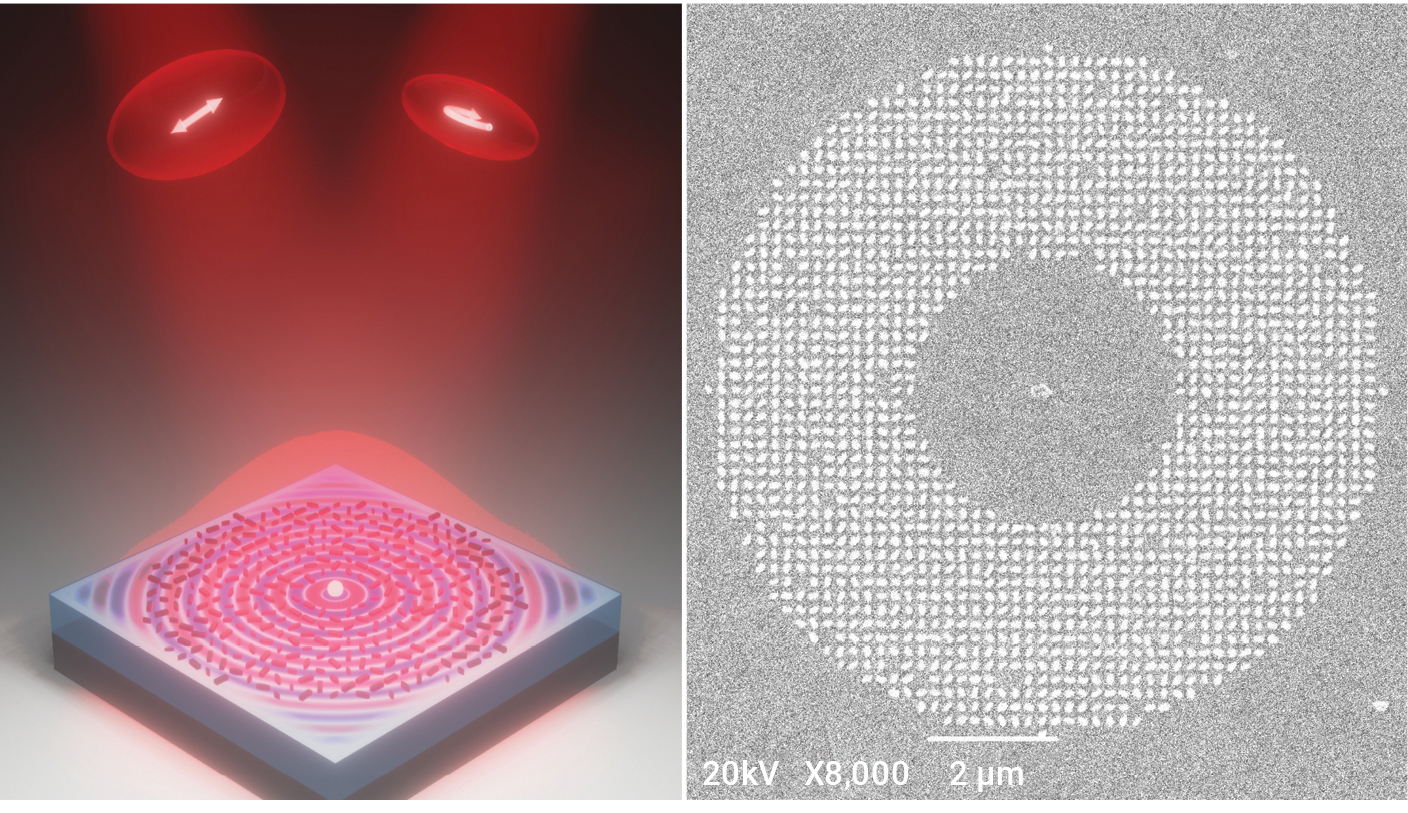
 [Enlarge image]Left: Schematic of emitter-coupled meta-optics for versatile photon generation. A nanoscale quantum emitter launches radially polarized surface waves that are scattered by engineered meta-atoms into spatially separated photon beams with prescribed polarization, direction and relative intensity. Right: Scanning electron microscope (SEM) image of a representative metasurface designed for directional circularly polarized emission. Photon polarization is encoded by the local geometry and orientation of the meta-atoms, while the annular layout improves robustness without determining the polarization state. The metasurface is approximately 10 µm in diameter.
Photons are ideal carriers of quantum information, but practical quantum technologies require compact sources that can deliver photons in precisely prescribed optical states. Solid-state quantum emitters are attractive nanoscale sources, yet their native emission is typically omnidirectional and poorly defined in polarization. Metasurfaces have opened new opportunities for molding quantum emission, but previous on-chip approaches have generally controlled only a subset of the available degrees of freedom, such as polarization, directionality or spatial mode. What has been missing is a general way to tailor these properties simultaneously.
In our recent work,1 we developed an emitter-coupled meta-optics platform that directly transforms quantum-emitter-excited surface waves into freely propagating photon beams with designer properties. A nanodiamond containing nitrogen-vacancy centers is positioned above a silver mirror and surrounded by an array of anisotropic silver meta-atoms. The emitter first launches radially polarized surface plasmon polaritons, which propagate outward and are then scattered into free space by the metasurface.
The key advance is to engineer the meta-atoms as nanoscale half-wave plates that combine resonance and geometric phases. This allows independent phase control of the left- and right-circularly polarized components of the surface wave. By matching these phases to those required for the desired output, we can prescribe the polarization, propagation direction and phase profile of the emitted photons within a unified design framework. The concept builds on emerging quantum meta-optics2,3 while substantially expanding the available control over photon emission.
Experimentally, we generated highly directional, off-normal photon emission with selected linear or circular polarization. The averaged Stokes parameter reached 0.986 for linearly polarized emission and 0.938 for circularly polarized emission. We further produced two spatially separated channels with orthogonal linear or circular polarizations, as well as channels combining linear and circular polarization with adjustable relative intensities. The platform can also be extended to three-channel emission and to structured photons carrying vector or vortex modes.
Our results turn the metasurface surrounding a nanoscale emitter into a programmable interface between a localized optical excitation and desired free-space photon states. This ability to create “made-to-order” photons on a micrometer-scale platform could provide versatile sources for integrated quantum communication and information processing, while also offering new possibilities for classical nanophotonic light sources.
Researchers
Fei Ding (fding@eitech.edu.cn), Eastern Institute of Technology, Ningbo, China, and University of Southern Denmark, Denmark
References
1. S. im Sande et al. Phys. Rev. Lett. 135, 086902 (2025).
2. F. Ding and S.I. Bozhevolnyi. Mater. Today 71, 63 (2023).
3. A.S. Solntsev et al. Nat. Photon. 15, 327 (2021).
