

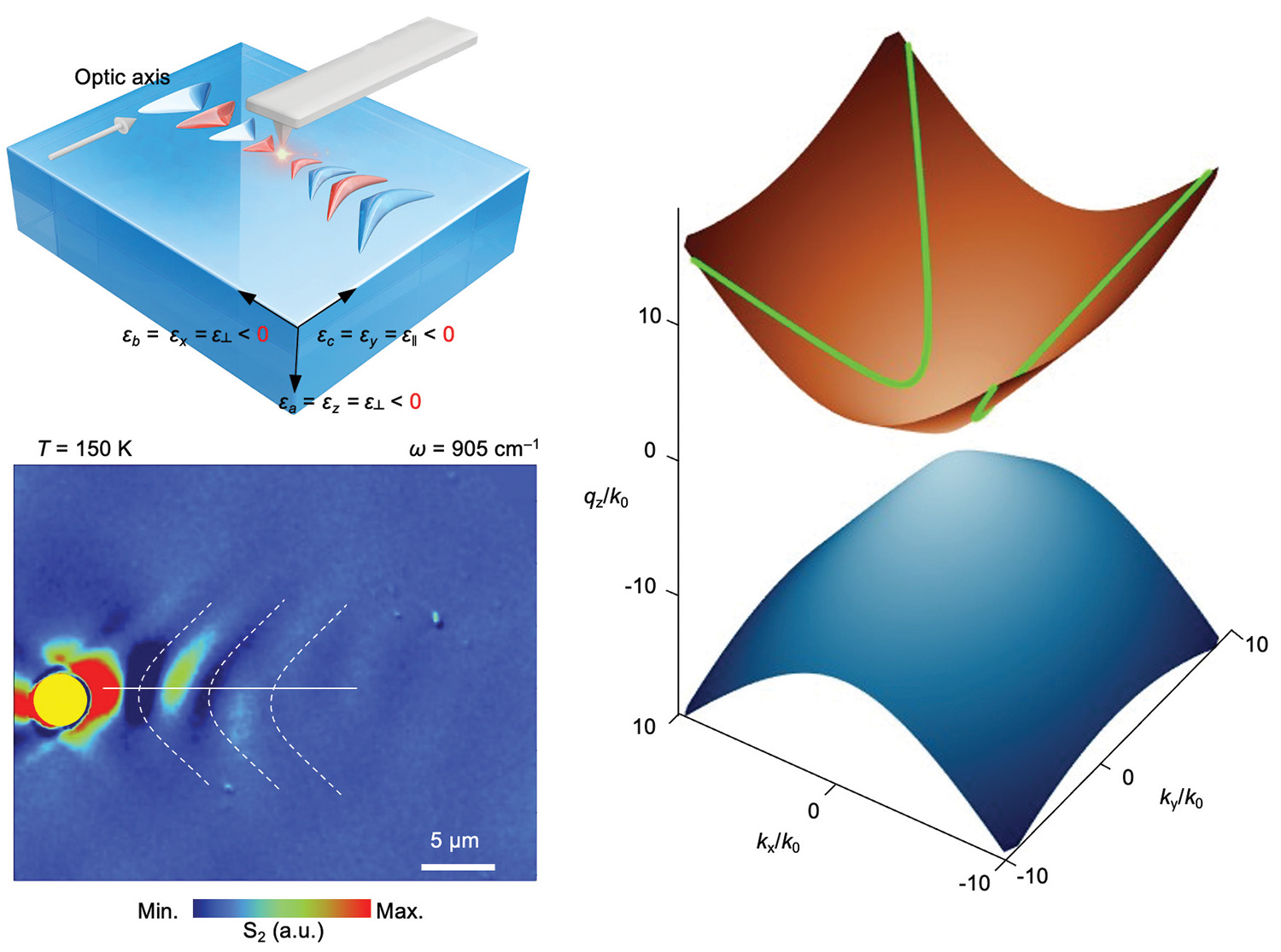
 [Enlarge image]Upper left: Schematic of s-SNOM for nanoimaging of hyperbolic polaritons at the surface of a non-hyperbolic YVO4 crystal. Lower left: Experimental near-field amplitude images of hyperbolic polaritons in YVO4. Right: Hyperbolic dispersion relation in (kx, ky, qz) parameter space.
Hyperbolic polaritons—hybrid light–matter excitations supported by strongly anisotropic materials—enable unusual optical phenomena through their strong confinement and nanoscale directional wave propagation.1,2 To date, hyperbolic polaritons have been observed in the band (a narrow spectral range in which different components of the dielectric tensor have opposite signs) of many hyperbolic materials. This limits the spectral tunability, material platforms and broader exploitation of hyperbolic nano-optics.3,4
Inspired by the exotic surface physics of bulk solids and by Wolfgang Pauli’s famous dictum that “God made the bulk; surfaces were invented by the devil,” we establish a general theoretical framework to obtain hyperbolic polaritons at the surface of non-hyperbolic bulk crystals. Specifically, we find that hyperbolicity in the bulk is not a necessary condition; rather, it is the anisotropic surface-wave resonance condition at the interface that governs the emergence of these modes. This provides a different perspective on the origin of hyperbolic polaritons and substantially broadens the range of materials that can potentially support such exotic surface modes. Such a mode features a hyperbolic dispersion with real in-plane momentum and an imaginary out-of-plane wave vector, reflecting its strong surface confinement.
With a common and foundry-compatible yttrium vanadate (YVO4) crystal, which is widely used in laser and polarization optics, we demonstrate a hyperbolic surface polariton in its non-hyperbolic spectral range where both its extraordinary and ordinary principal permittivity components are negative.5 Such a hyperbolic wavefront is directly visualized using scattering-type scanning near-field optical microscopy. From room temperature to cryogenic conditions, we further tune the polariton dispersion in situ, driving transitions among hyperbolic, canalization and elliptic regimes. The temperature hence facilitates the continuous programmability of surface polariton dispersion and its associated topology without requiring a structural modification of the material.
Our findings broaden the design space of hyperbolic nano-optics by removing the need for intrinsically hyperbolic bulk materials. This interface-based approach could open new opportunities for negative refraction, superlensing, polaritonic chemistry and integrated mid-infrared photonics.
Researchers
Guangwei Hu (guangwei.hu@ntu.edu.sg), Qi Jie Wang, Chongwu Wang, Langlang Xiong and Yihua Bai, Nanyang Technological University, Singapore
Zhigao Dai, Guogang Li, Lu Liu and Yupeng Wang, China University of Geosciences, China
Francisco J. Garcia-Vidal, Universidad Autónoma de Madrid, Spain
Peining Li, Huazhong University of Science and Technology, China
Weiliang Ma, University of Electronic Science and Technology of China, China
References
1. D.N. Basov et al. Science 354, aag1992 (2016).
2. Q. Zhang et al. Nature 597, 187 (2021).
3. W. Ma et al. Nature 596, 362 (2021).
4. N.C. Passler et al. Nature 602, 595 (2022).
5. L. Liu et al. Nature 644, 76 (2025).
