

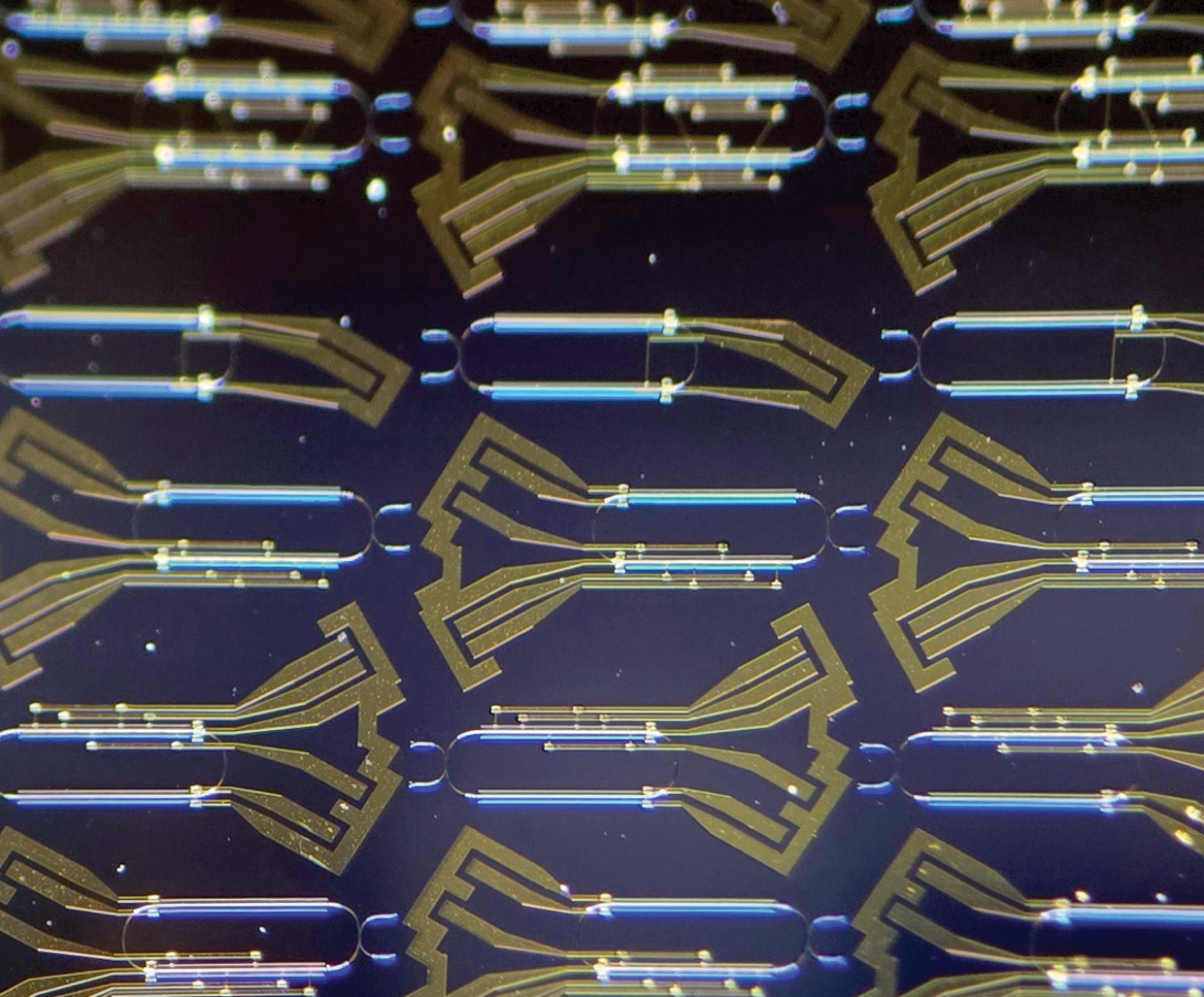
 [Enlarge image]An oxide-clad thin-film lithium-niobate isolator uses a three-phase electrode array to create synthetic momentum and direction-dependent photonic Autler–Townes splitting. Forward light is transmitted, while backward light is resonantly extinguished.
Optical isolators—two-port devices that ideally transmit all light in one direction while blocking it in reverse—are key for complex laser systems and reliable signal routing. Commercially available isolators always rely on magneto-optic materials, but these are difficult to integrate in photonic foundries, tend to be lossy and exhibit strong chromatic dependence. Alternative devices based on spatiotemporal modulation offer a nonmagnetic route, but integrated versions of these concepts often face practical limitations.
Many nonmagnetic designs use nonreciprocal interference via spatiotemporal modulation. Multiple modulated pathways interfere constructively in one direction and destructively in the other. Although comparatively straightforward, these devices require precise control of the electrical-drive amplitude and phase and commonly generate unwanted frequency sidebands. A second class of designs uses nonreciprocal conversion between selected optical modes. Here, the available modes themselves, rather than delicate interference, determine the response, and unwanted sidebands do not appear. A particularly effective architecture for this is the “chiral shunt” design, in which an applied modulation induces direction-sensitive strong coupling between modes of a resonator. When the resonator is shunt-coupled to a waveguide, the direction-dependent optical density of states makes the waveguide transparent to forward light while backward light is resonantly extinguished. The approach combines low insertion loss, high isolation contrast and linear operation.
A few years ago, we reported the first chiral-shunt isolators, using piezoelectrically launched acoustic waves to couple the resonator modes.1,2 These devices performed comparably to commercial magneto-optic isolators, but acoustic phase matching tightly linked drive frequency and momentum. This restricted spectral tuning, made yield sensitive to fabrication variations and favored suspended or air-clad structures that are difficult to protect and package.
In 2026, we realized the first integrated electro-optic device to reach the nonreciprocal strong-coupling regime.3 Our thin-film lithium niobate isolator replaces acoustic pumping with a three-phase electrode array that supplies lithographically defined synthetic momentum. A double-racetrack resonator provides even and odd optical modes with nearly constant momentum separation across a broad spectrum, while the radio-frequency drive remains freely selectable. The drive therefore hybridizes the modes—and creates a chiral optical density of states—for only one propagation direction. Forward light bypasses the resonator, whereas backward light is resonantly attenuated. Because other optical states are unavailable, unwanted frequency-shifted sidebands are strongly suppressed.
At 1545.5 nm, the device achieved 47.7 dB isolation contrast with 1.45 dB insertion loss—32.9 dB of contrast per dB of loss, comparable to commercial off-chip isolators. Across 27 mode pairs spanning 1.1 THz (8 nm), it maintained 41–52 dB contrast and 1.4–2.0 dB insertion loss; the measured span was limited by our radio-frequency sources. This combination of linearity, high performance and multi-terahertz addressability offers a practical route to integrated protection of lasers, atomic references and precision photonic systems.
Researchers
Gwan In Kim (gikim2@illinois.edu), Violet Workman, Oğulcan E. Örsel, Jieun Yim and Gaurav Bahl (bahl@illinois.edu), University of Illinois at Urbana–Champaign, USA
References
1. D.B. Sohn et al. Nat. Photon. 12, 91 (2018).
2. D.B. Sohn et al. Nat. Photon. 15, 822 (2021).
3. G.I. Kim et al. Nat. Commun. 17, 6532 (2026).
