

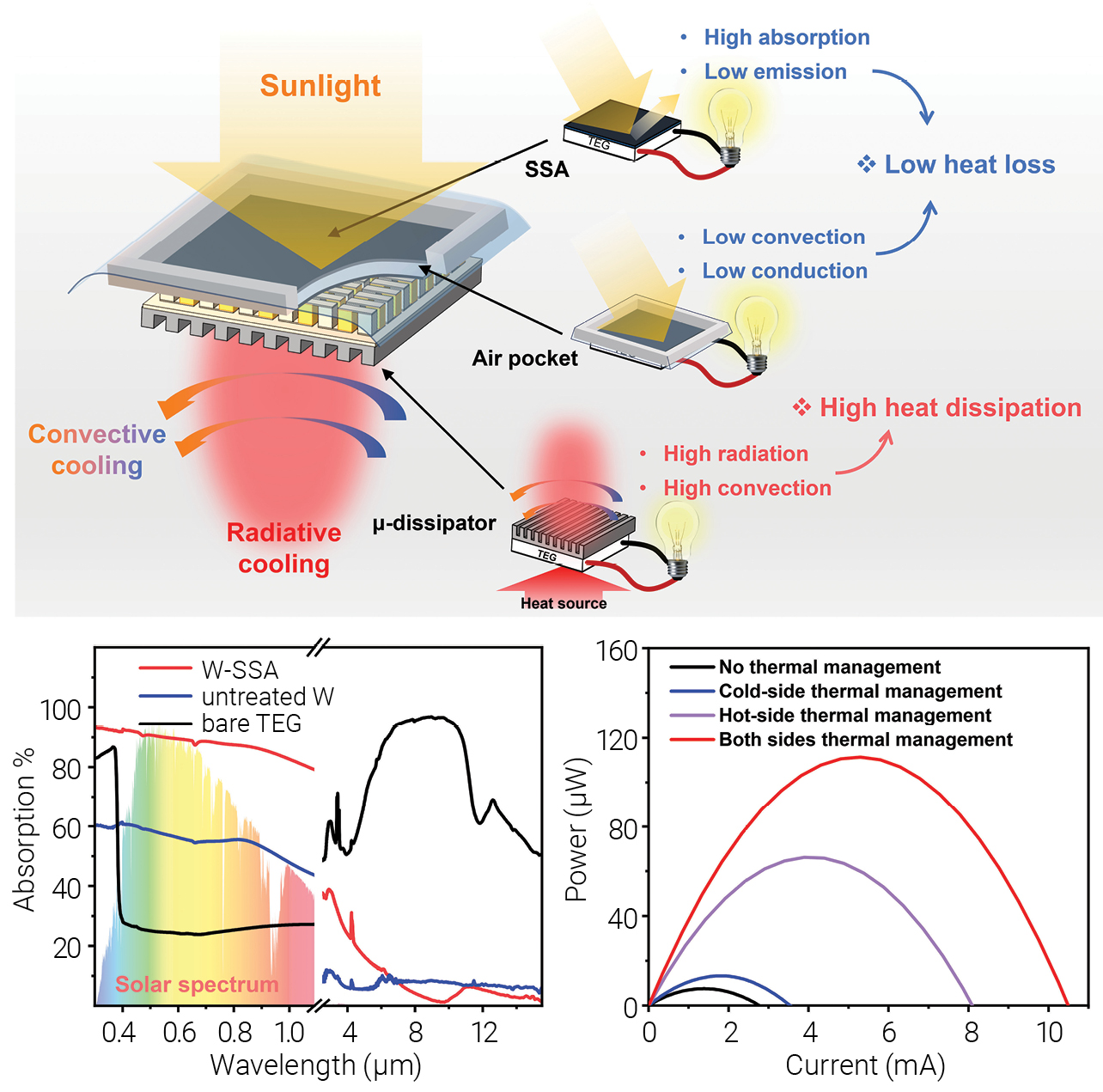
 [Enlarge image]Top: Schematic showing enhancement of solar thermoelectric generator (STEG)-output power through hot- and cold-side thermal management. The hot-side system consists of a tungsten (W)-selective solar absorber (SSA) and greenhouse chamber to reduce heat loss, while the cold-side system uses a µ-dissipator to enhance heat dissipation. Bottom: Absorption spectra of three solar receivers (left; ceramic absorber of the thermoelectric generator (TEG), untreated W and W-SSA) and STEG power–current curves under 3-sun illumination (right).
Solar energy is a main source of renewable energy, and converting sunlight directly into electricity without moving parts is one of the enduring goals of energy harvesting. Solar thermoelectric generators (STEGs) generate voltage when subjected to a temperature difference (ΔT) across the thermoelectric material, known as the Seebeck effect.1 Compact, silent and maintenance-free, STEGs are attractive for powering wireless sensor networks, wearable electronics and medical devices. However, their widespread adoption has been limited by the lack of high-efficiency thermoelectric materials and compact heat sinks for effective heat dissipation.
In our recent work,2 we show that with proper spectral engineering and thermal management on the hot- and cold-side surfaces, STEG output power can be greatly enhanced. Using femtosecond-laser processing, we tailor how each surface exchanges energy with its environment, raising STEG power output by roughly 15-fold while adding only 25% to the device weight.
On the hot side, we convert an ordinary tungsten (W) surface into a selective solar absorber (W-SSA). The laser-textured surface absorbs more than 80% of incoming sunlight while suppressing infrared emission, allowing it to reach and maintain a high temperature. A greenhouse-style chamber around the absorber cuts convective heat loss by more than 40%, trapping more thermal energy at the hot junction.
On the cold side, the same femtosecond-laser technique turns a plain aluminum surface into a microstructured dissipator (µ-dissipator) that sheds heat through enhanced radiation and convection. It removes heat about twice as effectively as an untreated aluminum heat sink, keeping the cold junction cooler without any fan or pump.
Because STEG output scales with the temperature difference across it, widening that gap from both ends compounds the gains. The large boost does not come from a new thermoelectric material, but instead from managing how light and heat are absorbed and emitted. Both surfaces are made using the same scalable laser process on common, inexpensive metals and can be further paired with improved thermoelectric materials.
Our overall spectral-engineering and thermal-management strategy positions STEG for broader adoption, enabling sensors and wearable systems to operate entirely on sunlight.
Researchers
Tianshu Xu, Ran Wei, Subhash C. Singh and Chunlei Guo (guo@optics.rochester.edu), University of Rochester, USA
References
1. D. Kraemer et al. Nat. Mater. 10, 532 (2011).
2. T. Xu et al. Light Sci. Appl. 14, 268 (2025).
