

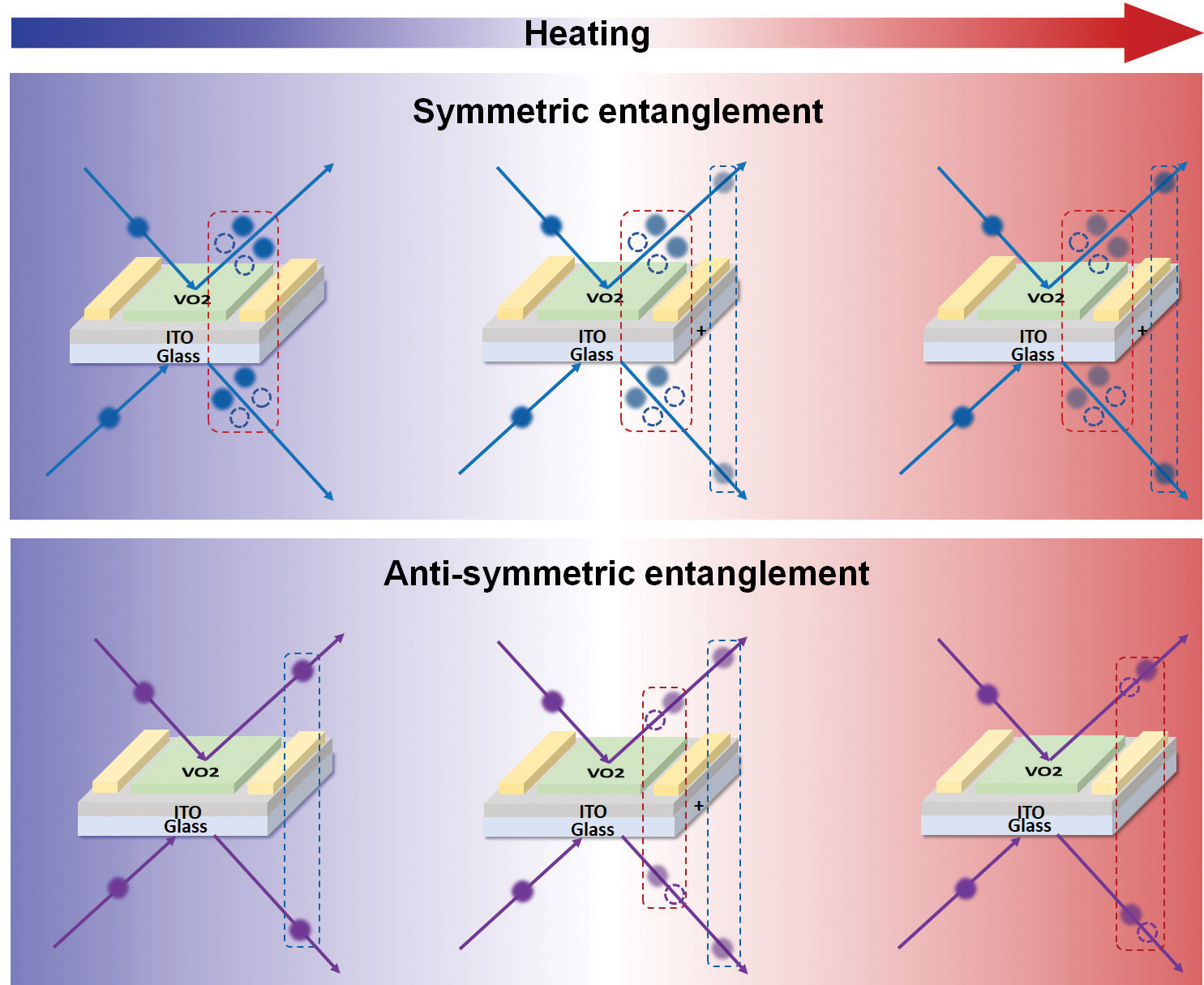
 [Enlarge image]Output states of Hong–Ou–Mandel interference for symmetric (top) and antisymmetric (bottom) input entanglement. Heating the vanadium dioxide (VO2) thin film to 40°C (left), 65.5°C (center) and 80°C (right) over an indium tin oxide (ITO) heater gradually transforms the system from unitary to nonunitary operation.
Traditional quantum Hong-Ou-Mandel (HOM) interference1 generates effective photon–photon interactions between non-interacting photons. However, quantum-state transformations face inherent constraints: They are limited by the unitary properties of standard lossless optical elements, restricting application in programmable quantum information processing. We propose and demonstrate a dynamically tunable nonunitary quantum regulation scheme based on the phase-change material vanadium dioxide (VO2),2 overcoming the long-standing bottleneck of previous nonunitary quantum operations, which have been static or relied on mechanical rotation for adjustment.3
In our recent experiment,4 we used a precisely engineered 75-nm thick VO2 thin film as a lossy, tunable beam splitter, leveraging its unique insulator-to-metal transition between monoclinic and rutile phases over a temperature range of 45°C to 75°C. An electrically driven indium tin oxide (ITO) heater with an integrated temperature sensor provides the external stimulus to continuously adjust the optical properties of the VO2 sample. The absorption probability can be dynamically tuned from 0.30 to 0.52, enabling a seamless transition of the optical system from conventional unitary to nonunitary operation without mechanical movement.
We prepared three representative biphoton states, including a frequency degenerate, symmetric frequency-entangled and antisymmetric frequency-entangled states, and then we systematically verified that the photon-exchange phase of the system can be arbitrarily customized through temperature modulation. In particular, this lossy beam splitter allows coherent perfect absorption of antisymmetric entangled photons, holding promise for advanced devices such as selective entanglement filters and two-photon absorption spectroscopy. This enables a transition from conventional bosonic coalescence (bunching) to anomalous anti-coalescence (antibunching) behaviors that mimics fermionic characteristics. Driven by the volatile nature of VO2 thin films, we also verified that cooling heated films restores their states, showing reversible and dynamic control over quantum photon–photon interactions.
This work opens a new pathway for dynamically regulating quantum light–matter interactions, providing a compact, nonmechanical integration-compatible solution for programmable photonic platforms for diversified quantum
tasks.
Researchers
Chaojie Wang and Lixiang Chen (chenlx@xmu.edu.cn), Xiamen University, China
Yuanyuan Chen (chenyy@xmu.edu.cn), Xiamen University, China, and Nanjing University of Science and Technology, China
References
1. C.K. Hong et al. Phys. Rev. Lett. 59, 2044 (1987).
2. D. Lencer et al. Nature Mater. 7, 972 (2008).
3. Q. Li et al. Nature Photon. 15, 267 (2021).
4. C. Wang et al. Phys. Rev. Lett. 136, 203601 (2026).
