

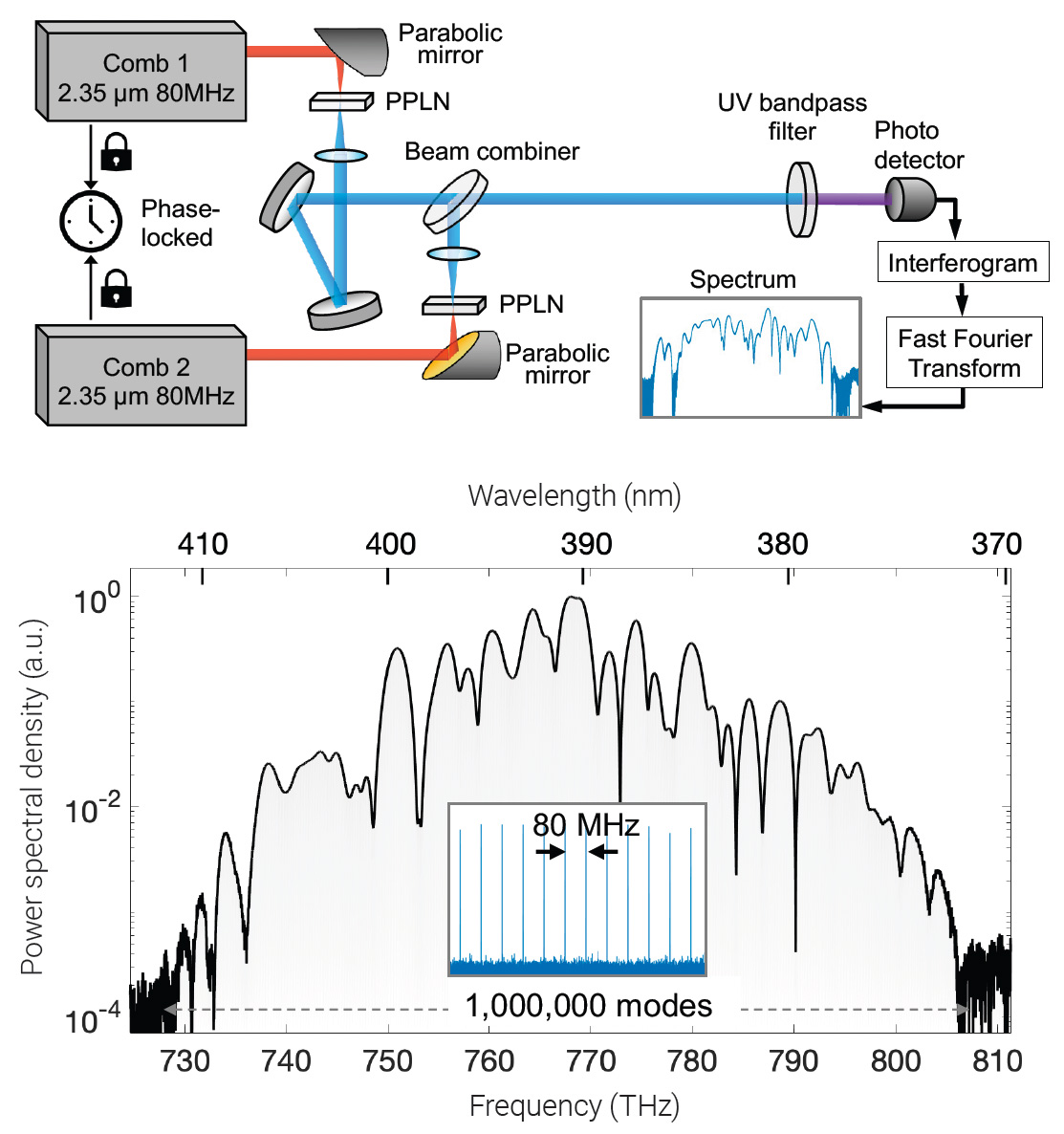
 [Enlarge image]Top: Schematic of the dual-comb setup in the UV range. Bottom: Spectrum of the sixth harmonic containing one million comb lines. The inset shows comb-line resolved portion of the spectrum obtained via dual-comb spectroscopy.
Optical frequency combs—“rulers of light” consisting of thousands of evenly spaced spectral lines, with both the line spacing and the frequency offset precisely tied to an atomic clock—provide hertz-level spectroscopic measurements over the terahertz to ultraviolet (UV) spectrum. Dual-comb spectroscopy (DCS) is a technique that makes best use of the coherent properties of frequency combs. It is based on measuring the time-domain interference between two frequency combs with slightly different line spacings, effectively converting high-resolution optical spectra into the radio frequency domain for fast and accurate analysis.1 The wider the comb spectrum, the more spectral information can be obtained from a single DCS measurement.
High-resolution spectroscopy in the UV offers unique insights into electronic transitions in atoms and molecules, making it highly desirable for a wide range of applications: testing fundamental laws of physics, chemical analysis, photochemistry, detection of trace gases in the atmosphere and the study of exoplanets.2 However, the implementation of DCS in the UV remains challenging: UV frequency combs are typically generated with harmonic generation, a process that amplifies phase noise—scaling quadratically with the harmonic order—and consequently degrades the mutual coherence between combs. In addition, UV combs have low output power and/or limited bandwidth.
In recent work, we have overcome these limitations, achieving ultra-broadband frequency combs in two UV spectral regions: 372–410 nm, spanning 80 THz with 1,000,000 comb lines, and 325–342 nm, spanning 44 THz with 550,000 comb lines—all resolved with DCS.3 The setup is based on a pair of ultra-low-noise, mutually phase-locked ultrafast Cr:ZnS lasers centered at 2350 nm and referenced to a Rb clock.4 The UV combs are produced via sixth- and seventh-harmonic generation in a single periodically poled multi-period lithium niobate crystal and have sufficient power to enable real-time detection of DCS interferograms and resolution of individual comb lines.
The system provides considerably higher harmonic generation efficiency compared with noble gas harmonic generation methods. The 80 MHz spectral resolution (resolving power λ/Δλ~107) significantly exceeds the capabilities of existing UV spectrometers. As a proof of concept, we measured an ultra-narrow reflectance spectrum of a high-finesse volume Bragg grating mirror.3
Further harmonic conversion using newly developed nonlinear crystals will extend spectral coverage to shorter wavelengths, allowing detection of a wider range of species—from ozone, hydroxyl radicals and aromatic compounds to the nuclear clock transition in thorium-229 near λ =148.4 nm—a cutting-edge frontier in UV precision spectroscopy.5
Researchers
Andrey Muraviev, Dmitrii Konnov and Konstantin Vodopyanov, CREOL, University of Central Florida, USA
Sergey Vasilyev, IPG Photonics Corporation, USA
References
1. N. Picqué et al. Nat. Photon. 13, 146 (2019).
2. V. Schuster et al. Opt. Express 29, 21859 (2021).
3. A. Muraviev et al. Optica 11, 1486 (2024).
4. S. Vasilyev et al. Opt. Express 27, 35079 (2019).
5. K. Beeks et al. Nat. Rev. Phys. 3, 238 (2021).
