

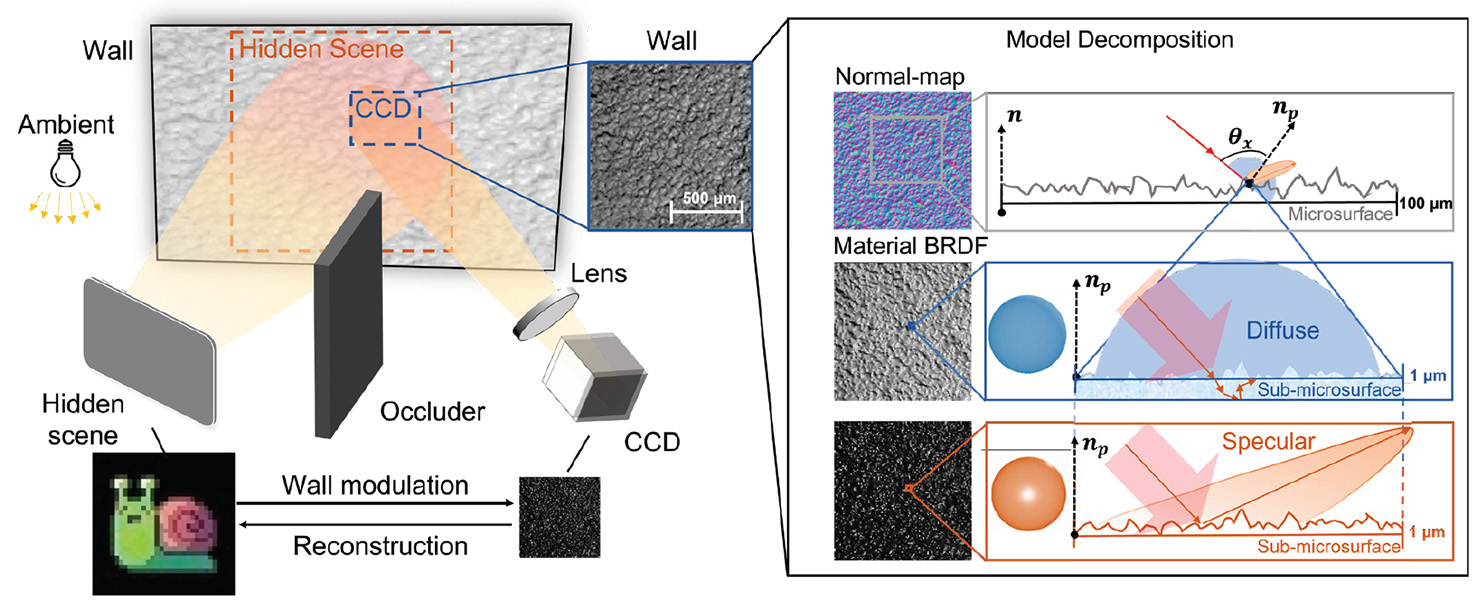
 [Enlarge image]Left: Schematic diagram of an experimental setup. An ordinary camera (the combination of a lens and CCD) captures a snapshot of the irradiance distribution on the wall, induced by rough wall modulation for the light emanating from the hidden scene (displayed on a cellphone). Then, a snapshot is fed through an algorithm to recover an image of the scene. Right: Microscopic appearance of rough walls is composed of a spatially varying normal map on the microsurface (right, top) and material BRDF on the sub-microsurface (right, bottom). This material BRDF can be further decomposed into diffuse and specular components.
Periscopes depend on mirrors or prisms to see what’s around a corner or other obstacle. Non-line-of-sight (NLOS) imaging, however, relies instead on detecting single photons reflected off several surfaces and then reconstructing the image computationally. In the past few years, NLOS imaging has attracted growing interest, including in areas like confocal imaging,1 virtual wave optics2 and so forth. Despite demonstrating advances, most of these results rely on active lasers and detectors, whose high cost and complexity limit their applications. Consequently, achieving high-performance practical NLOS imaging remains a long-standing goal.
An ideal solution for NLOS imaging is the use of an ordinary digital camera in a passive setting through the reflection of a relay wall. However, the key challenge of using passive NLOS imaging to see a hidden scene is how to overcome the spatial mixing due to scattering through a rough wall.
We recently proposed a completely new NLOS imaging model to accurately describe the microscale scattering properties of a rough wall and show that it is well conditioned for inversion.3 We derived analytical approaches to quantify the conditioning of the inverse problem and the fundamental limit of the reconstruction accuracy. These enable computational passive NLOS imaging with unprecedented capabilities. With an ordinary monochrome camera, we for the first time demonstrate real-time, high-resolution, large field-of-view, and full-color passive NLOS imaging. Notably, we also achieved the first demonstration of keyhole passive NLOS imaging.
The proposed method holds great promise for enabling comprehensive NLOS imaging capabilities and thus has the potential to reshape the study of NLOS imaging and related fields. The computed images and videos allow for NLOS target recognition and identification in a variety of complicated scenarios, which could be transformative for surveillance and autonomous-driving applications. The broad dissemination of our results will lead to follow-on work not only in optical imaging, but in many advanced computational imaging algorithms, photonic technologies, optical sensing and related areas.
Researchers
Wenwen Li, Yijun Zhou, Wei Li, Yutao Chen, Xin Huang, Chen Dai, Jianwei Zeng, Feihu Xu and Jian-Wei Pan, University of Science and Technology of China, China
Vivek K. Goyal, Boston University, USA
References
1. M. O’Toole et al. Nature 555, 338 (2018).
2. X. Liu et al. Nature 572, 620 (2019).
3. W. Li et al. Optica 12, 626 (2025).
