

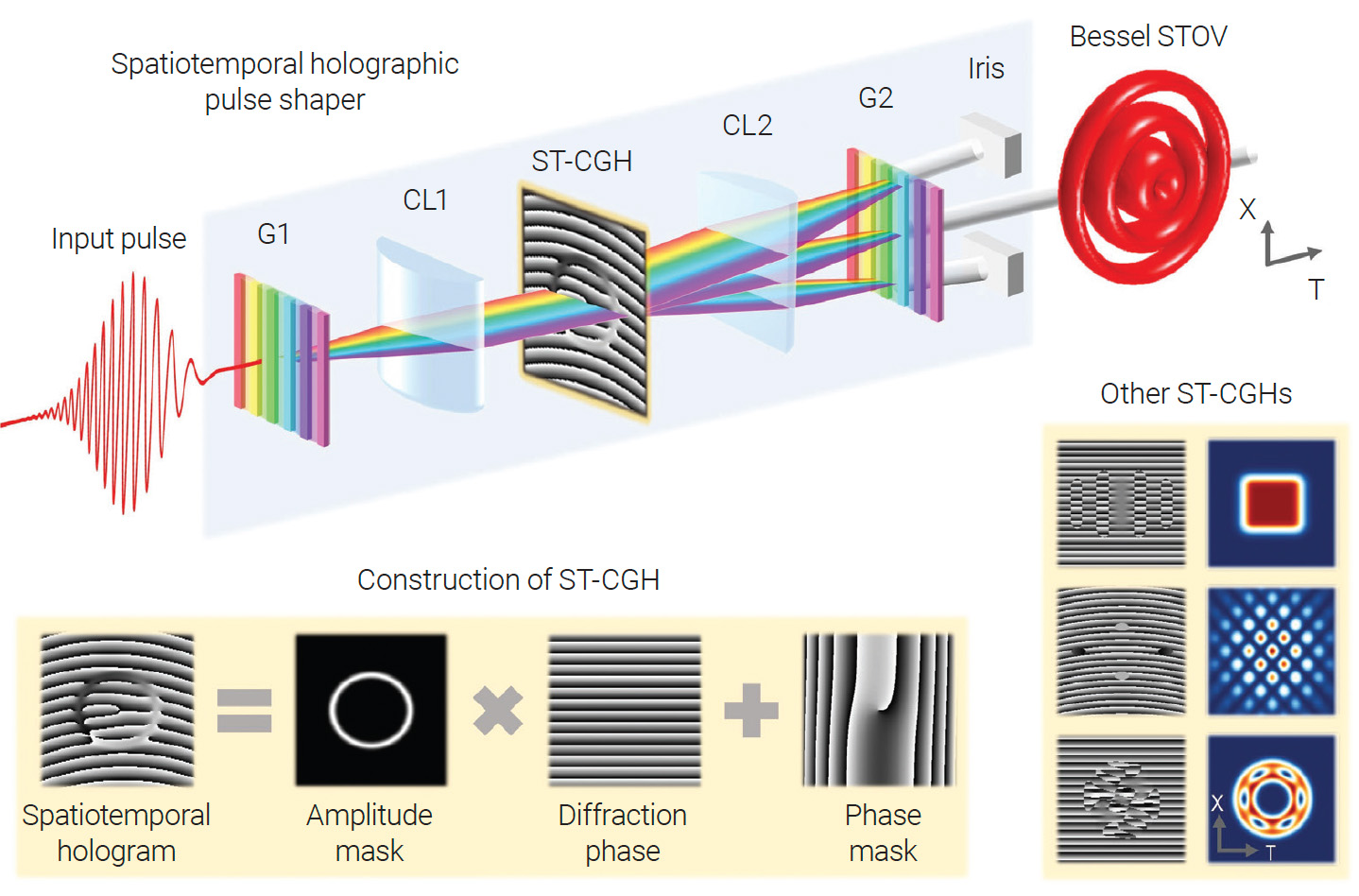
 [Enlarge image]Spatiotemporal holographic pulse shaper and examples of wavepackets generated by the spatiotemporal hologram technique.4
With the rapid development of ultrafast lasers, the ability to sculpt spatiotemporal wavepackets has become increasingly important for both unveiling fundamental physics and fulfilling demanding industrial applications.1 Recently, the successful generation of spatiotemporal optical vortices2 and optical vortex rings3 has spurred rapidly increasing interest in spatiotemporally sculptured light, exploiting the intricate space–time interplay within light itself.
We recently reported an advanced digital holographic pulse shaper capable of imprinting two-dimensional complex modulation (amplitude and phase) onto the spatiotemporal distribution of ultrashort laser pulses.4 This innovation opens new possibilities for spatiotemporal sculpting of light. Our work introduces a novel method for shaping the spatiotemporal complex amplitude distribution of light pulses, analogous to the computer-generated holography (CGH) developed for their spatial-domain counterparts. To achieve this, a specially designed hologram modulates the spatial-spectral distribution of the input laser pulse. The zeroth-order diffraction is then selected to produce the desired phase and amplitude modulation in the spatiotemporal domain while circumventing spatial dispersion.
The power of this spatiotemporal holographic technique is showcased through the generation of diverse and unprecedented spatiotemporal light structures. These include fundamental and higher-order spatiotemporal Bessel wavepackets, spatiotemporal crystal-like and quasi-crystal-like structures, and spatiotemporal top-hat wavepackets, highlighting the method’s potential for applications in various fields.
Building on this spatiotemporal hologram technique, we reported the generation of spatiotemporal Laguerre-Gaussian (STLG) wavepackets with controllable radial and azimuthal quantum numbers.5 Furthermore, we demonstrated a spatiotemporal mode conversion utilizing spatiotemporal astigmatism to convert spatiotemporal Hermite-Gaussian (STHG) wavepackets into spatiotemporal Laguerre-Gaussian (STLG) wavepackets. Both STLG and STHG sets form complete bases in the space–time domain, laying important foundations for future advancements in spatiotemporally structured light engineering. The ability to synthesize wavepackets with arbitrarily complex spatiotemporal amplitude and phase distributions is expected to inspire potential applications of spatiotemporally structured light in quantum information, photonic topology and optical communication.
Researchers
Qian Cao and Nianjia Zhang, University of Shanghai for Science and Technology, China
Qiwen Zhan, University of Shanghai for Science and Technology and Westlake University, China
Andy Chong, Pusan National University, Republic of Korea
References
1. Q. Zhan, Adv. Opt. Photon. 16, 163 (2024).
2. A. Chong et al. Nat. Photon. 14, 350 (2020).
3. C. Wan et al. Nat. Photon. 16, 519 (2022).
4. Q. Cao et al. Nat. Commun. 15, 7821 (2024).
5. X. Liu et al. Nat. Commun. 15, 5435 (2024).
