

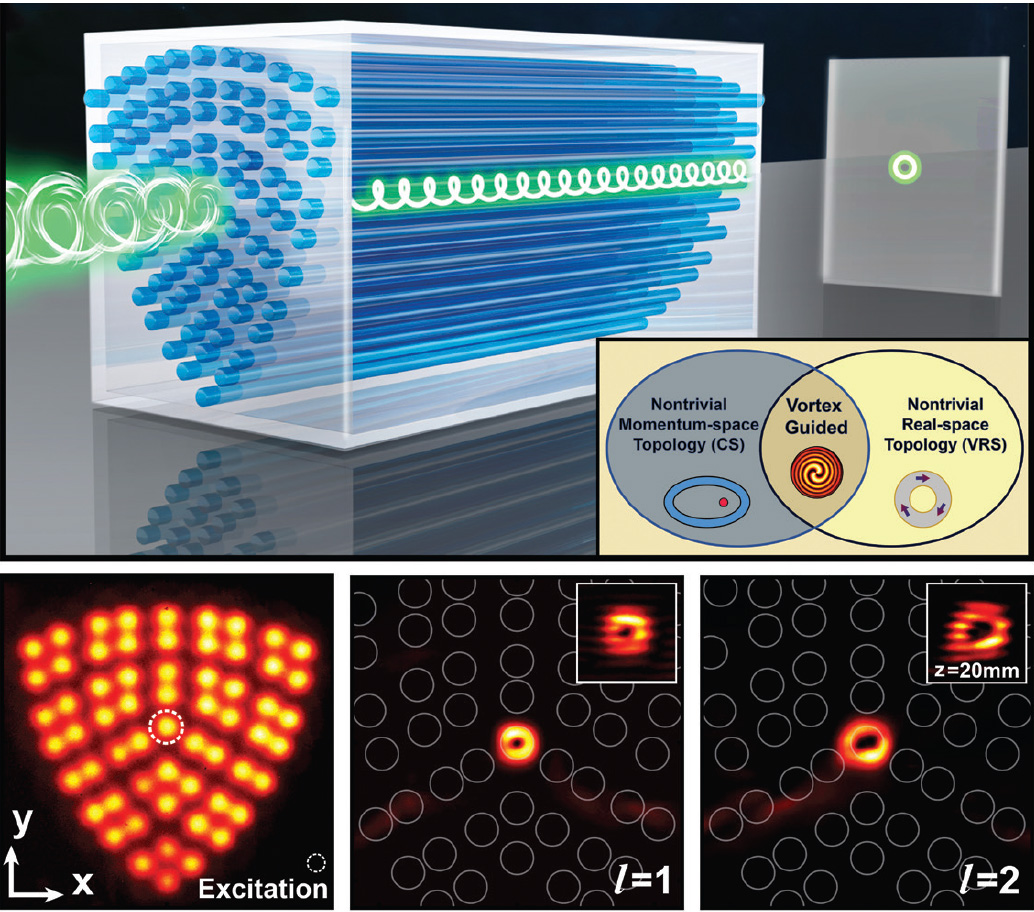
 [Enlarge image]Top: Schematic of a vortex beam propagating through a single-core C3 disclination lattice. The inset shows a Venn diagram illustrating the fundamental principle of vortex guidance: In the overlapping area, the vortex beam has dual topological protection from both real- and momentum-space topology. Bottom: A photonic C3 disclination lattice fabricated by laser writing (left) and output intensity patterns and interferograms after propagation through the lattice (center, right). [Adapted from Ref. 4]
Optical vortices carrying orbital angular momentum (OAM) have attracted considerable attention over the past decades due to their unique physical properties and wide range of applications in optics and photonics.1,2 Despite significant progress in generating and detecting optical vortices, achieving robust and protected vortex transport remains a long-standing challenge.
Recently, we have reported topological methods to generate3 and guide4 optical vortices featuring arbitrary higher-order charges, enabling cascaded OAM production and dual protection of vortex transport. Specifically, we realized photonic disclination lattices that contain a single-core defect but display different Cn-symmetries, enabling robust transport of optical vortices with conserved OAM, protected simultaneously in real and momentum space.4 This discovery unveils a fundamental interaction among vorticity, disclination and higher-order topology, opening a promising pathway toward innovative optical and photonic devices such as vortex waveguides, fibers and lasers.5
To ensure robust propagation of an optical vortex through the central disclination core while retaining both its topological charge and distinctive doughnut-shaped intensity profile, two conditions must be simultaneously satisfied: momentum-space topology and vorticity-coordinated rotational symmetry (VRS). Together, we refer to this as dual topological protection, which arises from the combined effects of nontrivial winding in momentum space enforced by chiral symmetry, and nontrivial winding in real space stemming from the intricate coupling of OAM modes across the disclination structure.
This combined mechanism ensures that specific vortex modes, determined by their topological charge and lattice symmetry, propagate stably even in the presence of structural perturbations, providing a universal criterion for determining whether a higher-order vortex can be guided. In the C3 disclination, for example, vortices with topological charge l = 1 and l = 2 satisfy the VRS, ensuring that their features remain intact after transport. A higher-order l = 5 vortex can also be transported robustly despite disturbances. Conversely, an l = 3 vortex cannot be guided, since in this case the VRS condition is violated despite the preservation of chiral symmetry.
Experimentally, topological vortex transport has been accomplished by laser-writing tailored photonic disclination structures, with the observed results closely matching theoretical predictions. These findings establish a topological framework for the unconventional generation and protection of optical vortices, providing potential solutions to the long-lasting challenge of controlled vortex transport with implications beyond photonics.
Researchers
Z. Hu, D. Bongiovanni, Z. Wang, S. Lei, S. Xia, X. Wang, D. Song, J. Xu and Z. Chen, Nankai University, Tianjin, China
D. Bongiovanni and R. Morandotti, Institut National de la Recherche Scientifique—EMT, Varennes, Canada
H. Buljan, University of Zagreb, Croatia
References
1. Y. Shen et al. Light Sci. Appl. 8, 90 (2019).
2. J. Ni et al. Science 374, eabj0039 (2021).
3. S. Lei et al. Nat. Commun. 15, 7693 (2024).
4. Z. Hu et al. Nat. Photon. 19, 162 (2025).
5. M-S. Hwang et al. Nat. Photon. 18, 286 (2023).
