

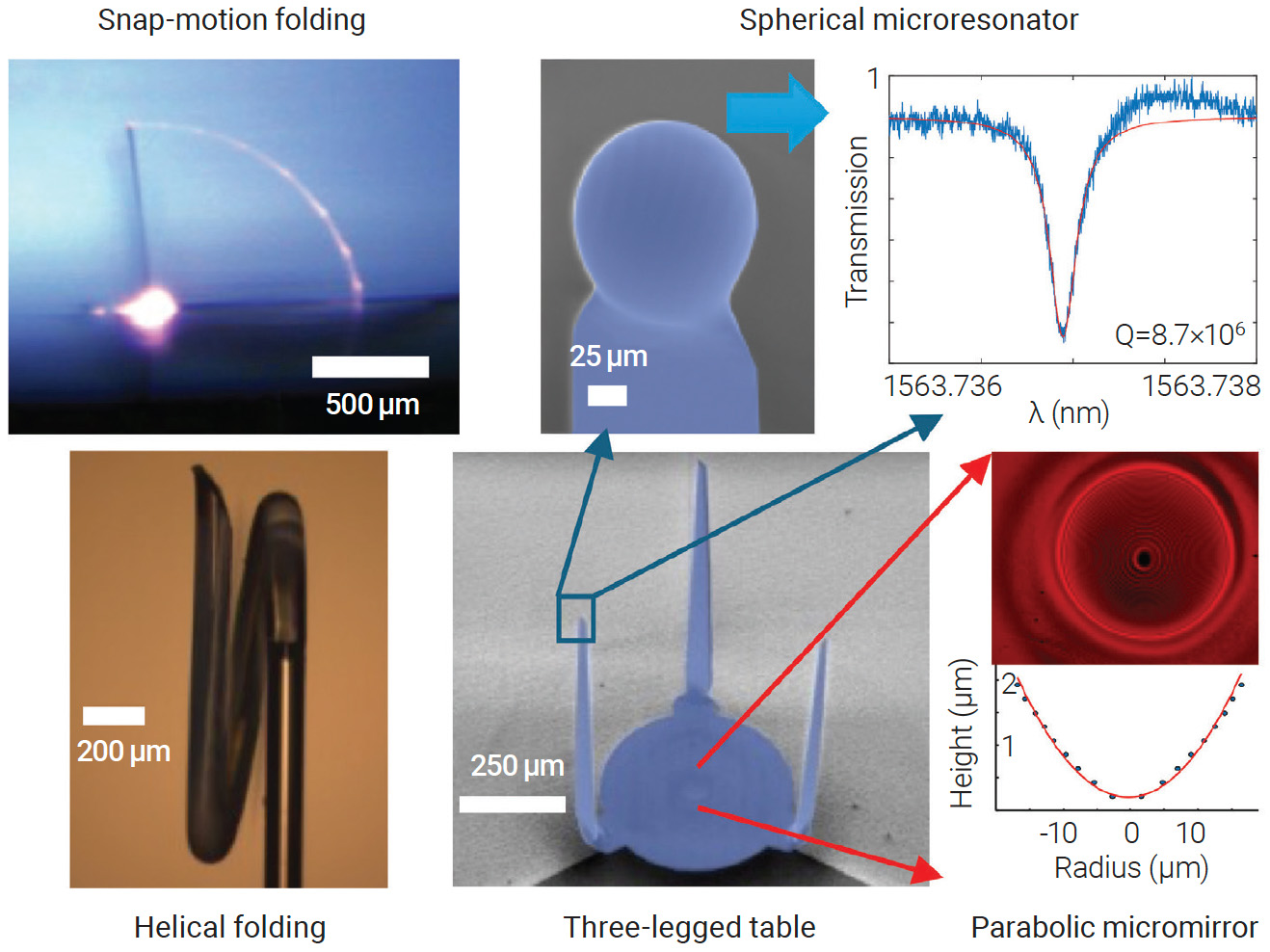
 [Enlarge image]Left: Snap-motion folding of a horizontal silica bar by 90° within less than a millisecond. The molten silica at the knee emits light that is guided through the bar and scattered from its tip, creating an arc-shaped flare (top). Helical folding by moving the bar under the focused folding laser (bottom). Right: A three-legged table where we reflow legs to become a spherical microresonator with Q exceeding 8 × 10⁷, or evaporatively evacuate material to generate a parabolic micromirror with a 0.41 numerical aperture, as correspondingly measured from their spectral linewidth and interferogram.
Silica is beneficial for fabricating nanometer-smooth resonators, giving them ultrahigh quality, as well as supporting record finesse for concave micro-mirrors.1 But previously, folding such planar photonics1,2 into 3D architectures was out of reach. In our recent work,3 we borrowed hygroscopic principles used in plants, including in seed-release mechanisms, to fold photolithographed silica by harnessing surface tension.
To prepare the glass for folding, we thermally grow a very smooth and thin (down to 0.5 μm) amorphous silica layer on top of a silicon chip with cleanroom-grade silicon and oxygen, then release the silica from the silicon with dry xenon difluoride silicon etching. Using a CO2 laser, we selectively liquefy one side of a 5-µm-thick silica bar, which allows it to be folded in a controllable, touchless and additive-free manner. The laser heats the contact point to 3000 K, starting to liquify it. In contrast, the side of the silica opposite the laser contact point reaches a temperature of 1500 K, which is slightly above the transition temperature of glass, turning it into a soft solid. Surface tension at the hotter liquified side, together with the soft solid on the other side, then causes the silica bar to bend. We demonstrated a bending event where a laser pulse initiated a snap-motion fold to 90° within less than a millisecond. Our 3D structures contain microresonators with a quality factor, Q, exceeding 8 × 10⁶ as well as 30-µm-diameter parabolic mirrors, which are made by reflowing or evaporating the silica accordingly.
While most 3D-printing techniques rely on additive fabrication in discrete steps, leading to challenges in uniformity, purity, smoothness and voxel size (which are related to their inherent nonlinear photocuring mechanisms); we combine subtractive 2D lithography with tunable bending by harnessing surface tension to fabricate 3D structures that are ultrasmooth. We demonstrated bending from 0° to unlimited helices with 0.1-microradians resolution. One example of a fabricated device is a three-legged table containing a parabolic mirror. Fully releasing this table might permit optical levitating cavity mirrors4 for testing gravity models. Another example relates to our fabricated 3-mm-long, 500-nm-thick bars that reach the ultimate size-to-weight limit and might therefore serve in lightsails.5
Researchers
Manya Malhotra, Ronen Ben-Daniel, Fan Cheng and Tal Carmon, Tel Aviv University, Israel
References
1. H. Lee et al. Nat. Photon. 6, 369 (2012).
2. N. Jin, et al. Optica 9, 965 (2022).
3. M. Malhotra et al. Optica 9, 1338 (2025).
4. H. Yang et al. Phys. Rev. Lett. 111, 183001 (2013).
5. L. Michaeli et al. Nat. Photon. 1 (2025).
