

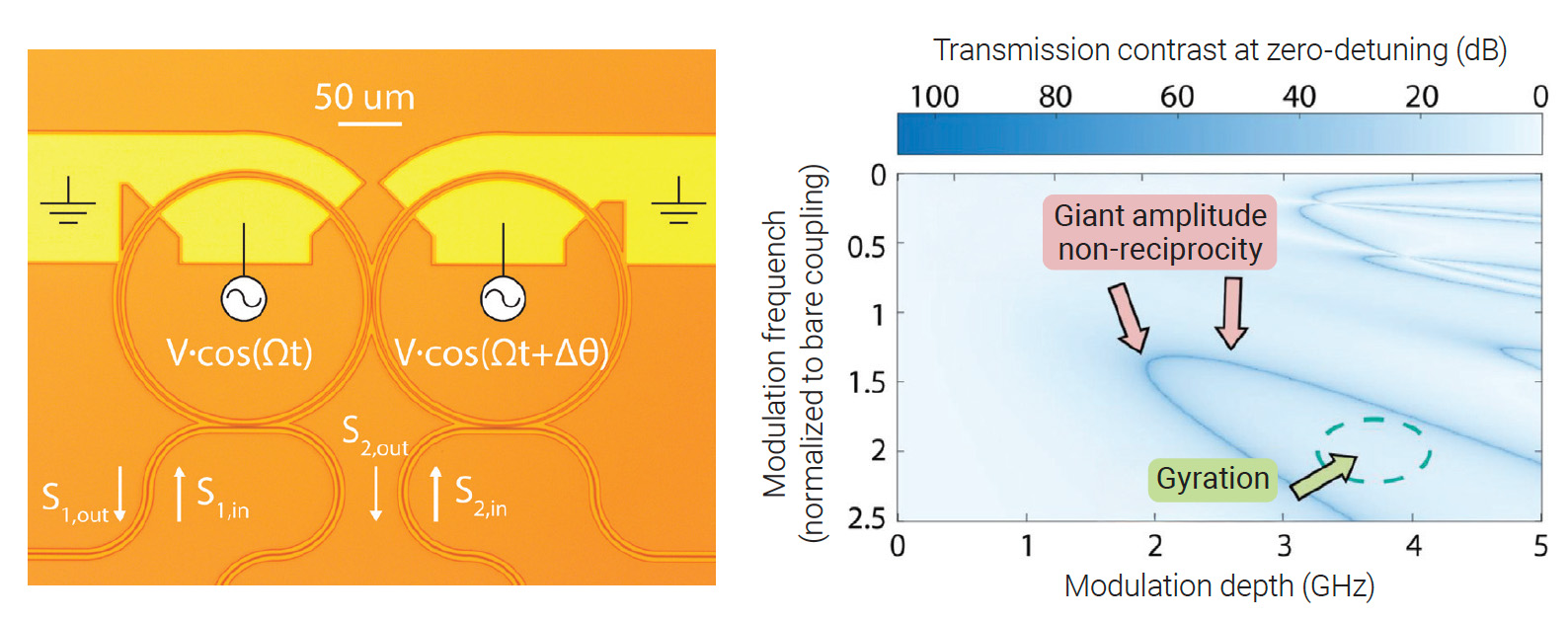
 [Enlarge image]Left: Photograph of the spatiotemporally modulated lithium niobate test device. Right: Map of the non-reciprocity space where giant coupling contrast is achieved.
In most photonic systems, the real-space coupling between any two modes is routinely assumed to be reciprocal—identical in both directions. However, recent studies of non-Hermitian dynamics that incorporate asymmetric couplings have revealed surprising new physical phenomena, including the non-Hermitian skin effect (NHSE),1 exceptional points (EPs) and generalized bulk-boundary correspondence.
In this context, a crucially important non-Hermitian system is the Hatano-Nelson (HN) chain,1,2 in which the couplings between adjacent resonators are asymmetric in the form t ± δ. This is the simplest model that produces the NHSE and exhibits EPs. While the availability of non-reciprocal components in electronics and mechanics has enabled many advanced topological studies on this topic, such capabilities are not readily available in photonics. In fact, there have been only two prior demonstrations of asymmetric couplings in photonic devices, both of which required optical gain and achieved only modest asymmetry.3,4 As a result, it has remained challenging to make appreciable progress on systems that require strongly non-reciprocal couplings.
This year, we presented a new approach that employs time-domain dynamic modulation to obtain large-contrast, reconfigurable asymmetric couplings in integrated photonics.5 Our experimental study used a compact photonic “molecule” fabricated on a thin film lithium-niobate-on-insulator substrate, with electro-optic dynamic modulation performed at GHz frequencies. Combining our concept and implementation, we demonstrated the first Hatano-Nelson photonic device that can reach the EP condition (where one of the couplings is exactly zero with t = δ). We additionally showed that it is possible to surpass this condition and flip the relative signs of the couplings.
With these new capabilities, we configured the photonic molecule to exhibit giant optical isolation contrast of 60 dB, the highest non-reciprocity reported to date in an integrated photonic device. Moreover, by flipping the couplings, we demonstrated the first photonic gyrator in integrated photonics, a device that robustly produces a perfectly non-reciprocal π phase contrast.
Our approach shows that strongly asymmetric couplings are accessible across a wide range of photonic systems simply through modulation and without the need for active photonic materials. This method can also be readily scaled to longer chains of resonators and more complex configurations by means of multiple incommensurate modulation frequencies, opening the door to exploring new photonic metamaterials and topologies.
Researchers
O.E. Örsel, J. Yim, T.L. Hughes and G. Bahl, University of Illinois at Urbana–Champaign, USA
J. Noh, University of Illinois at Urbana–Champaign and Sandia National Laboratories, USA
P. Zhu, The Ohio State University, USA
R. Thomale, University of Würzburg, Germany
References
1. N. Hatano and D.R. Nelson, Phys. Rev. Lett. 77, 570 (1996).
2. N. Hatano and D.R. Nelson, Phys. Rev. B 58, 8384 (1998).
3. Y.G.N. Liu et al. Light Sci. Appl. 11, 336 (2022).
4. Z. Gao et al. Phys. Rev. Lett. 130, 263801 (2023).
5. O.E. Orsel et al. Phys. Rev. Lett. 134, 153801 (2025).
