

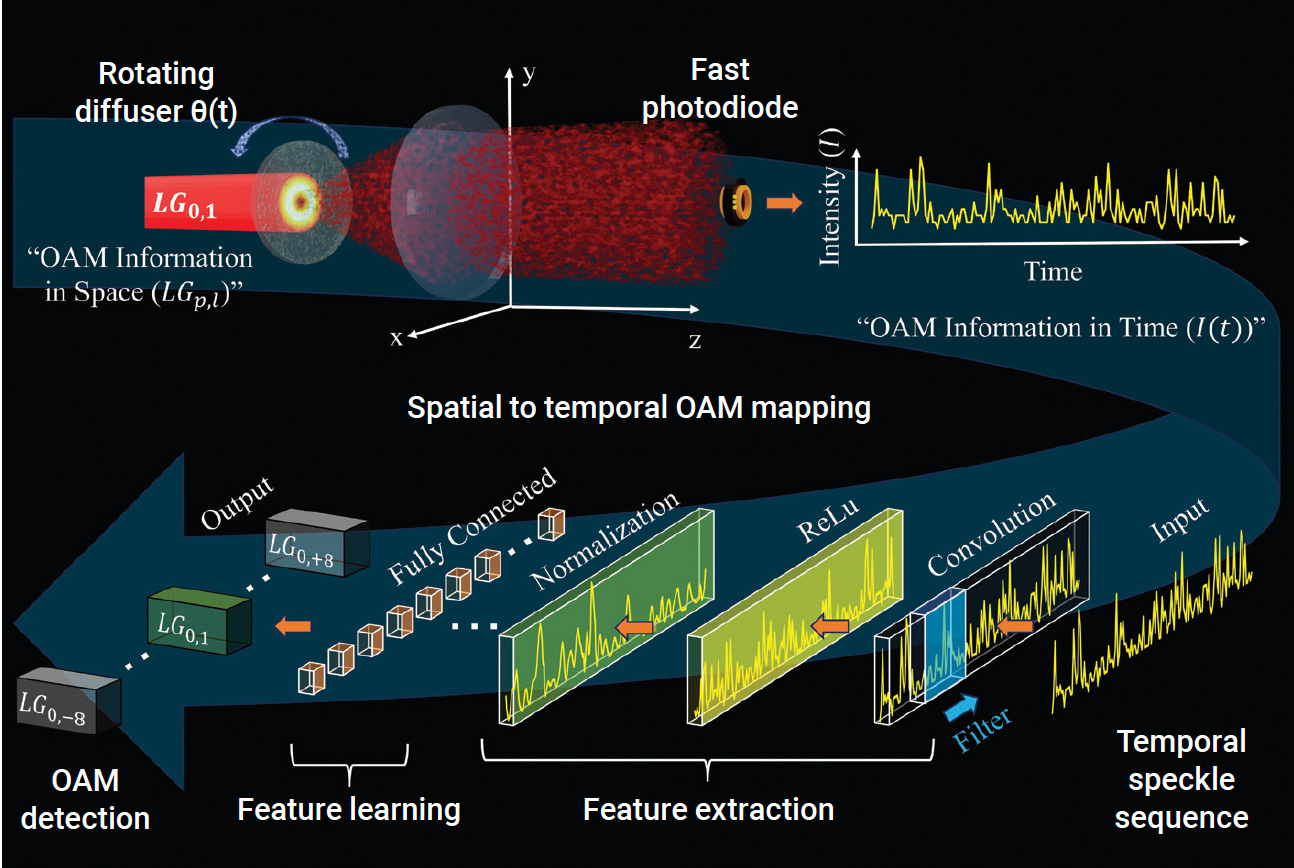
 [Enlarge image]caption Mapping spatial information of OAM beams on temporal speckle sequences (TSS) by leveraging the spatiotemporal speckle field. (Top) A rotating diffuser maps OAM 2D spatial information onto 1D TSS, recorded by a fast photodiode. (Bottom) The 1D TSS are processed by a 1D convolutional neural network.
Light beams carrying orbital angular momentum (OAM) have captured enormous attention over the past three decades.1 OAM beams provide a powerful means to encode and transmit information, from classical communications to quantum encryption. But probing and identifying OAM beams that have a 2D spatial structure remains challenging. Until now, researchers and industry have heavily relied on spatial 2D cameras. These are employed to capture the beam’s spatial intensity or phase information, requiring complex optical setups, large data sets, and high-end computational devices to process them. Additionally, the relatively slow frame rates of 2D cameras add further delays, making the cameras impractical for high-speed, scalable OAM detection.
To address these challenges, we harnessed the spatiotemporal speckle dynamics of OAM beams. When they interact with a rotating diffuser, they generate a spatiotemporal speckle field carrying the OAM information in space2,3 and time.4 The speckle sequences are recorded in the temporal domain using a single-pixel fast photodiode (FPD). By leveraging the spatiotemporal speckle dynamics, we have mapped the spatial OAM information onto 1D temporal speckle sequences (TSS). The recorded 1D TSS of 16 Laguerre-Gaussian (LGp,l) beams have been fed to a custom-designed 1D convolutional neural network with fewer than 15,000 learnable parameters, achieving accuracies exceeding 96%. Remarkably, the demonstrated approach remains robust even under severe turbulence that would typically disrupt camera-based OAM detection.4
By transitioning from large 2D images to compact 1D TSS, our method offers several key advantages: (1) High speed: Photodiodes operate far faster than standard cameras. (2) Compact and scalable: The lightweight CNN can run on small, low-power devices. (3) Low storage and computation: No need to process millions of camera pixels. (4) Robustness: The system works even in the presence of severe atmospheric turbulence.
The implications of this approach are far-reaching. In free-space optical to radio spectrum communications, this method enables sustainable high-dimensional OAM channels, providing high speed and spectral efficiency. In sensing, compact photodiode-based systems can deliver reliable, fast state recognition without bulky and expensive optical elements. Looking ahead, this approach could enable low-light OAM detection for efficient and sensitive quantum networks in both fiber and free space. In essence, we show that OAM beams can be recognized not just in space but also in time, with simplicity, speed and accuracy, paving the way toward sustainable optical technologies.
Researchers
Purnesh Singh Badavath and Vijay Kumar, National Institute of Technology Warangal, India
References
1. S. Franke-Arnold et al. Nat. Rev. Phys. 4, 361 (2022).
2. V. Raskatla et al. J. Opt. Soc. Am. A 39, 759 (2022).
3. P.S. Badavath et al. Opt. Lett. 49, 1045 (2024).
4. P.S. Badavath et al. J. Opt. 27, 01LT01 (2024).
