

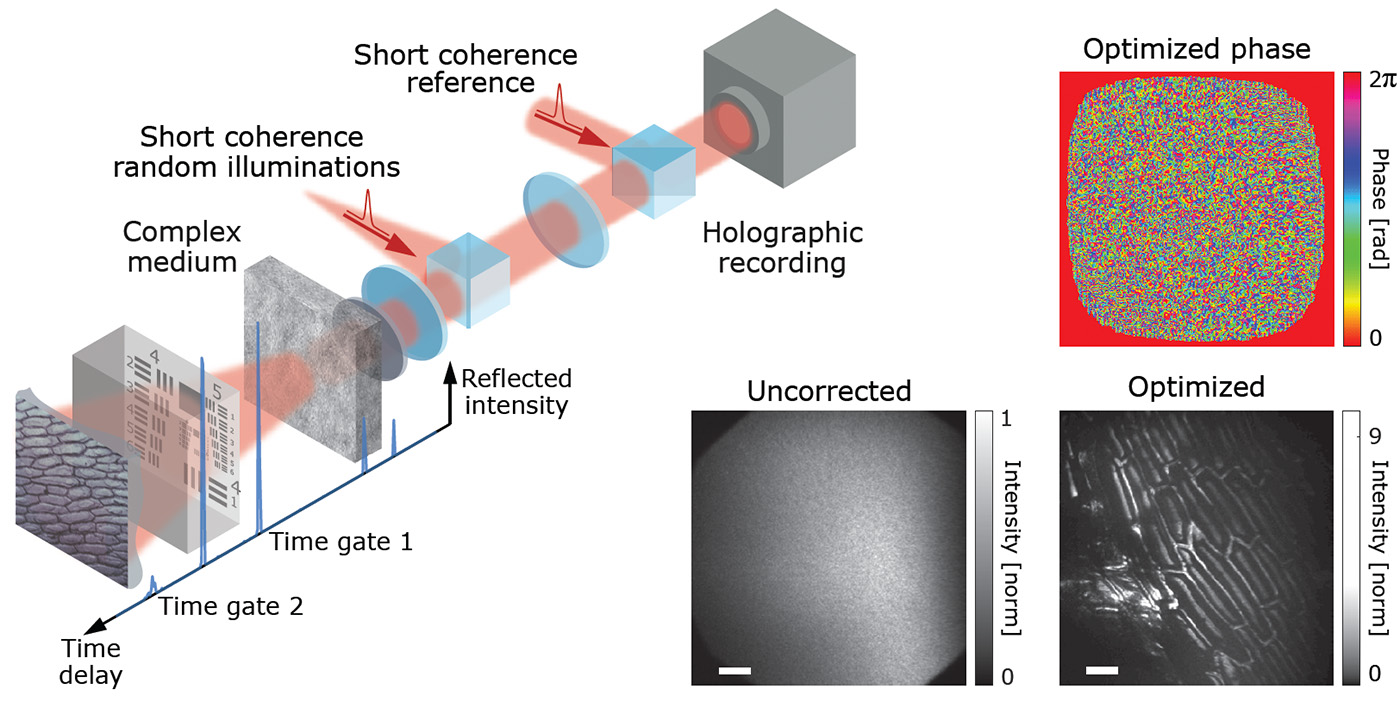
 [Enlarge image]Experimental imaging of a complex target through highly scattering media. Left: Schematic of the experiment in which an onion skin target is placed behind a scattering layer. A pulsed light source generates interference between the reference beam and the target. Right: Retrieved phase mask of the “virtual SLM” (top). Uncorrected image propagated to the target plane and optimized image revealing the cellular structure of the onion (bottom).
When light travels through fog, biological tissue or other turbid materials, it scatters in unpredictable ways, scrambling any image of the object behind. This scattering poses a major challenge for applications ranging from medical imaging to remote sensing and microscopy. Over the past two decades, wavefront shaping1 has emerged as a powerful approach to reverse scattering, but most existing methods still rely on known guide stars or large-scale reflection matrix measurements,2,3 limiting speed, flexibility and applicability in many real-world scenarios.
In our work, building on image-guided wavefront shaping,4 we present a new way to tackle this challenge: by shifting the task of scattering correction from specialized optical hardware into software. Using a small number of holographic recordings of scattered light, we computationally reconstruct the hidden object, digitally “unwinding” the distortions. This allows us to see clearly through strongly scattering layers, retrieve fine details and even refocus at different depths within a sample.5
The core concept involves optimizing one or more “virtual spatial light modulators” (SLMs) to maximize a simple image quality metric, such as image entropy or variance, enabling widefield imaging even in anisoplanatic scattering conditions.
This approach is inherently parallel, scalable and versatile and can be adapted to a wide range of imaging modalities. We experimentally demonstrated its power in several contexts: imaging through highly scattering media, performing lensless endoscopy using multi-core fibers and achieving anisoplanatic correction through multi-layered diffusers. In each case, our digital optimization retrieves diffraction-limited images where conventional refocusing produces only diffuse speckle.
Our work represents a paradigm shift: from slow, hardware-limited wavefront correction to fast, software-based scattering compensation. By eliminating the need for prior knowledge or invasive access, this technique opens new possibilities for fast, flexible imaging in complex and dynamic environments.
Researchers
O. Haim, J. Boger-Lombard and O. Katz, Institute of Applied Physics, The Hebrew University of Jerusalem, Israel
References
1. I.M. Vellekoop and A.P. Mosk. Opt. Lett. 32, 2309 (2007).
2. A. Badon et al. Sci. Adv. 6, eaay7170 (2020).
3. H. Lee et al. Light Sci. Appl. 11, 16 (2022).
4. T. Yeminy and O. Katz, Sci. Adv. 7, eabf5364 (2021).
5. O. Haim, J. Boger-Lombard and O. Katz. Nat. Photon. 19, 44 (2025).
