

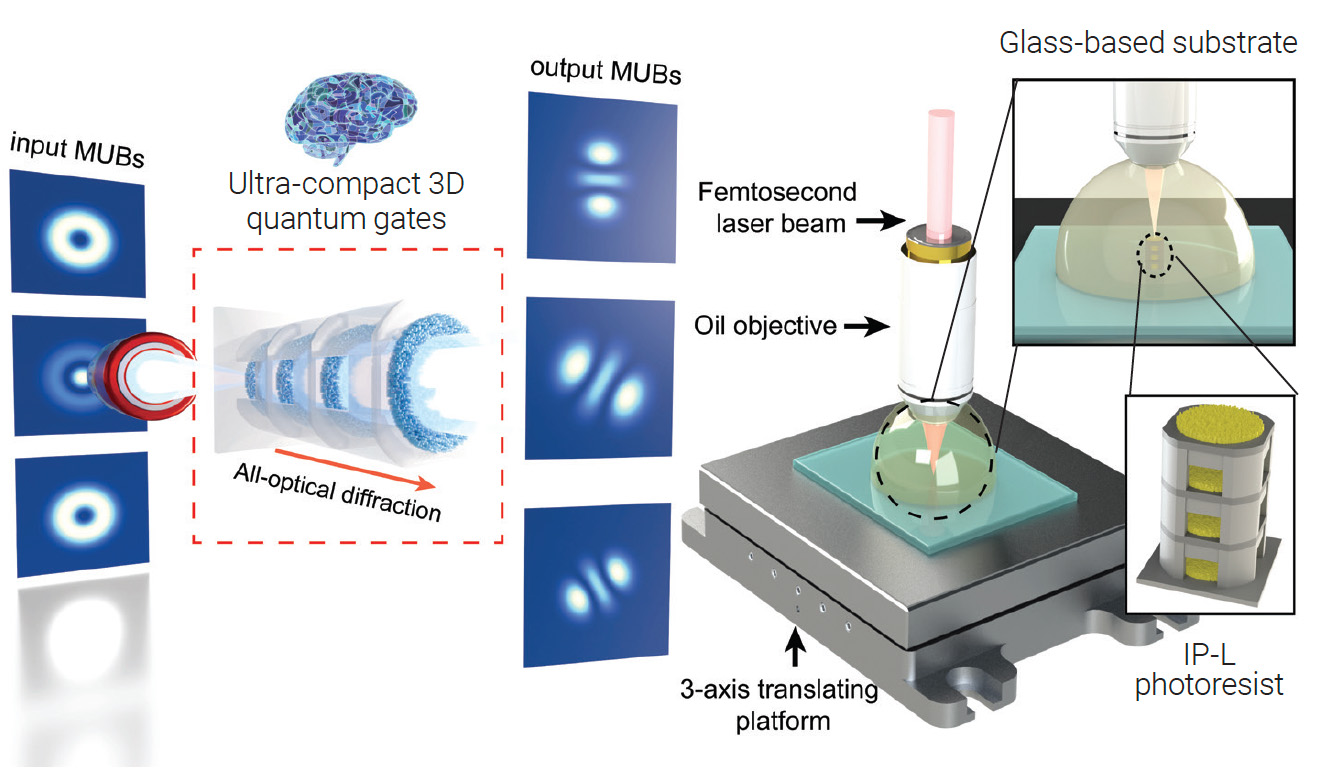
 [Enlarge image]Left: The high-dimensional quantum gates in photonic spatial modes. Right: TPP-based FLDW fabrication device.
Photons, as robust carriers of quantum bits, are well suited for quantum computing but suffer from weak photon–photon interactions. To overcome this, spatial modes offer a promising degree of freedom for encoding high-dimensional qubits. Diffractive neural networks (DNNs) provide compact and efficient control of photonic states, enabling scalable quantum operations.
We previously introduced a spatial-mode-based quantum gate using DNNs to realize high-fidelity, deterministic and universal transformations. Qubits encoded in spatial modes were manipulated experimentally with a spatial light modulator (SLM), validating this approach.
Building on this framework, we demonstrate high-dimensional quantum gates on SLMs and femtosecond laser–written 3D polymer devices. The DNNs, composed of trainable phase layers, were optimized through computer-based modeling. On the SLM platform, we realized 3D Hadamard, 3D X and CNOT gates with process fidelities above 99%.1 Furthermore, a compact three-qubit Toffoli gate, encoded in polarization and orbital angular momentum, achieved 97.3% truth table visibility and 94.1% fidelity. These results confirm the feasibility, performance and scalability of DNN-based photonic quantum gates.2
In parallel, by combining DNNs with a fabrication method such as femtosecond laser direct writing (FLDW), we can manipulate spatial modes at the micrometer level.3 Thus, we made a polymer-based multi-plane light converter quantum device using FLDW with two-photon polymerization (TPP), offering submicrometer precision and high alignment accuracy.4 The device exhibits a lateral pixel size of ~1.58 μm, a feature resolution of ~1.6 μm, and a vertical resolution of 100 nm, with an overall footprint of approximately 160 × 160 × 150 μm³. Its four-layer diffractive structure ensures accurate phase modulation, while scanning electron microscopy confirmed well-defined morphology and layer spacing. Experimental characterization through single-photon quantum process tomography demonstrated the successful implementation of a 3D Hadamard gate, achieving a fidelity of ~90%.
This level of performance, previously achievable only in bulky free-space optical systems, is now realized in a micrometer-scale 3D integrated device. By combining ultracompact geometry, high fabrication precision and reliable functionality, the approach not only validates the feasibility of on-chip high-dimensional quantum logic but also establishes a route toward scalable, low-loss and reconfigurable photonic quantum processors for future quantum information technologies, demonstrating high performance and scalability in integrated high-dimensional quantum logic.
By emphasizing device-level integration and ultracompact design, our work advances beyond bulk-optics implementations. Leveraging the abundant dimensional resources of photons, the demonstrated spatial-mode quantum gates provide a novel paradigm for quantum computing. This approach facilitates low-cost, programmable quantum computation and can be employed to validate quantum algorithms and explore complex quantum phenomena.
Researchers
Kangrui Wang, Dawei Lyu, Qianke Wang, Chengkun Cai, Tianhao Fu, Jue Wang, Jun Liu and Jian Wang, Huazhong University of Science and Technology, China, and Optics Valley Laboratory, China
References
1. Q. Wang et al. Light Sci. Appl. 13, 10 (2024).
2. Q. Wang et al. Phys. Rev. Lett. 133, 140601 (2024).
3. J. Wang et al. Laser Photon. Rev. 18, 2400634 (2024).
4. K. Wang et al. Sci. Adv. 11, 5718 (2025).
