

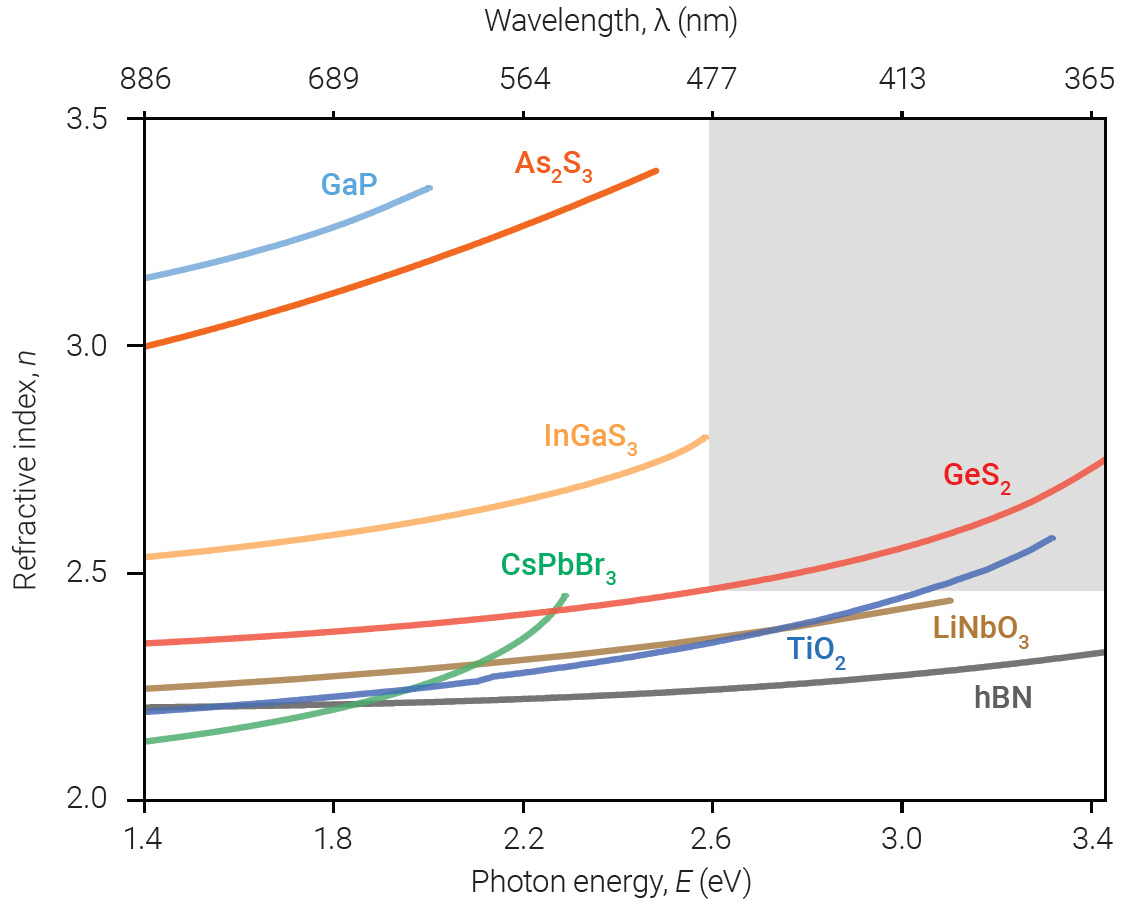
 [Enlarge image]Germanium disulfide (GeS2) fills a critical gap in the photonic materials landscape. This chart compares the refractive index and transparency window of GeS2 against other key van der Waals and conventional materials, demonstrating its unique combination of a high refractive index and transparency across the entire visible spectrum.
The “flat land” of van der Waals (vdW) materials has become a thrilling playground for nanophotonics, offering a toolkit of atomically thin crystals with record-breaking optical properties. Yet, for all their exotic behaviors in the infrared, a frustrating gap remained in their color palette. The entire visible spectrum—the most critical range for applications from imaging to displays—remained the domain of conventional bulk materials like TiO2, hindering the development of truly all-vdW photonic circuits.
Our work introduces germanium disulfide (GeS2) as the missing piece.1 We have identified and comprehensively characterized GeS2 as the first vdW material to combine the three essential properties for visible-light photonics: a very high refractive index (n > 2.5), negligible optical loss across the entire visible range (down to 360 nm) and giant, intrinsic biaxial anisotropy. This unique combination, verified through spectroscopic ellipsometry, near-field optical microscopy and first-principles calculations, positions GeS2 to finally challenge the dominance of traditional dielectric materials.
To move this discovery from scientific curiosity to technological reality, we leveraged GeS2’s unique properties to design a device with record performance. By creating an interface between GeS2 and TiO2, we engineered a highly efficient polarizing beam splitter. The material’s specific anisotropy, where one axis is perfectly index-matched to TiO2 while others are not, allows near-perfect transmission for one polarization and strong reflection for the other. This results in a calculated extinction ratio exceeding 106, surpassing existing commercial solutions in the near-UV range.
The addition of GeS2 to the vdW family is more than just a new material: It completes the photonic palette. It unlocks the potential for ultra-thin, high-performance components such as metasurfaces, waveguides for augmented- and virtual-reality headsets and on-chip polarization optics that can now operate with unprecedented efficiency across all wavelengths, from the UV to the infrared. This work opens the door to a new era of nanophotonic design built entirely from the rich and diverse vdW toolkit. Notably, the material was recently highlighted as an optical all-round van der Waals crystal.2
Researchers
A. Slavich, G. Ermolaev, D. Grudinin, K. Kravtsov, M. Mironov, A. Toksumakov, G. Tselikov, I. Fradkin, A. Syuy, I. Kruglov, A. Vyshnevyy, A. Arsenin and V. Volkov, Emerging Technologies Research Center, XPANCEO, Dubai, United Arab Emirates
I. Zavidovskiy, M. Tatmyshevskiy, M. Povolotskiy, O. Matveeva, D. Yakubovsky, D. Ghazaryan and S. Novikov, Moscow Center for Advanced Studies, Russia
K. Voronin, Donostia International Physics Center (DIPC), San Sebastián, Spain
D. Tsymbarenko, Lomonosov Moscow State University, Russia
K. Novoselov, University of Manchester, UK, and National University of Singapore, Singapore
References
1. A.S. Slavich et al. Light Sci. Appl. 14, 213 (2025).
2. X. Lin et al. eLight 5, 18 (2025).
