

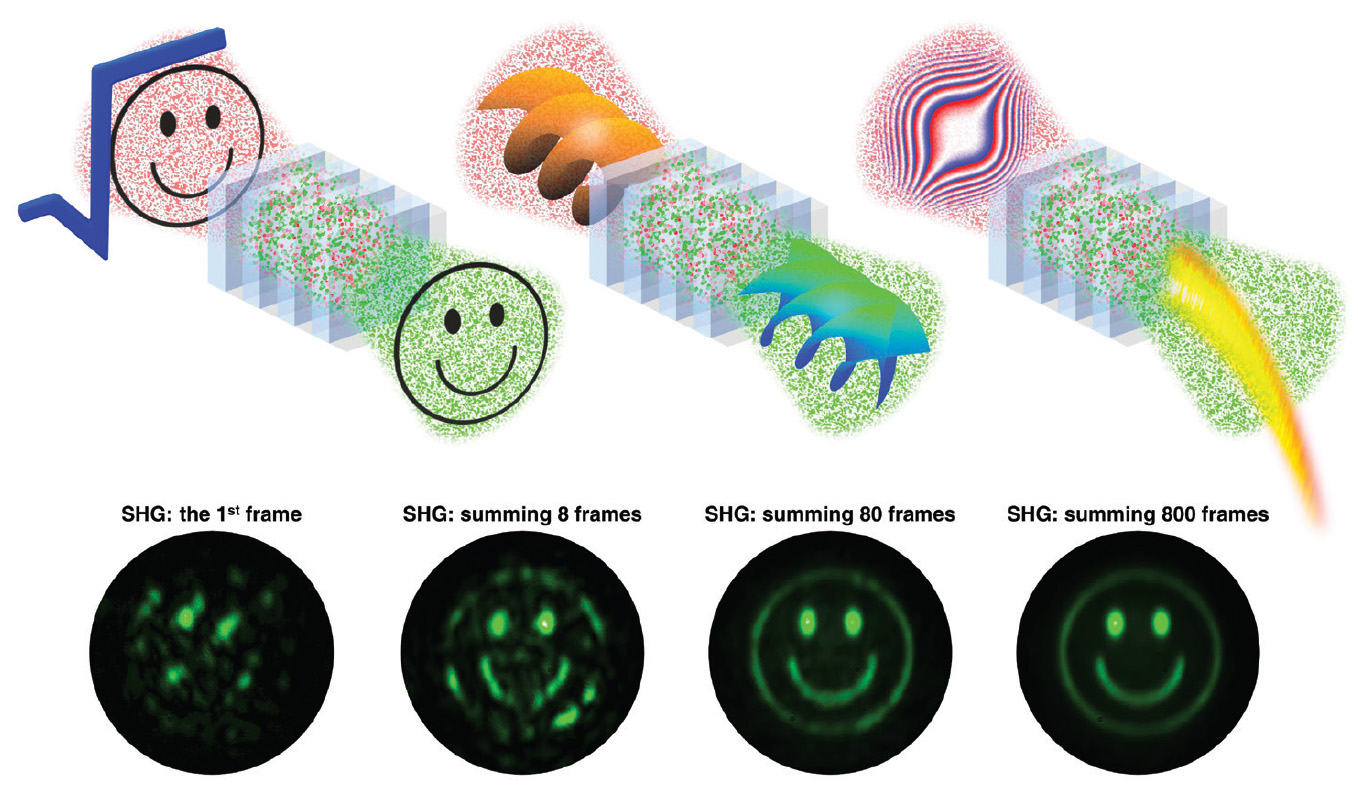
 [Enlarge image]Nonlinear synthesis of spatial coherence using quadratic nonlinear photonic crystals for incoherent imaging and for generating vortex and Airy beams. Bottom: Experimental demonstration of incoherent imaging of a “smiley-face” object through accumulated second-harmonic speckle patterns.
Since the invention of the laser in 1960,1 nonlinear optics has been built primarily around coherent light sources. Only a year later, in 1961, the first experimental demonstration of second-harmonic generation (SHG) firmly associated the phenomenon with coherent lasers.2 This historical precedent entrenched the widespread intuition that nonlinear frequency conversion inherently demands coherent illumination. However, this longstanding assumption has inadvertently restricted our understanding of the role optical coherence can play in nonlinear light–matter interactions (LMI).
Traditionally, coherence in nonlinear optics, except for a few rare cases,3 is regarded as an intrinsic property of the light source, something to be passively accepted or externally managed. In contrast, this year we introduced a framework in which spatial coherence is not a limitation but a programmable degree of freedom.4 By tailoring the statistical properties of an incoherent pump beam before it enters a nonlinear crystal, we demonstrate that coherence can be synthesized during SHG, allowing the second-harmonic beam to acquire a user-defined coherence spatial function.
In our work, we begin by numerically retrieving the complex speckle field of an incoherent object at the fundamental frequency. A square-root filter is applied to each frame to compensate for the quadratic nature of SHG under the weak interaction approximation. These filtered fields, possessing the desired statistical properties, are recreated and directed into a 2-mm-long periodically poled KTiOPO4 crystal, whose length is much shorter than the confocal parameter of the interacting beams.
Inside the crystal, the second harmonic is produced with a spatial coherence function shaped by the engineered statistics of the pump. To demonstrate this concept, we synthesized the spatial coherence of an incoherent “smiley-face” object and verified that the second-harmonic speckle ensemble replicates the object as the synthetic frames accumulate.
Beyond incoherent imaging, we also explored nonlinear generation of incoherent structured beams. In one case, we synthesized incoherent vortex beams carrying orbital angular momentum (OAM) and observed the expected doubling of topological charge, verifying OAM conservation even under incoherent illumination. In another, we demonstrated the nonlinear generation of incoherent Airy beams, which preserve their ballistic self-accelerating trajectories, with the added benefit of reducing the (usually) unwanted side lobes as the coherence width decreases.
Our results demonstrate that spatial coherence can be actively engineered through nonlinear optical processes. This not only deepens the fundamental understanding of optical coherence but also unlocks exciting possibilities for applications such as infrared imaging and fluorescence microscopy, where nonlinear LMI effects play a central role.
Researchers
Z. Pang and A. Arie, Tel Aviv University, Israel
References
1. T.H. Maiman, Nature 187, 493 (1960).
2. P.A. Franken et al. Phys. Rev. Lett. 7, 118 (1961).
3. L. Waller et al. Nat. Photon. 6, 474 (2012).
4. Z. Pang and A. Arie, Light Sci. Appl. 14, 101 (2025).
