

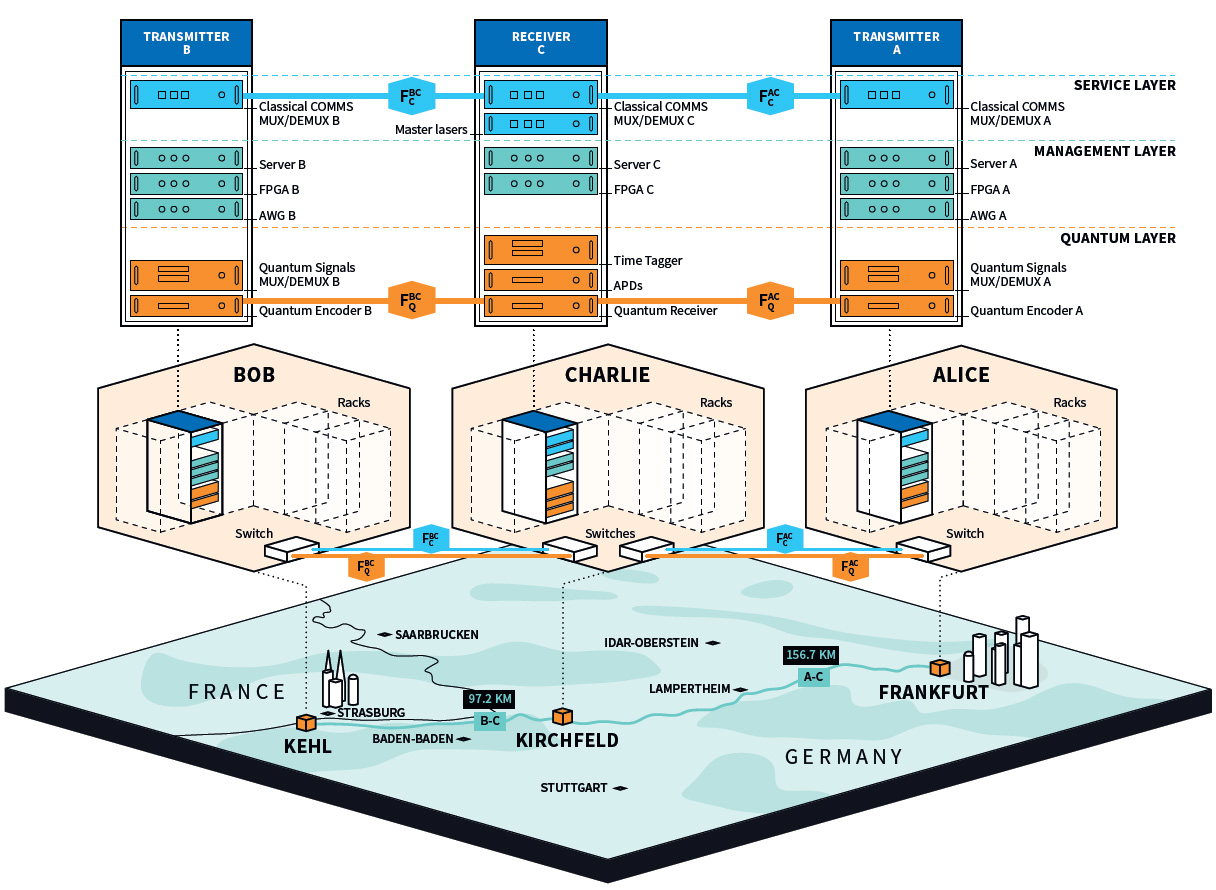
 [Enlarge image]Deployed coherent quantum communication system across installed telecom infrastructure in Germany, showing network layout and schematic architecture.
Quantum communication harnesses the unique properties of quantum states to perform tasks that are impossible with classical technologies. This includes provably secure communication, enhanced distributed sensing and networked quantum computing.
Recent advances have identified optical coherence—the ability of light waves to interfere predictably—as a crucial resource for quantum communications. Coherence not only extends the range of secure quantum links1 but also enables foundational functions of the quantum internet such as teleportation and entanglement swapping.2, 3 Maintaining coherence across long distances, however, is extremely challenging. Previous demonstrations of coherence-based protocols relied on ultra-stable lasers and cryogenic superconducting detectors, restricting them to specialized laboratory settings.
In our recent work,4 we reported the first real-world demonstration of long-distance coherent quantum communication over an operational fiber network. Using the twin-field quantum key distribution (TF-QKD) protocol,1 we established secure key exchange across a 254-kilometer deployed link between Frankfurt and Kehl, Germany, at a rate of 110 bps. This achievement more than doubled the maximum distance previously attainable with practical detectors and, crucially, surpassed the fundamental capacity limit for point-to-point QKD using comparable hardware. This effectively realized the functionality of a quantum repeater without requiring quantum memories.
The success of this experiment hinged on a scalable and practical system design. A central node distributed optical frequency references to remote users for phase-locking their lasers. To counteract fiber-induced fluctuations, we developed an off-band phase-stabilization technique, which relied on bright reference signals to cancel noise in real time. This approach made it possible to use compact, non-cryogenic avalanche photodiodes in place of superconducting detectors, dramatically reducing complexity while ensuring full compatibility with existing telecom standards.
Equally important, the system was designed with deployment in mind. All components were integrated into standard racks in colocation data centers alongside conventional networking equipment. Field measurements confirmed that underground telecom fibers offered sufficient environmental stability, allowing the system to maintain coherence over hundreds of kilometers.
This achievement4 represents one of the most advanced demonstrations of real-world quantum communication to date. Beyond secure key distribution, the ability to distribute and stabilize coherence across deployed networks provides the foundation for many other advanced quantum communication, computing and sensing technologies.5 By bridging the gap between demanding quantum requirements and the realities of deployed telecom infrastructure, our work marks a decisive step toward practical, large-scale quantum networks and the future quantum internet.
Researchers
M. Pittaluga, Y.S. Lo, A. Brzosko, R.I. Woodward, D. Scalcon, M.S. Winnel, T. Roger, J.F. Dynes, K.A. Owen, S. Juárez and A.J. Shields, Toshiba Europe Limited, UK
P. Rydlichowski, Poznan Supercomputing and Networking Center, Poland
G. Roberts, GÉANT Vereniging, Netherlands
D. Vicinanza, GÉANT Vereniging, Netherlands, and Anglia Ruskin University, UK
References
1. M. Lucamarini et al. Nature 557, 400 (2018).
2. S.L.N. Hermans et al. Nature 605, 663 (2022).
3. J.L. Liu et al. Nature 629, 579 (2024).
4. M. Pittaluga et al. Nature 640, 911 (2025).
5. C.L. Degen et al. Rev. Mod. Phys. 89, 035002 (2017).
