

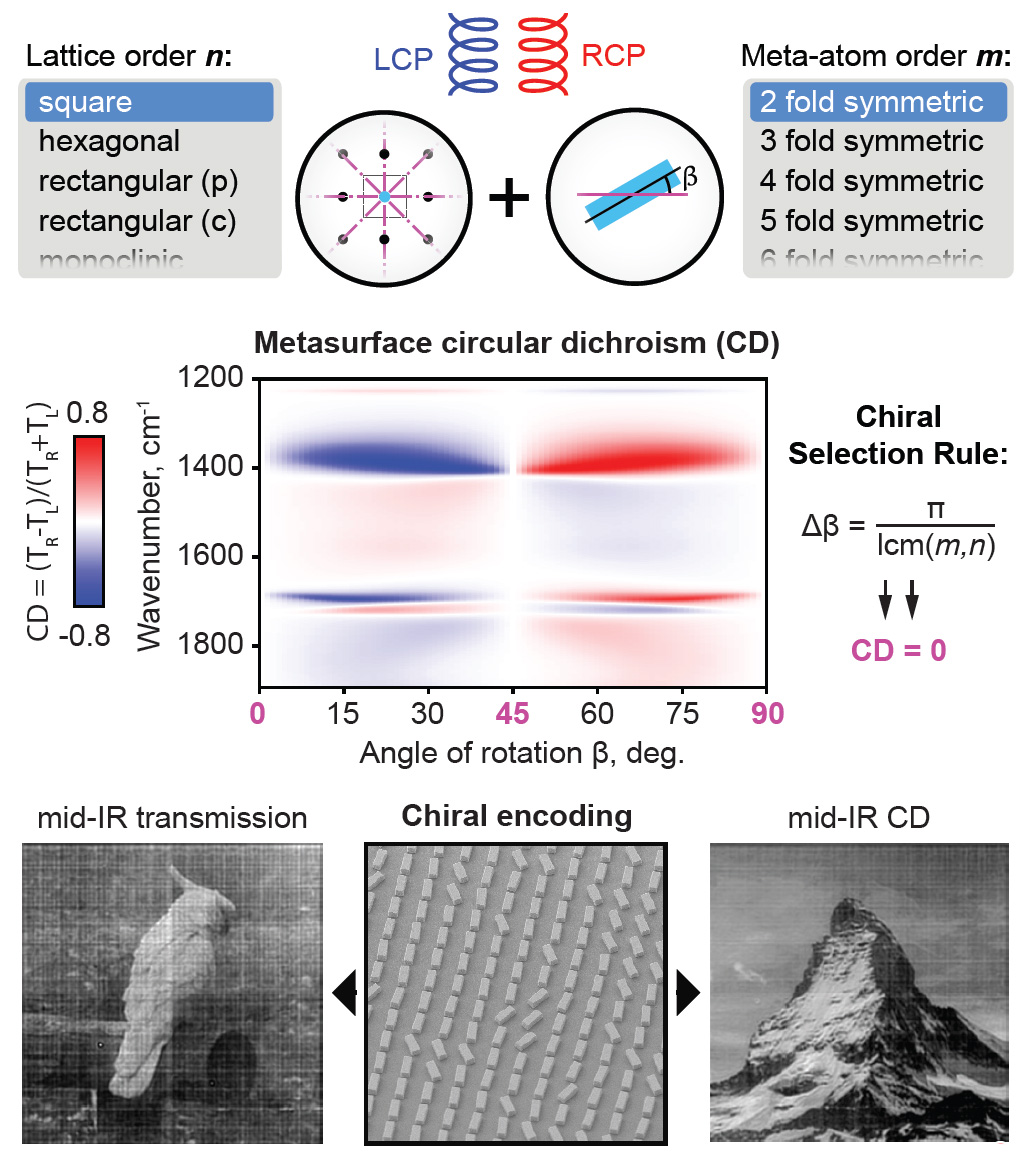
 [Enlarge image]Selection rules defining chiral response of resonant dielectric metasurfaces and their application to chiral image encoding in the mid-IR frequency range. Here lcm is the least common multiple.
Chirality—a property of an object whose mirror image cannot be superimposed onto itself—is ubiquitous in science and life, but the quantitative measure of chirality is challenging. A common evaluation relies on properties of an object manifested in its interaction with other chiral entities. In optics, the ideal probes are left- and right-circularly polarized waves. Their interaction with left- and right-handed objects is analyzed in transmission and absorption response, giving rise to circular dichroism and circular birefringence. These effects are widely exploited in molecular sensing, drug design and solid-state quantum physics.1
In recent years, metasurfaces have emerged as a powerful platform for controlling light–matter interactions.2 By arranging nanoscale resonators into planar arrays, we can replace bulky optics and unlock new functionalities. Metasurfaces are particularly promising for controlling chiral responses, since they can be engineered to enhance the difference between the interaction with left- and right-circularly polarized light.3 However, the design parameter space is vast and often not intuitive. Various strategies—like 3D chiral resonators, twisted bilayer structures, and substrate-induced asymmetry—have been proposed, each effective in certain cases but offering little general guidance on chiral design. What was missing was a unified framework to predict and control metasurface chirality.
In our recent work,4 we developed a universal symmetry-based strategy for chirality control. Rather than focusing solely on the resonator geometry or the lattice arrangement, we looked at the interplay of both. We derived compact selection rules and identified the angular periods Δβ of resonator rotation that result in absent circular dichroism. This allowed us to predict and engineer the chiral response across all possible combinations of the 2D lattice and resonator symmetries, uniting phenomena that previously seemed unrelated.
As a demonstration, we realized chiral gradient metasurfaces by controlling the shape, angle and lattice symmetry of the resonators to tailor the optical response of the metasurface under polarized light. Furthermore, we showed encoding of two distinct images onto a single metasurface operating in the mid-infrared spectrum. The first image, a picture of an Australian cockatoo, was encoded by varying the size of the resonators and became visible under unpolarized light. The second image, of the Matterhorn, was encoded via the orientation angle of the resonators and was revealed when the metasurface was illuminated with circularly polarized light.
By distilling metasurface chirality into clear rules and tunable parameters, we provided a universal toolkit that streamlines the process of engineering metasurfaces and opens new opportunities. Applications could range from ultrasensitive detection of biomolecules and secure authentication technologies based on unique optical signatures, to compact sources of structured and quantum light. By grounding the field in symmetry principles, we offer a roadmap for predictable, on-demand control of chirality.
Researchers
Ivan Sinev and Hatice Altug, École Polytechnique Fédérale de Lausanne (EPFL), Switzerland
Ivan Toftul and Yuri Kivshar, Australian National University, Australia
References
1. Y. Wang et al. Chem. Soc. Rev. 42, 2930 (2013).
2. A.I. Kuznetsov et al. ACS Photonics 11, 816 (2024).
3. M. Gorkunov et al. Phys Rev. Lett. 125, 093903 (2020).
4. I. Sinev et al. Nat. Commun. 16, 6091 (2025).
