

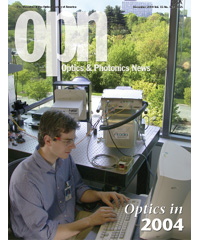
December 2004 Issue
Feature Articles
Special Issue: Optics in 2004 Introduction
A record number of research groups submitted summaries to “Optics in 2004”: there were 104 submissions this year, representing the work of 414 authors. This was a significant increase over the total of 61 submissions to “Optics in 2003.”
by Bob D. Guenther David Hardwick, Changsheng Li and R. John KoshelOne of the most significant future advances in the study of other solar systems will be the direct imaging detection of planets orbiting other stars by either space-based telescopes or groundbased telescopes equipped with adaptive optics (AO).
by Lisa A. Poyneer and Bruce MacintoshWe demonstrate highly efficient evanescent-wave detection of fluorophore-labeled biomolecules in submicroliter aqueous samples positioned in the microstructured part of a photonic crystal fiber (PCF).
by Jesper B. Jensen, Lars H. Pedersen, Poul E. Hoiby, Lars B. Nielsen, Theis P. Hansen, Jacob R. Folkenberg, Jesper Riishede, Danny Noordegraaf, Kristian Nielsen, Anneline Carlsen and Anders BjarklevSelf-Rotation of Red Blood Cells in Optical Tweezers: Prospects for High Throughput Malaria Diagnosis.
by Samarendra Kumar Mohanty, Abha Uppal and Pradeep Kumar GuptaFiber Photodetectors Codrawn From Conducting, Semiconducting and Insulating Materials.
by Mehmet Bayindir, Ayman F. Abouraddy, Fabien Sorin, John D. Joannopoulos and Yoel FinkAssuming a circularly polarized input field, any scalar transmission function can be replaced by a unique fringe-orientation function without changing the (monochromatic) optical effect. What’s more, by assuming a linearly polarized input field, one can design diffractive beam splitters with 100 percent efficiency, a result that is not possible in the realm of scalar optics.
by Hanna Lajunen, Jani Tervo and Jari TurunenIn recent years, a new class of optical fiber that operates by the photonic bandgap (PBG) effect has created great excitement in the optical community. Here we suggest that PBG fibers with low-index contrast can be used to obtain fibers with zero dispersion and a large mode area below 800 nm.
by Jesper Riishede, Jesper Lægsgaard, Jes Broeng and Anders BjarklevDiffracted Evanescent Wave Model for Enhanced and Suppressed Optical Transmission Through Subwavelength Hole Arrays.
by Henri J. Lezec and Tineke ThioHere, we summarize the independent observations of vortex-ring lattice solitons by two separate groups. These vortex-ring solitons are generic to nonlinear lattices in two dimensions and are building blocks for more extended and complex wave structures.
by Jason W. Fleischer, Dragomir N. Neshev, Guy Bartal, Tristram J. Alexander, Oren Cohen, Elena A. Ostrovskaya, Ofer Manela, Hector Martin, Jared Hudock, Igor Makasyuk, Zhigang Chen, Demetrios N. Christodoulides, Yuri S. Kivshar and Mordechai SegevDevelopment of Polymer Cholesteric Liquid Crystal Flakes for Electro-Optic Applications.
by T. Z. Kosc, K. L. Marshall, A. Trajkovska-Petkoska, R. Varshneya and S. D. JacobsLateral Thinking With Photonic Crystal Fibers
by Hong C. Nguyen, Peter Domachuk, Eric C. Mägi, Paul Steinvurzel, Michael J. Steel, Martin Straub, Min Gu, Mikhail Sumetsky and Benjamin J. EggletonInce-Gaussian Beams: The Third Family of Eigenmodes of Stable Laser Resonators.
by Miguel A. Bandres, Ulrich T. Schwarz and Julio C. Gutiérrez-VegaQuantum Cryptography Edges Toward Telecom Speeds and Practical Applications.
by Joshua C. Bienfang, Alex J. Gross, Alan Mink and Charles W. ClarkShort Fiber Lasers Produce Record Power/Length of 1.33W/cm.
by Nasser Peyghambarian, Tiequn Qiu, Pavel Polynkin, Axel Schulzgen, Li Li, Valery Temyanko, Masud Mansuripur and Jerome V. MoloneyCompressing Femtosecond Laser Pulses Non-Iteratively.
by Matthew E. Anderson, Josh Thornes and Phillip PoonDepartments and Columns
Also in this Issue
![Conceptual representation of entanglement. [Getty Images]](https://opnmedia.blob.core.windows.net/$web/opn/media/images/articles/2026/0226/departments/202602-cover-web.jpg?ext=.jpg)
