

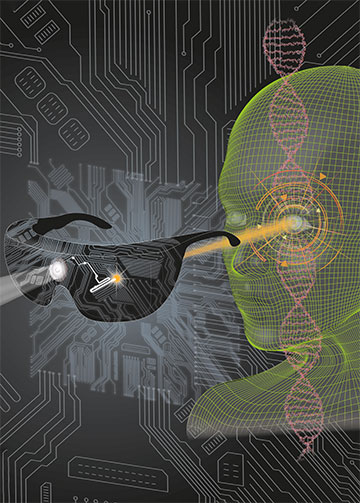
A gene therapy makes surviving retinal ganglion cells light-sensitive, allowing blind patients to detect objects using stimulating goggles. [Image: IOB, Veronique Juvin, 2021]
An international team of researchers has shown that optogenetic therapy can improve the vision of people who have become blind through an inherited eye disease (N. Engl. J. Med., doi: 10.1056/NEJMoa2602215). Clinical tests showed that seven out of the 10 patients became more sensitive to light while some of the participants were also able to detect and reach for specific objects.
Restoring light sensitivity
A landmark result five years ago showed that optogenetic therapy had partially restored the sight of a single patient with an advanced form of retinitis pigmentosa, a disease that causes photoreceptors in the retina to lose their sensitivity to light. The disease can arise from mutations in more than 100 different genes, which makes it challenging to treat using emerging techniques that target a specific genetic defect.
Instead, optogenetic therapy aims to activate undamaged nerve cells in the retina that are normally prompted by the photoreceptors to process and send visual information to the brain. Injections into the eye provide the genetic instructions for these retinal ganglion cells to produce light-sensitive proteins, restoring their ability to respond to light.
In this new, early-stage clinical trial, each participant received a single injection that made the retinal cells sensitive to amber light. After the injection, the patients wore special goggles that capture visual information with a built-in camera. An integrated processor converts this information into patterns of amber light, which are projected onto the retinal cells to stimulate a response.
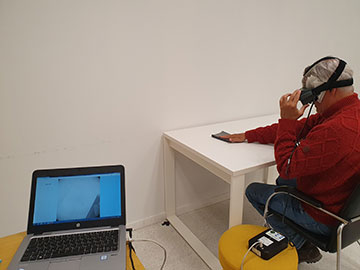
An early-stage clinical trial has shown that optogenetic therapy can enable people with irreversible blindness to locate small objects like a notebook. [Image: Sahel et al., NEJM]
Tests showed that wearing the goggles enabled most of the patients to become more sensitive to light, with six reaching the clinical threshold for a meaningful improvement. While the treatment did not restore normal sight or the ability to recognize faces, several participants were able to follow a line, find a doorway or locate specific objects. Measurements of neural activity during these tasks also indicated that visual information was reaching the brain.
Safe, promising results
Within the limits of the study, the researchers concluded that the combination of gene therapy and light-stimulating goggles was safe for clinical use. Adverse effects such as inflammation were classed as mild or moderate, with one severe event immediately after an injection that resolved within just a few minutes.
The researchers believe that the findings from this early-stage study provide the foundations for developing more sensitive and effective optogenetic therapies. “These results show that the visual system retains a remarkable capacity to process new information, even in people with profound vision loss,” said first author José-Alain Sahel, University of Pittsburgh, USA. “The approach could also help patients with other blinding diseases, many of whom have few or no treatment options.”
