

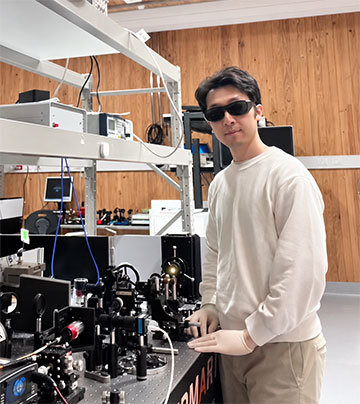
Ziwei Yang in the lab. [Image: Ziwei Yang, ARC Centre for Transformative Meta-Optical Systems at the Australian National University]
Traditionally, metasurfaces for nonlinear optical processes such as harmonic generation and frequency mixing are static, meaning their functionality is fixed after fabrication. Actively tunable metasurfaces, on the other hand, offer dynamic control over light–matter interactions at subwavelength scales. However, conventional tuning approaches—such as thermal, electrical and mechanical actuation—have intrinsic limitations that include a lack of speed or scalability.
To this end, an international team of researchers has developed an ultrathin metasurface platform that leverages liquid crystals and light to manipulate both linear and nonlinear responses (Sci. Adv., doi: 10.1126/sciadv.aeh0904). The platform’s all-optical control may enable greater flexibility for reconfigurable nonlinear signal processing and adaptive photonic computing.
A contactless mechanism
Metasurfaces have emerged as a compact and versatile platform for nonlinear optics, given the high cost of nonlinear crystals and the limited space in miniaturized devices. Actively tunable metasurfaces with real-time modulation of optical responses have been explored for applications such as dynamic beam steering, focusing, programmable holography and optical information processing.
Liquid crystals work well for this purpose, but the tunability of metasurface–liquid crystal systems generally depends on external control mechanisms, such as wire-connected electrodes. Instead, the researchers aimed to identify a contactless and reversible tuning mechanism.
Yang believes that one possible application for the technology is in optical computing—specifically, optical neural networks.
“Our question was whether light could directly tune or program the function of the metasurface without needing contact electrodes,” said study author Ziwei Yang of the ARC (Australian Research Council) Centre of Excellence for Transformative Meta-Optical Systems, Australian National University, Australia, in a press release accompanying the research.
Optical neural networks
In the study, Yang and his colleagues created a novel metasurface–liquid crystal system that can be driven by an optical torque tuning mechanism in a contactless fashion. First, they encapsulated a dielectric metasurface within a Teflon-aligned liquid crystal cell that acts as an anisotropic medium for all-optical tuning. Upon applying an electric field by a near-infrared femtosecond pump laser, the liquid crystals undergo reorientation toward a direction parallel to the metasurface plane.
The researchers demonstrated a clear resonance shift in the linear regime, as well as pronounced modulation of the nonlinear response through third-harmonic generation from the metasurface. Yang believes that one possible application for the technology is in optical computing—specifically, optical neural networks.
“At the moment, the nonlinear layer is mostly controlled by electronics,” said Yang. “If we can somehow use light to directly control this nonlinear layer directly, it could be useful for optical neural networks in the future.”
