

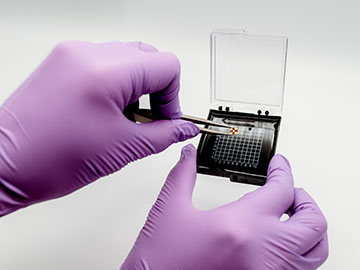
An infrared sensor for rapid analysis of the chemical properties of atmospheric particles. [Image: Romana Maalouf Photography]
Researchers at TU Wien, Austria, have demonstrated an infrared sensor that can rapidly determine the chemical properties of nanoscale particulates in the atmosphere (Sci. Adv., doi: 10.1126/sciadv.aeb2254). The compact and lightweight instrument, which is now commercially available through spin-off company Invisible-Light Labs, is sensitive enough to monitor dynamic changes in particulate populations in a variety of real-world environments.
Determining particle composition
Ultrafine particles in the atmosphere have a significant impact on the weather, climate change and air quality, but determining their chemical composition remains an analytical challenge. Mass spectrometers flown on airborne instruments offer real-time measurements of atmospheric aerosols, but they only detect particles within a limited size range and struggle to identify specific molecular structures. Infrared spectroscopy in the lab provides more detailed chemical information, but samples must be collected over long periods of time to accumulate enough material for an accurate analysis.
In contrast, the infrared sensor developed by the Austrian researchers only requires a small number of particles to produce a signal that is strong enough to determine their chemical composition. The device works by capturing the particles on a membrane just a few nanometers thick. When illuminated with infrared light, the particles absorb energy at wavelengths that match the vibrational modes of their molecular bonds. Some of this energy is transmitted to the membrane, triggering a change in its vibrational behavior that can be measured with high precision.
Quick and efficient analysis

Jelena Timarac Popovic of Invisible-Light Labs, a spin-off company that has produced a commercial version of the infrared sensor. [Image: Romana Maalouf Photography]
The researchers tested the performance of the sensor by taking atmospheric measurements within the city of Vienna of particles with a diameter of less than 300 nm. The new device was able to identify the chemical compositions of different particulates after a sampling time of just 15 to 45 minutes. These results were consistent with the analysis provided by conventional infrared spectroscopy, which required a much longer sampling period extending to 45 hours.
The instrument was also used to determine the vertical distribution of atmospheric aerosols at a remote Arctic observatory in Greenland. In this case the sensing device was attached to a tethered balloon, allowing measurements to be taken at regular intervals from ground level up to altitudes of 550 m. These data reveal variations in the size and mass of the particles that are consistent with Arctic weather patterns, as well as rapid changes in chemical composition that would be difficult to detect using other methods.
The technology is equally adept at detecting ultrafine particulates in liquid samples. In one example, the researchers found traces of a nylon teabag in just 100 nanoliters of tea. “We have shown that our method delivers excellent results in real-world applications,” says team leader Silvan Schmid. “Together with Invisible-Light Labs, we now aim to further commercialize this technology and hopefully contribute to more effective environmental protection.”
