

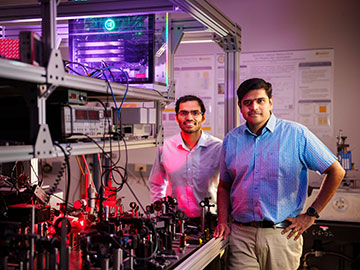
Sandia National Laboratories scientists Saaketh Desai, left, and Prasad Iyer, modernized an optics lab with a team of artificial intelligences that learn data, design and run experiments, and interpret results. [Image: Craig Fritz]
Self-driving labs integrate artificial intelligence, laboratory automation and robotics to operate as closed-loop systems that conduct experiments without human involvement. Although many self-driving labs remain relatively in early in their development, researchers are increasingly demonstrating their potential to accelerate solutions for complex scientific problems that traditionally require slow, labor-intensive work.
Now, a team of physicists from Sandia National Laboratories, USA, has developed a self-driving lab that addresses the challenge of steering spontaneous light emission (Nat. Commun., doi: 10.1038/s41467-025-66916-0). The platform discovered a novel strategy for controlling spontaneous emission beyond conventional Fourier optics that demonstrates up to a four-fold enhancement in peak emission directivity over a 74° field of view.
“Without the self-driving lab, I wouldn’t have explored this possibility since it goes against our current, nascent understanding of light emission and steering based on Fourier optics,” said study author Prasad Iyer. “Our work could be applied to energy-efficient displays in a low cost, weight, size and power form factor for augmented-, virtual-, and extended-reality displays.”
Supercharging their experiment
In 2023, Iyer and his colleagues demonstrated for the first time the ability to steer spontaneous light emission, as seen in light-emitting diodes (LEDs) and thermal lamps, with a reconfigurable semiconductor metasurface. In the current study, they incorporated the same experiment into a self-driving lab platform to refine their technique and achieve better results.
“We set up our self-driving lab in three parts, following the scientific method,” said Iyer. “We started with hypothesis-driven experiment generation using the generative AI model, then proceeded to efficient design of experiments with an active learning agent and interpretability of results with neural network equation learners.”
The self-driving lab was able to efficiently generate hypothesis-driven experiments, design an order of experiments based on closed-loop feedback from previous experiments, and finally interpret the results in equation form. After running 300 experiments, which took about five hours, the platform output the governing equations for predicting the far-field emission profile from light-emitting metasurfaces.
Going beyond conventional principles
Using the results from their self-driving lab, the researchers discovered a novel approach to steer incoherent light that goes beyond conventional Fourier optical principles. Specifically, they observed that a spatial index profile represented by a superimposed lens and grating works three to four times better than a grating alone. In addition, a negative grating and negative lens steers light just as well as a positive lens and positive grating combination.
“For next steps, we are generally interested in interpretable optimization schemes and arriving at explainable decisions using AI,” said study author Saaketh. “We are interested in applying this to the steering problem, as well as other material science problems in general.”
