

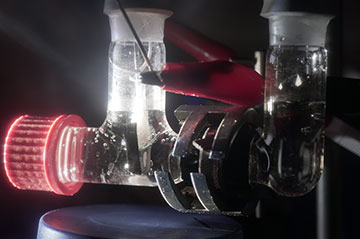
A semi-artificial leaf powered only by solar energy can drive industrially important chemical reactions. [Image: Celine Yeung]
Researchers at the University of Cambridge, UK, have demonstrated a light-harvesting device that could offer a more sustainable way to manufacture everyday chemicals (Joule, doi: 10.1016/j.joule.2025.102165). Their bio-inspired structure is designed to mimic photosynthesis, combining organic semiconductors with bacterial enzymes to convert sunlight, water and carbon dioxide into a feedstock compound that acts as a fuel for further chemical transformations.
Going organic
The layered device, which the Cambridge researchers call a semi-artificial leaf, is powered only by solar energy. Unlike earlier prototypes, this latest design avoids the use of toxic materials, maintains its performance for longer, and functions without the need for additional chemicals that had previously compromised the stability and efficiency of the conversion process.
Those advances were made possible by replacing inorganic semiconductors with organic light absorbers and by using biological enzymes instead of synthetic catalysts. “If we can remove the toxic components and start using organic elements, we end up with a clean chemical reaction and a single end product, without any unwanted side reactions,” said Celine Yeung, who completed the research as part of her Ph.D. work.
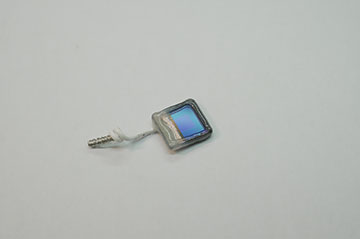
Semi-artificial organic photocathode (Front view). [Image: Celine Yeung]
Organic semiconductors can now achieve solar conversion efficiencies of up to 20%, while their bandgap can be tuned at the molecular level to optimize the chemical action of the biocatalyst. Previous biohybrid designs have required additional chemicals to keep the enzymes running, but in this case the researchers embedded a second helper enzyme within the same porous structure as the main biocatalyst. This combined approach enabled the system to operate effectively in a simple and benign bicarbonate solution.
Toward green fuels and chemicals
Tests showed that the artificial leaf produced high current densities and achieved a near-perfect efficiency for converting light-generated electrons into chemical activity that created a compound called formate. The researchers also demonstrated that the formate produced by the device could be used as the fuel for another chemical reaction, this time producing a compound that is widely used in the manufacture of pharmaceuticals and plastics with a high yield and purity.
The device ran successfully for more than 24 hours, at least twice as long as previous prototypes, and the researchers are now aiming to develop the design to further extend the operating lifetime and to produce a greater range of chemical products. “We’ve shown it’s possible to create solar-powered devices that are not only efficient and durable but also free from toxic or unsustainable components,” said team leader Erwin Reisner. “This could be a fundamental platform for producing green fuels and chemicals in future.”
