

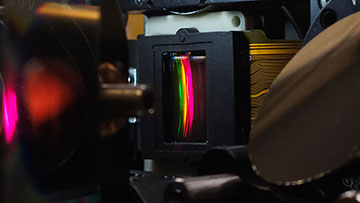
Researchers developed a new type of spectral shaper that can shape the spectrum of 10,000 lines of light from a laser frequency comb. [Image: Optica]
A critical tool in the search for Earth-like exoplanets is the astro-comb, a broadband and uniformly spaced laser frequency comb optimized for wavelength calibration of astronomical spectrographs. Astro-combs provide a reference akin to a precise wavelength ruler, with an ability to measure the Doppler “wobble” from increasingly smaller planets.
Now, researchers at Heriot-Watt University in the United Kingdom have developed a practical approach to spectral shaping that extends spectral control to 10,000 individual comb lines (Optica, doi: 10.1364/OPTICA.571303). The added precision can be used to increase the uniformity of comb lines, allowing the spectrograph to detect smaller stellar motions that would otherwise be hidden in the noise.
Unprecedented control
Previous demonstrations of line-by-line modulation have leveraged two-dimensional liquid crystal on silicon spatial light modulators to control significant numbers of comb lines at high resolution. Notable examples include controlling 836 individual 6.5 GHz-spaced comb lines from a 1525–1570 nm electro-optic comb and, more recently, 300 comb lines spaced at 1 GHz for use in quantum-based Josephson arbitrary waveform synthesizers.
The current study reports a novel cross-dispersion shaper that maps the spectrum of a 20 GHz visible to near-infrared laser frequency comb onto a two-dimensional liquid crystal on silicon spatial light modulator. The device gives researchers the ability to arbitrarily and dynamically control individual lines from a configurable array of thousands of coherent frequencies.
“For our spectral shaper, we took inspiration from the astronomical spectrographs on large telescopes, which split up the spectrum of light into many rows, a format that makes more efficient use of high-resolution two-dimensional camera sensors,” said study author Derryck T. Reid in a press release accompanying the research. “By substituting a spatial light modulator for the camera typically used in spectrographs, we could control the spectrum of light across a wide bandwidth much more precisely than ever before.”
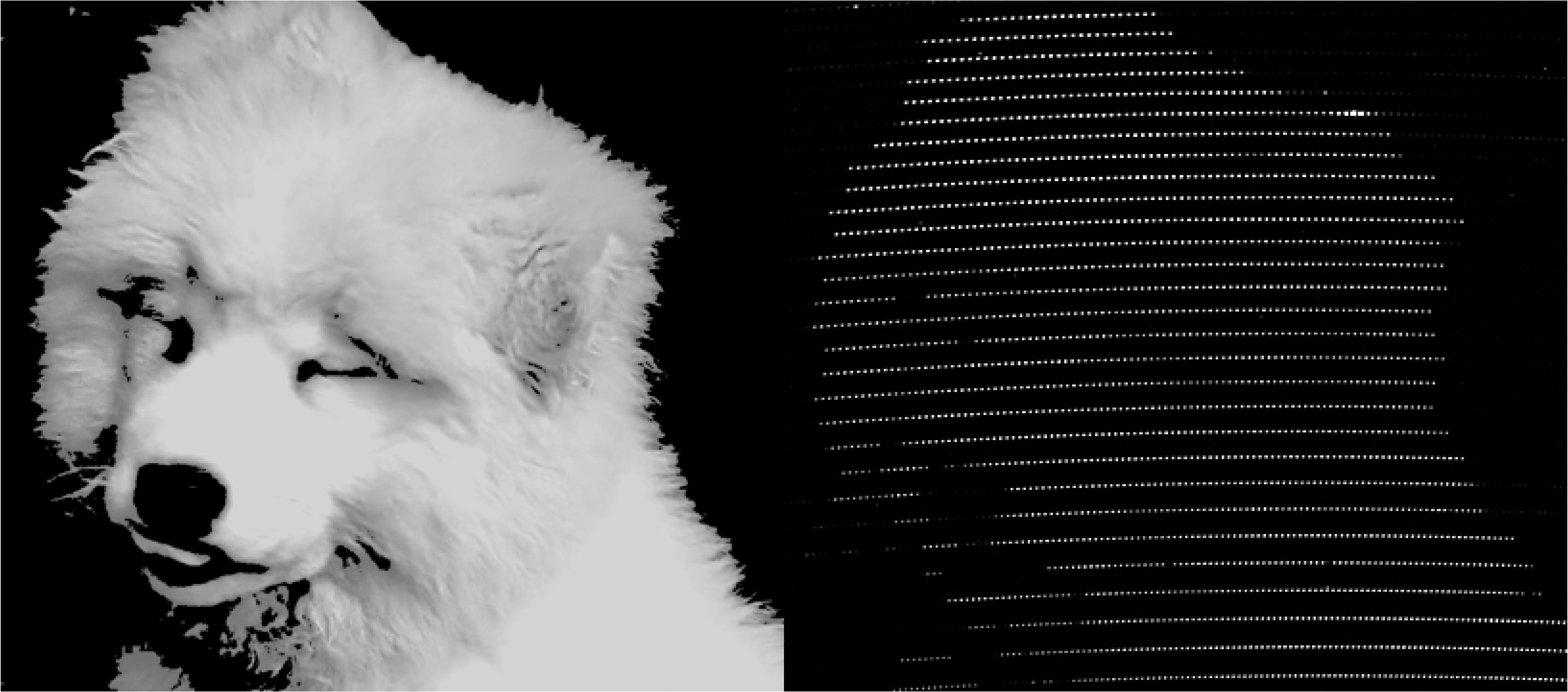
A picture of a researchers dog (left) represented by thousands of laser frequency comb lines (right). [Image: Optica]
10,000 comb modes
For the laser frequency comb, Reid and his colleagues used a 516 MHz, 55 fs Ti:sapphire laser, which was broadened and delivered a bandwidth of 550–950 nm. It was designed to span the operational bandwidth of the high-resolution spectrograph at the Southern African Large Telescope (SALT), where the performance of the spectral shaper will be assessed during actual observations.
They tested the spectral shaper in various ways, including flattening or isolating different comb lines, and even programmed photos as target shapes on the two-dimensional spectrograph. In the end, the device achieved precise amplitude control of 10,000 comb modes spanning 580–950 nm (200 THz), with a bandwidth-to-resolution ratio exceeding 20,000.
“Although there is an immediate application in astronomy instrumentation, spectral shapers are versatile tools,” said Reid. “This technology could also benefit fields such as telecommunications, quantum optics and advanced radar, where precise control over the shape of light across broad bandwidths can improve signal fidelity, enable faster data transfer and enhance the manipulation of quantum states.”
