

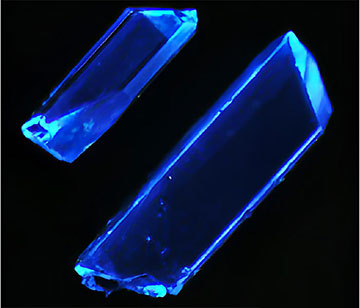
A hybrid material that combines copper iodide with an organic compound generates ultrabright emission at deep-blue wavelengths. [Image: Kun Zhu / Jing Li Lab / Rutgers University]
Researchers in the United States and China have created a material that could enable high-power LEDs operating at deep-blue wavelengths to be manufactured much more cheaply than existing devices (Nature, doi: 10.1038/s41586-025-09257-8). Unlike other candidate materials, the ultrabright emitter combines high efficiency with long-term stability and can be produced entirely from safe and sustainable materials.
Reaching for the rainbow
In the continuing drive to develop lower-cost technologies for displays and lighting, researchers strive to fabricate LEDs of all colors using inexpensive and energy-efficient techniques such as solutions processing. For green wavelengths and beyond, suitable light emitters have been found in organic semiconductors, perovskite compounds and colloidal quantum dots. However, deep-blue versions lack the efficiency and stability of their low-energy counterparts, while more sustainable materials that eliminate the need for toxic elements require complex and costly synthesis techniques.
One promising alternative is copper iodide, which is made from readily available materials and has been shown to achieve a high luminescence efficiency when formed into small molecular clusters. However, this impressive light output cannot be maintained when the material is incorporated into an LED structure, since its clustered nature impedes the efficient movement of charge carriers.
One promising alternative is copper iodide, which is made from readily available materials and has been shown to achieve a high luminescence efficiency when formed into small molecular clusters.
In this new work, the researchers attempted to address that problem by creating thin films of a hybrid material that combines copper iodide with an organic molecule. Tests showed that this material produces deep-blue photoluminescence at around 449 nm with near-perfect efficiency. Further optical analysis revealed the specific decay processes that generate the complex light emission.
Toward an efficient LED
To form this material into an efficient LED, the team engineered the interfaces between the hybrid light emitter and the two electronic layers of the device. Adding ultrathin layers of other organic compounds at these interfaces generates extra hydrogen bonds across the heterojunctions, which act to passivate the surface defects and enhance the injection of charge carriers into the light-emitting layer.
LEDs fabricated using this approach emitted deep-blue light with an efficiency as high as 12.6%, around 10 times greater than previous devices made from copper iodide. A large-area version measuring 4 cm2 maintained an emission efficiency of 7.9%, suggesting that the approach is both scalable and robust for practical applications.
The researchers also found that the interfacial treatment extended the long-term performance of the devices, with the emission intensity taking more than 200 hours to fade to half its original value. “Overall, this type of new material is paving the way for better, brighter and longer-lasting LEDs,” said principal investigator Jing Li of Rutgers University, USA.
