

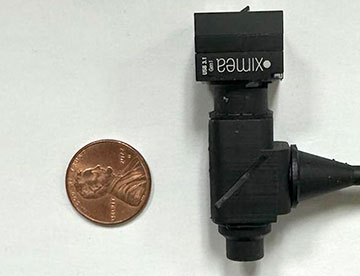
Researchers in the United States have developed a microscope measuring a few centimeters across and weighing just 16 g, which can capture the electrical activity of neurons hundreds of times a second in awake but not yet mobile mice. [Image: Emily A. Gibson, University of Colorado Denver, Anschutz Medical Campus]
By recording neurons’ detailed electrical activity in time and space, scientists hope to better understand the basic workings of the brain and develop new treatments for neurological disorders. But imaging such activity with adequate sensitivity and temporal resolution using a device that is also small and lightweight enough to be attached to live rodents—the model for many human diseases—has proved a challenge.
Now, researchers in the United States have designed a miniature high-performance microscope from off-the-shelf optics and sensors that is light enough to be placed on mice that are awake but fixed in position (Biomed. Opt. Express, doi: 10.1364/BOE.576516). They expect that by employing customized components in the future, it ought to be possible to follow the behavior of free-roaming mice.
Toward improved neuronal imaging
Tracking the neuronal activity of mice in vivo can already be done using what are known as genetically encoded calcium indicators. These are molecules that fluoresce when binding to calcium ions, which are involved in many of the changes in voltage taking place across cell membranes known as spikes.
However, calcium-based measurements of spikes typically occur on timescales of hundreds of milliseconds. In contrast, voltages usually change in less than a millisecond. Using the former to monitor such fast neuronal processes can therefore lead to loss of temporal resolution. Calcium-based data can be post-processed on a computer to reveal the underlying spikes, but doing so can introduce errors.
In the latest work, Emily Gibson at the University of Colorado Anschutz Medical Campus and colleagues at the University of Colorado Boulder and Columbia University instead employ what are known as genetically encoded voltage indicators. These proteins fluoresce in response to changes in voltage across cell membranes, providing a more direct and higher-resolution view of neural firings—rising and falling in line with millisecond voltage fluctuations.
As the researchers point out, however, these voltage spikes produce only small variations compared with the baseline fluorescence signal. The challenge, they say, is developing a microscope that has a large numerical aperture to collect light with adequate efficiency and then coupling that to an image sensor that is sensitive enough and quick enough to capture individual voltage spikes—all the while keeping the device’s size and weight to a minimum.
A tiny high-performance microscope
Calcium-based data can be post-processed on a computer to reveal the underlying spikes, but doing so can introduce errors.
Gibson and colleagues have designed and built such a microscope, which they dubbed MiniVolt. They have done so using commercially available components, including four lenses that yield a numerical aperture of about 0.6 and an image sensor capable of operating at more than 500 Hz. Adding in suitable filters and enclosing the system in a casing custom made using 3D printing, they ended up with a T-shaped device measuring just a few centimeters across and weighing only 16 grams.
They put the device to the test by making a small hole in the skull of a mouse that had been genetically engineered to produce the commercial voltage indicator Voltron2 in its visual cortex. The researchers attached the microscope to the mouse’s head and kept the head in a fixed position. Then, they fed the device with light from a green laser via a fiber optic cable and recorded the resulting fluorescence to monitor the firing of individual neurons within the mouse’s brain.
To benchmark the performance of their microscope, the scientists compared its results with those from a bench-top wide-field microscope. They found that the two devices recorded similar patterns of voltage spikes for a given neuron, and that both had similar spike peak-to-noise ratios—of at least 3—while imaging at 530 frames per second.
Gibson and colleagues say that the microscope is already light enough to be placed on freely moving rats, which can carry loads of up to 35 g on their heads. But they point out that mice are the most valuable rodents when it comes to understanding human brains. And mice, in contrast, can only support devices weighing around 4 g.
Reducing the microscope’s weight to that kind of figure ought to be doable, they reckon. They say they should be able to achieve this by customizing the optics so that they obtain a similar numerical aperture with smaller lenses. At the same time, they believe they can maintain the performance of the sensor using a smaller custom-made CMOS device, since, they say, they are currently using only “a small fraction” of the existing sensor.
