

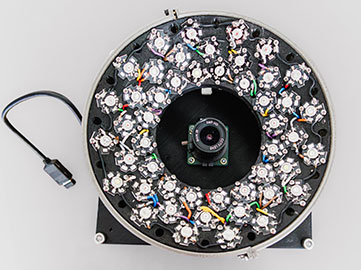
Close-up photo of the prototype tested at the Sorte Muld dig site. The camera lens is in the center, surrounded by LEDs emitting light at 16 different wavelengths. [Image: Peter Gammelby, Aarhus University]
When digging for artifacts of past cultures, archaeologists need to determine if the dark soil they are looking at is from the same layer they have been working in or is the start of a new layer of “dirt,” as this provides important information for interpreting their finds. Often, the excavators must decide before the next thrust of the shovel potentially destroys precious evidence.
Researchers in Denmark have developed a low-cost multispectral imaging system that extends the vision of archaeologists past the visible region (J. Archaeol. Sci., doi: 10.1016/j.jas.2026.106620). The prototype system uses 16 different wavelengths of light to evaluate the reflectance and fluorescence properties of the dirt layers before the scientists dig into them.
Lighting up the layers
In designing the system, dubbed LEDMSI for “LED multispectral imaging,” the team from Aarhus University and the Moesgaard Museum wanted to give archaeologists close to real-time imaging results in the field.
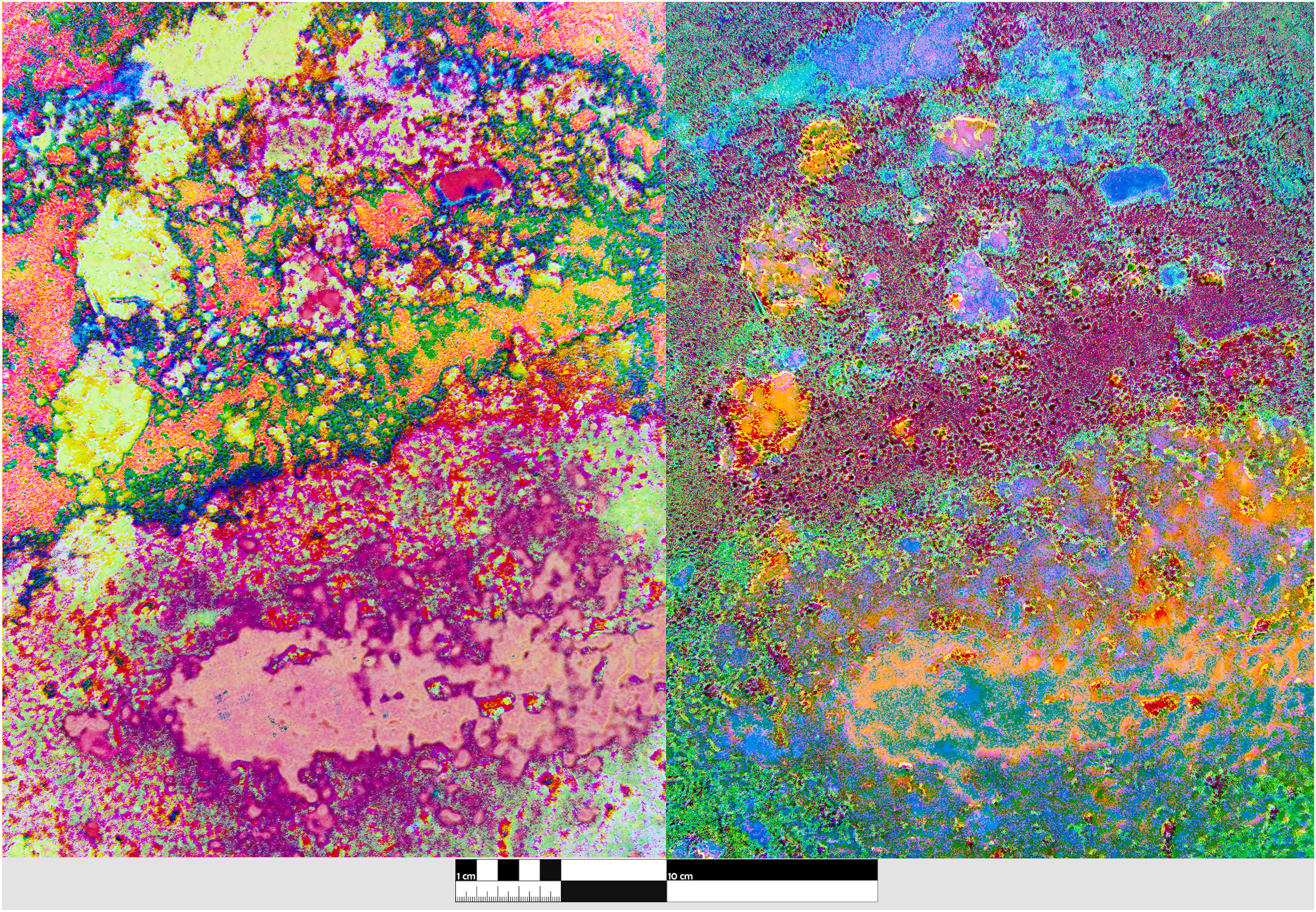
LEDMSI created this false-color composite image after scanning the soil at visible, ultraviolet and infrared wavelengths. An algorithm then separates the combined signal and isolates distinct sources in the soil, displaying them in false colors. Different values have been assigned to the red, green and blue channels in the left and right images. This makes it possible, for example, to see that the five yellow patches on the left are not all made of the same material: in the image on the right, the uppermost patch appears blue. [Image: David Stott, Moesgaard]
At the heart of LEDMSI is an off-the-shelf digital camera modified by removing the filter that normally blocks near-infrared and near-ultraviolet light from reaching the sensor. To create even illumination on a patch of excavated dirt, the team surrounded the camera lens with 15 narrow-band LEDs with wavelengths ranging from 365 to 940 nm and one “cool white” broadband-emission LED.
The researchers mounted the LED-camera setup on rails to ensure consistently overlapping images. Black plastic sheeting kept ambient sunlight from interfering with the desired illumination.
On the software side, the team stacked the images and performed principal-components and independent-components analyses to identify spectral signatures of the materials uncovered in the dig. They compared the results from the full-spectrum images with RGB images illuminated only by the “cool white” broadband LED to determine whether the multispectral device significantly improved contrast between layers of geological and archaeological materials.
Results in the field
For a proof-of-concept test, the Danish team took the equipment to Sorte Muld, a well-studied archaeological site on the Baltic Sea island of Bornholm. Humans have lived there for centuries going back to the Iron Age, and archaeologists have been studying the thin layers of culturally significant deposits for more than 100 years.
The Aarhus-Moesgaard group had chosen LED bands that were likely to distinguish between types of materials, and the scientists found enhanced differences between such things as wood ash, burned clay and bone. From image acquisition to final results, each LEDMSI run takes about 5 minutes.
“The images looked almost psychedelic when we took them, and we only really saw what we had when we analyzed them back at the computer,” Aarhus geoscientist Søren Munch Kristiansen said in a statement. “Then we could see new layers and changes in the fill that we simply could not see with the naked eye.” By adjusting the image-processing technique, the team detected bone fragments using filter-free fluorescence.
The Danish group is now testing an improved prototype system, with a better camera and two LED units, on a different archaeological site in the country. Furthermore, the researchers want to incorporate machine learning into the data-handling system in order to speed it up.
