

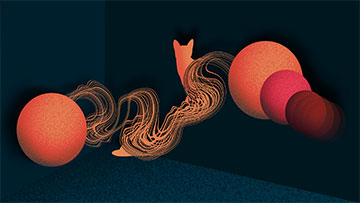
Entangling a molecular ion with an atom creates a “Schrödinger’s cat” state that is more sensitive to external disturbances than the individual particles. [Image: Helen Heinzer]
Researchers at the University of Innsbruck in Austria have devised a spectroscopic technique that can measure the characteristic vibrations of a single molecular ion (Nature, doi: 10.1038/s41586-026-10915-8). By entangling the molecular ion with an auxiliary atom, the method amplifies the interaction with light to detect the absorption of single photons by the molecule.
A less-destructive method
The new technique builds on the established method of absorption spectroscopy, which has become a vital tool for probing molecular structures and their energy transitions. For single molecules, however, the interaction with light is so weak that the spectrum is largely obscured by noise. Indirect methods have been used to measure the effects of light absorption, but they often perturb the molecular state or destroy the sample entirely.
For a less-destructive alternative, recent research has focused on a technique originally developed for reading out the quantum states in a trapped-ion quantum computer. In this method, called quantum logic spectroscopy, the molecular ion is coupled to an easy-to-control atomic ion within the same trapping potential. In this coupled system the molecular states and the transitions between them can be determined by measuring the light absorbed by the atomic ion, an approach that has already proved successful for simple diatomic species.
The new experimental scheme exploits the same co-trapping principle, but it allows more complex ions to be studied by measuring the recoil experienced by the molecule when a single photon is absorbed. This tiny change in momentum is transferred to the coupled atom through the Coulomb interaction, but the effect on the atom’s motion is too small to be detected using existing techniques.
Creating a cat state
To amplify the signal, the researchers used laser light at two distinct frequencies to generate entanglement between the molecular and atomic ions. This creates a single quantum state known as a Schrödinger cat state, which experiences a larger displacement than the individual particles when a photon is absorbed. “The entanglement of the particles in a cat state makes the system extremely sensitive to the slightest disturbances,” says Zhenlin Wu, the study’s lead author. Reversing the cat-generation process allows the displacement to be mapped onto the electronic state of the atom, which can be read out using methods developed for quantum computing.
Applying this cat-detection scheme to an ion of calcium hydroxide (CaOH+) and a calcium ion, the researchers showed that they could measure the energy transition between the ground and first excited state of the O–H stretching mode. The spectrum recorded for this transition achieves single-photon sensitivity and shows good agreement with theoretical calculations performed by collaborators at the University of Warsaw in Poland.
The researchers believe that the same technique could be applied to many other molecular ions, allowing vibrational transitions to be measured at frequencies down to 60 THz. Experimental strategies also exist to improve the sensitivity of the recoil measurement, which could enable selective single-shot measurements of molecular states for quantum applications.
