

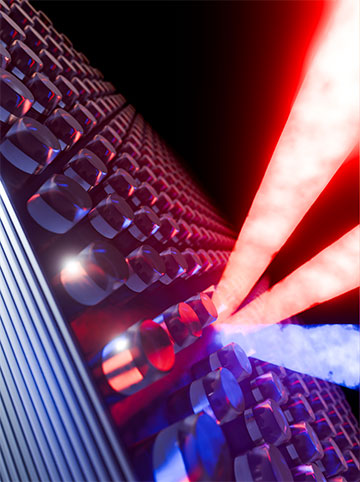
Illustration of frequency conversion, with two lower-energy waves combining into a higher-energy wave. [Image: Joshua Mornhinweg / Capasso group]
Nonlinear frequency conversion enables the generation of coherent light at wavelengths that are otherwise difficult or even impossible to access with lasers. Traditionally, the process relies on bulk crystals with weak intrinsic nonlinearities, meaning that efficient conversion requires relatively large interaction volumes or high light intensities—a significant barrier to device miniaturization.
Now, researchers in the United States have combined a semiconductor multi-quantum-well material with a metasurface to enable giant effective nonlinearities in the near-infrared to visible spectrum (Nat. Nanotechnol., doi: 10.1038/s41565-026-02268-0). The innovation unlocks potential for more compact, efficient components for telecommunications, quantum computation and other photonic technologies.
Higher photon energies
The proof-of-concept experiment highlights the possible benefits of combining metasurfaces and quantum wells for nonlinear frequency conversion.
Pernille Undrum Fathi and her colleagues started by exploring multi-quantum-well materials, which have been used to demonstrate second-order susceptibilities that exceed bulk-crystal values by orders of magnitude. However, operating wavelengths have been restricted to the mid-infrared.
“Unlike established nonlinear quantum-well approaches that rely on transitions within the conduction band, here we engineer transitions between the valence and conduction bands,” said study author Fathi, Ph.D. candidate in Federico Capasso’s lab at Harvard University’s John A. Paulson School of Engineering and Applied Sciences. “This allows us to extend the concept to much higher photon energies, including the near-infrared wavelengths used in telecommunications.”
The strong nonlinear response requires electric fields parallel and perpendicular to the quantum well layers, posing a challenge for free-space excitation. To overcome this issue, the researchers combined the multi-quantum-well heterostructure with a high-quality-factor dielectric metasurface for precise control of the electromagnetic fields at the nanoscale.
A stronger nonlinear response
The proof-of-concept experiment highlights the possible benefits of combining metasurfaces and quantum wells for nonlinear frequency conversion. Adding the precisely tailored nanopillars of the metasurface boosted the effective nonlinear conversion to three orders of magnitude higher than what would be observed from the unpatterned wafer and higher than previously reported values for comparable devices at near‑infrared wavelengths.
“A big advantage uncovered by our study is the ability to achieve a strong nonlinear response in a structure less than a micrometer thick, at wavelengths that are among other things important for telecommunications,” Fathi said. “Ultimately, platforms like this could enable much smaller and more energy efficient nonlinear optical components, that can be integrated with other photonic technologies, with applications ranging from data centers and optical signal processing to quantum photonics.”
