

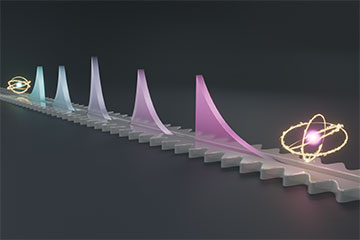
The photon changes shape during propagation. [Image: Oliver Diekmann / TU Wien]
Quantum networks that facilitate the transmission of information in the form of qubits are the basis of modern quantum technologies. Photons are used to transfer an excitation from one qubit to another, distant qubit—but with conventional methods, the second qubit can only absorb the photon pulse about 54% of the time.
To boost absorption efficiency, researchers at TU Wien in Austria propose a dispersion-engineered waveguide that reshapes the photon pulse into its time-reversed counterpart (Phys. Rev. Lett., doi: 10.1103/m2md-rxkv). The theoretical work may open the door to more efficient and simpler architectures for quantum communication and quantum computation.
“This allows the second qubit to perfectly absorb the photon and therefore enables perfect quantum information transfer,” said study author Zeyu Kuang., a postdoctoral researcher at TU Wien’s Institute of Theoretical Physics. “What makes our approach different from traditional methods is that it is entirely passive.”
Time-reversal symmetry
Quantum information is transferred between two qubits when one qubit spontaneously decays to its ground state and emits a photon pulse. The photon pulse then travels through a waveguide to a second qubit, which absorbs the photon pulse and jumps to an excited state.
Because absorption is the time-reversed process of emission, perfect absorption requires a photon pulse with the time-reversed profile of the emitted pulse. The current standard method employs an external laser to dynamically tune the effective qubit-waveguide coupling rates to generate a symmetric photon pulse that can be perfectly absorbed.
“However, this demands precise timing and active control of both qubits,” said Kuang. “In contrast, our approach eliminates this active modulation entirely by employing a dispersion-engineered waveguide, which passively reshapes the photon as it propagates.”
Working with experimentalists
By tailoring its dispersion relation, the waveguide can provide the necessary phase shift at each frequency to time-reverse the emitted pulse. In the study, Kuang and his colleagues analytically derived the required dispersion for qubits that are far apart and close together, numerically optimizing it for regions in between. They also propose a new waveguide architecture that preserves perfect transfer even when the qubit positions are not correctly determined or are later reconfigured.
The results indicate near-unity transfer fidelity (≥ 98%) that is robust against typical photon propagation loss as well as imperfections in qubit frequencies and qubit-waveguide couplings. Next, the researchers aim to explore the transfer of more complicated quantum states, such as entangled two-photon states and super-radiant states.
“We are actively working with experimentalists to explore the design and fabrication of these dispersion-engineered waveguides, especially in microwave superconducting circuits, where we see the potential for this technology to be implemented in the near term,” Kuang said.
