

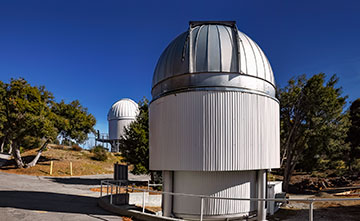
The CHARA (Center for High Angular Resolution Astronomy) array is an optical interferometer located on Mount Wilson in California. The array consists of six 1-meter (40-inch) telescopes operating as an astronomical interferometer.[Image: NOIRLab/NSF/AURA]
The CHARA Array, located on Mount Wilson, CA, USA, is an optical interferometer that consists of six 1-meter telescopes dispersed across the mountain to achieve exceptionally high angular resolution. Arguably the most powerful instrument of its kind in the world, the CHARA Array has measured the diameters, distances, masses and luminosities of stars, as well as imaged features such as spots and flares on their surfaces.
Now, an international team of researchers has demonstrated that a compact photonic chip can combine the light from multiple CHARA telescopes—a task that typically requires much larger and more complex optical systems (Mon. Not. R. Astron. Soc., doi: 10.1093/mnras/stag1745). The proof-of-concept instrument that houses the chip, named CHARIOT (CHara ARray Integrated Optics Testbench), also offers a platform to test photonic interferometric components with plug-and-play capabilities.
“Traditionally, combining the light from multiple telescopes requires bulky instruments with complex arrangements of mirrors and lenses,” said study author Robert Thomson, Heriot-Watt University, UK, in a press release accompanying the research. “We have shown that much of that work can instead be carried out by a glass chip only a couple of centimeters in size.”
Getting an upgrade
The heart of interferometric instruments such as the CHARA Array is a beam combination unit that coherently interferes the light from several telescopes. Thomson and his colleagues wanted to explore small-scale photonic-based components for beam combination in order to reduce the instrument footprint, lower the impact of environmental changes such as vibration and thermal variations and boost interferometric precision.
CHARIOT replaces JouFLU, a single-mode fiber-based beam combiner instrument for interferometry, which had been operating at the CHARA Array since 2002 until it was decommissioned in 2019. Since then, JouFLU has been taken apart, adjusted and upgraded, with one of the main differences being the photonic beam-combiner chip. The chip was fabricated using ultrafast-laser inscription in quartz glass with high-transmission properties over the whole K band.
The design is based on three asymmetric directional couplers: At each input, one coupler splits the light into a photometric arm and an interferometric arm, and a third coupler then recombines the two interferometric paths evenly to produce the two output signals. The plug-and-play nature of CHARIOT means that swapping the beam combiner takes only a few hours, so novel astrophotonic components can be rapidly tested on-sky at the CHARA Array.
“The great advantage of our approach is that we can integrate complex optical functions into a remarkably small and stable glass chip,” said study author Aurélien Benoît, Heriot-Watt University. “Combined with the flexibility of CHARIOT, this gives us a powerful platform for rapidly testing and validating increasingly advanced photonic technologies as we develop them.”
Frontline astronomical research
During observation campaigns beginning in May 2024, CHARIOT combined light from two telescopes at the CHARA Array and performed at a level comparable to the former JouFLU instrument. The successful on-sky qualification provides support for CHARIOT as a new high-precision K-band beam-combiner instrument.
“These first observations show that photonic technologies can deliver the performance needed for frontline astronomical research,” said study author Aline Dinkelaker, a former postdoctoral researcher at the Leibniz Institute for Astrophysics Potsdam, Germany. “As the technology develops, it could help astronomers study planetary systems around other stars in greater detail and support some of the most ambitious goals in modern astronomy.”
