

An artist's representation depicts a novel method that strips away the blaze of starlight that obscures exoplanets in telescope images. Starlight at the top of the image is filtered out through the digital twin of a telescope to reveal new worlds. [Image: Avesta Rastan]
Scientists in the United States have used physics-based modeling of space telescopes' optics to detect an extra-solar planet within the otherwise obscuring glare of its far brighter host star (Nature, doi: 10.1038/s41586-026-11213-z). They demonstrated their technique with infrared data from NASA’s James Webb Space Telescope (JWST), and they reckon that with further refinements it could aid in the discovery of Earth-like exoplanets.
Correcting instabilities
Astrophysicists often observe exoplanets by recording the faint light they reflect from the star that they orbit, but this signal is usually at least 100,000 times weaker than the light received directly from the star. To pick out the former, they can block much of the direct starlight by attaching a coronagraph to the observing telescope. However, some of the starlight still leaks through in the form of glare and must be removed by image processing.
That processing usually involves recording the light from a separate, very similar star and subtracting this reference image from the original to leave only the light from any exoplanets present. But this approach is vulnerable to any slight movement or distortion of the telescope’s optics, since these can alter the reference starlight between one observation and the next.
In the latest work, Rodrigo Ferrer-Chavez and Jason Wang of Northwestern University, working with colleagues at several other US institutes, show how to correct for a space telescope’s instabilities. Rather than subtracting glare by measuring the starlight from a reference object, they use physics-based modeling to work out how the telescope’s optics shape the incoming light field—instabilities included.
Creating a model
The researchers generated a computer model of the JWST Near-InfraRed Camera (NIRCam) by refining an existing but simplified model held by the Space Telescope Science Institute in Baltimore. Their aim was to incorporate as much detail as they could about how the various components of the telescope act on the incoming starlight, including the influence of defects and temporal variations, such as nanometer-scale bending of parts of the telescope’s mirrors.
They did so by exploiting some of the technology underlying neural networks and AI models—particularly GPU chips and back-propagation algorithms—without using the models themselves. Rather than optimizing the links between abstract nodes in a black box, their model, known as Physics-based Learning for Imaging Planets (FLIP), optimized the representation of the physical components themselves—its millions of free parameters symbolizing the component’s defects.
With the parameters fixed to certain values, the researchers used FLIP to work out how the instrument ought to represent a star’s glare and then compared that result with the real image from NIRCam data. By tuning the parameters to reduce the difference between simulated and real data, then repeating the process many times over, they ended up with a model able to reproduce stellar glare as captured by the instrument.
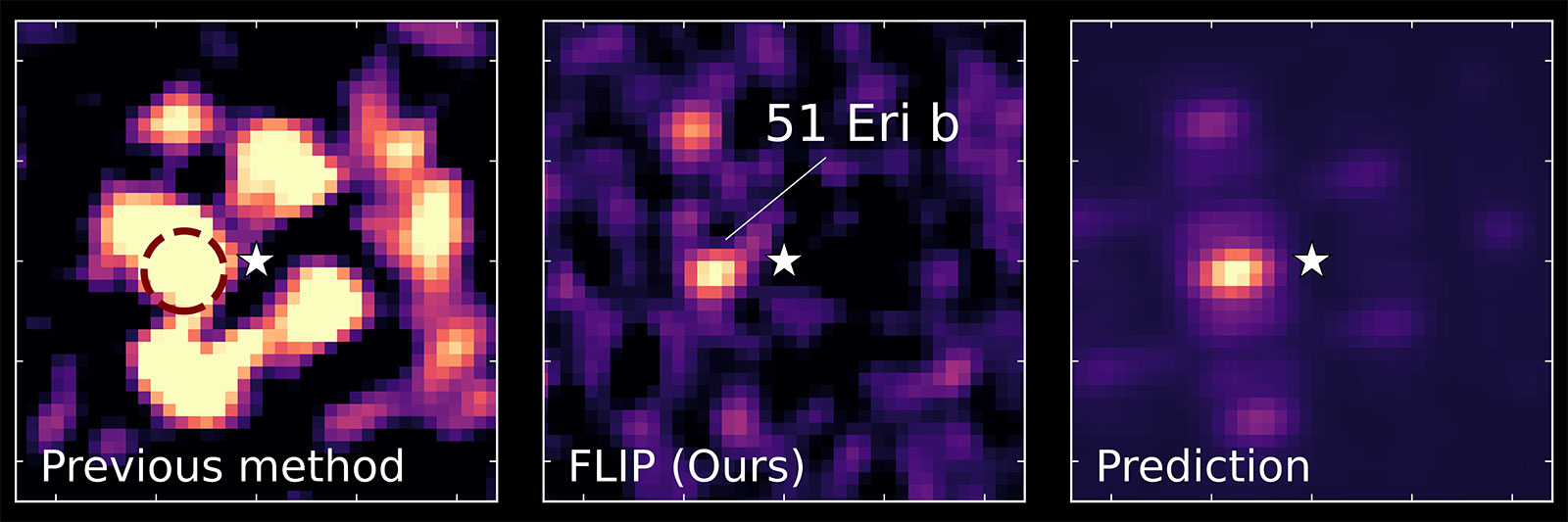
Physics-based Learning for Imaging Planets (FLIP) models a telescope’s optics in exquisite detail to better remove the glare from host stars, exposing any exoplanets that would otherwise remain hidden. [Image: Rodrigo Ferrer-Chavez]
Detecting never-seen exoplanets
To put FLIP through its paces, Ferrer-Chavez and colleagues tested it with observations from NIRCam of two stars known to have exoplanets: HIP 65426 and 51 Eridani. They found that FLIP outperformed empirical reference-star Karhunen–Loève image processing (KLIP) for both stars, roughly doubling the signal-to-noise ratio when detecting the exoplanets using one particular infrared filter, while enabling the detection of 51 Eridani’s planet with another filter that previously yielded no planetary signal—one at a wavelength of 4.3 micrometers.
As the scientists point out, this wavelength corresponds to one of carbon dioxide’s absorption bands and is inaccessible to Earth-based telescopes. They say that because carbon dioxide tends only to be found in atmospheres with lots of elements heavier than helium, they will in future use the detection of this particular molecule to establish how much carbon and oxygen is likely present in 51 Eridani’s atmosphere as well as to better understand how the planet formed.
The researchers also analyzed data from a star without any known exoplanets (TYC 5899), which was observed four months after the reference star—the latter being another science target to limit the overall number of observations. Injecting fake exoplanet signals into these data, they found that FLIP would be up to 15 times as sensitive to new planets around such self-referenced stars as KLIP would be. Pointing out that more than 100 similar stars have already been observed, they say that “the exoplanet discovery potential of using FLIP in these surveys is large.”
In particular, according to Ferrer-Chavez, the new technique should help reveal planets that resemble Saturn soon after it formed. “JWST is the first observatory with the capabilities to directly image planets like this, but young Saturn analogues typically remain hidden in the glare of the star,” he says. “Our technique can drastically help uncover planets like these if they are indeed hiding.”
Looking further into the future, Ferrer-Chavez and colleagues argue that their technique could help advance the discovery of exoplanets with a mass, composition, orbital radius and atmosphere similar to that of Earth. Such observations are exceptionally difficult, given that these “exo-Earths” would be around 10 billion times fainter than their stars (compared with a mere 1 in 100,000 disparity for young, bright hot gas giants). But the researchers believe that the new approach might conceivably simplify NASA’s proposed Habitable Worlds Observatory by easing the required performance of its hardware.
