

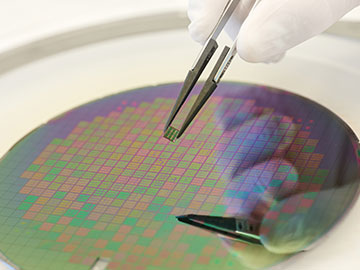
Technology companies NVision and HyperLight have set up a partnership to manufacture photonic chips to host systems of molecular qubits made from carbene molecules. [Image: NVision Quantum Technologies]
Researchers at a quantum technology company in Germany have shown how to address an individual molecular qubit using light (Nature, doi: 10.1038/s41586-026-11147-6). They plan to integrate their synthetic molecular system with photonic chips, arguing that it can be scaled up to provide the technology for quantum networking and distributed computing.
Overcoming defects
Much of the previous research on memories for quantum nodes has centered on defects in wide-bandgap semiconductors, such as nitrogen-vacancy centers in diamond. These solid-state systems enable quantum spins with long coherence times and optical read-out. However, the host crystals housing the color centers contain electron defects and other undesired variations in charge that often distort the emitter’s optical properties.
This problem can in principle be overcome by replacing the continuous covalent networks of semiconductors with artificial crystals made up of molecules bound to one another only weakly. Over the years, scientists have shown how to optically read out the spin in a variety of these bottom-up systems, including electron spins in excited states and, more recently, ground states. They’ve also investigated organic qubits, whose lack of heavy atoms extends spin lifetimes by limiting spin–orbit coupling.
However, all such systems to date have relied on reading out spin as a property of the bulk ensemble. The latest work, carried out by Ilai Schwartz, Matthias Pfender, Simon Roggors and colleagues at NVision Quantum Technologies in Ulm, working with academics in Germany and Israel, aimed instead to address molecules individually by identifying a suitably robust molecular qubit.
A new system
Schwartz and colleagues analyzed the properties of a range of organic “carbene” candidate molecules using a combination of large-scale computational screening and laboratory synthesis. The system they identified as the most promising consists of two pairs of phenyl rings (each ring being made up of six carbon and four or five hydrogen atoms) connected to one another via an additional carbon atom. It derives its qubit properties thanks to two strongly correlated unpaired electrons, both sitting near the central carbon atom.
The researchers made their molecular system by doping a suitable rigid crystalline matrix with precursor molecules that can be activated by light. They placed the crystal in a cryo-confocal microscope and cooled it down to 4.5 Kelvin, before exposing it to an orange laser beam and in the process converting the precursor molecules into dense ensembles of carbene qubits.
Under continued exposure to the laser, the qubit molecules fluoresced and exhibited two sharp emission lines in the orange region of the electromagnetic spectrum. The researchers say that these lines correspond to two very similar but nonidentical sites for qubit molecules within the host crystal, with subsequent tests showing these qubits to have a series of characteristics making them well suited to light–matter interfaces for quantum networking.
The researchers made their molecular system by doping a suitable rigid crystalline matrix with precursor molecules that can be activated by light.
For one thing, they showed that the qubits’ spectra remained almost unchanged while being repeatedly excited for more than an hour—the center frequencies of two distinct molecular lines varying by no more than a few megahertz. They also showed that changing the spin state shifts the optical transition by several gigahertz, which they point out is easily resolvable given an inhomogeneous linewidth of only a few hundred megahertz.
The researchers then read out the spin from single qubits, recording fairly high values for both the spin coherence time and the spin relaxation time—roughly 2 milliseconds and 20 milliseconds, respectively. They say these results imply that their molecular crystal could store a quantum state with a fidelity of 99% for around 40 microseconds, which they point out is about an order of magnitude longer than has been achieved with molecular ensembles.
Suitable memory
Schwartz and colleagues argue that this bundle of attributes makes their carbene crystals potentially well suited as memory in quantum repeaters. Repeaters provide a way of transmitting quantum states over long distances without the luxury of being able to simply amplify attenuated signals in optical fiber (owing to the no-cloning theorem). The idea is to distribute entanglement over ever-greater spans by storing quantum information in matter qubits while attempting to make successful Bell measurements between distant nodes. The researchers say that their measured spin coherence times, spectral stability and spin-selective transitions meet the criteria for working repeaters.
Besides these intrinsic characteristics, the researchers also point out that organic molecular crystals can be processed into thin films and deposited directly onto photonic integrated circuits—in a similar way to the fabrication of organic light-emitting diodes. To this end, NVision has set up a partnership with HyperLight, USA, a producer of photonic chips from thin-film lithium niobate. The company says the collaboration expects to manufacture its first prototype integrated chips by the end of the year.
In the longer term, NVision aims to scale up its technology to 1,000 physical qubits and then, by 2030, to 1,000 logical fault-tolerant qubits on a chip suited for use in data centers. Achieving such an ambitious aim will, however, involve ensuring that the qubits’ properties are preserved once they are integrated onto photonic chips, whose complex surfaces, the researchers say, could potentially affect the molecules’ optical and spin properties.
