

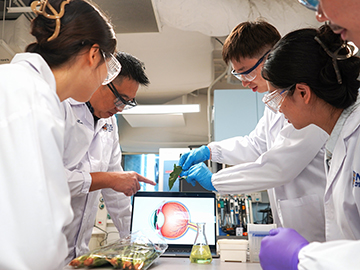
The NUS team developed a patented method that gently extracts the thylakoid grana from the cells of the spinach plant and used it as the active ingredient in their eye drops. [Image: College of Design and Engineering, NUS]
During photosynthesis, plants use light to generate energy-rich organic compounds critical to their survival. While algae and some bacteria also transform light into biochemically useful energy, such photosynthetic ability isn’t naturally found in higher animals. However, certain sea slugs store chloroplasts from the algae they eat in intestinal cells, which can provide emergency nutrition in times of starvation.
Inspired by these unique animals, scientists from Singapore and China have transplanted chloroplast structures from spinach into mammalian ocular cells as a potential treatment for dry eye disease (Cell, 10.1016/j.cell.2026.04.034). In preclinical studies, the light-activated technology could supply photosynthetically generated metabolites directly within inflamed ocular cells to alleviate oxidative stress and inflammation.
“This is an exciting finding as we have, for the first time, demonstrated that plant photosynthetic machinery can be transplanted into mammalian tissue to generate biologically useful molecules, powered entirely by the same light that enables our vision,” said study author Xing Kuoran, National University of Singapore (NUS). “We, too, can have limited photosynthetic abilities.”
Reducing oxidative stress
Keratoconjunctivitis sicca is a dry eye disease affecting over 1.5 billion people worldwide that causes irritation, burning and grittiness. Currently available treatments, such as cyclosporine A and lifitegrast, suffer from high costs and adverse side effects that limit long-term use. At a cellular level, keratoconjunctivitis sicca is driven by oxidative stress and inflammation.
“Although the cornea cells are capable of producing anti-oxidative molecules and anti-inflammatory molecules on their own in a healthy eye, the amounts produced in a dry-eye-diseased eye are far from sufficient,” said David Leong Tai Wei, NUS. “One such molecule, NADPH, acts as a key factor for many anti-oxidative reactions.”
Plant chloroplasts generate NADPH through light-dependent photosynthetic reactions, giving Leong and his colleagues the idea to transplant the functional structures into the eye.
Road to clinical trials
The team carefully extracted thylakoid grana—the stacks of discs found inside chloroplasts that are the site of the light-dependent reactions of photosynthesis—from spinach to create LEAF (light-reaction enriched thylakoid NADPH-foundry) technology.
“We isolated just the thylakoid grana, which are sub-micron in size, without denaturing much of these inherent structure and function,” said Leong. “Corneal cells took up LEAF and upon light stimulation were able to produce NADPH and relieve oxidative stress within and outside of the cells.”
Within 30 minutes of light exposure, LEAF was able to restore NADPH levels, suppress reactive oxygen species, and switch immune cells in the cornea from a pro-inflammatory to an anti-inflammatory state. In addition, LEAF treatment significantly increased NADPH levels in tears from patients with keratoconjunctivitis sicca, by roughly 20-fold.
Lastly, preclinical experiments on a mouse model of keratoconjunctivitis sicca demonstrated that NADPH levels in the LEAF group had doubled compared with a control group treated with only saline. Notably, light-activated LEAF also outperformed cyclosporine A. The researchers are now working towards clinical trials to test LEAF in humans with dry eye diseases.
