

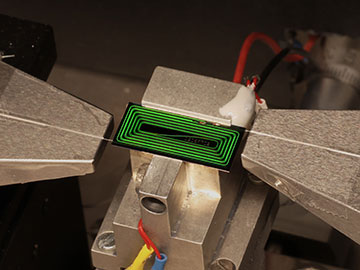
An optical chip exploits an erbium-doped waveguide to generate a train of intense laser pulses as short as 147 fs. [Image: Zheru Qiu/EPFL]
Researchers in Switzerland and Germany have demonstrated an optical chip that delivers femtosecond pulses of laser light with energies above a nanojoule (Nature, doi: 10.1038/s41586-026-10517-4). The millimeter-scale device produces pulses as short as 147 fs while achieving peak powers in the kilowatt regime, a performance that has previously only been achieved with tabletop systems.
“For more than twenty years, a high-pulse-energy femtosecond laser was widely regarded as a holy grail of integrated photonics,” says team leader Tobias Kippenberg from EPFL, Switzerland. “Our result shows that it is not only possible, but that it can be achieved with a surprisingly elegant architecture.”
Overcoming limitations
Most femtosecond lasers operate by using a nonlinear optical component to absorb low-intensity light, which after repeated round trips within the laser cavity generates a regular sequence of intense and narrow laser pulses. Chip-based solutions have been developed to replicate this mode-locking scheme, for example by integrating a laser diode with a passive light absorber, but the pulse energies generated by these devices have so far been restricted to a few picojoules.
To overcome this problem, Kippenberg and his colleagues turned to a different mode-locking mechanism. They exploited a laser design called a Mamyshev oscillator, which has been used in fiber lasers to produce few-cycle pulses and peak powers of several megawatts. For integrated photonics, one key advantage of this architecture is that it eliminates the need for a passive light absorber. It is also less vulnerable to the nonlinear interactions that can degrade the pulse shape in tightly confined optical circuits.
Higher pulse energies
In the chip-based solution designed by Kippenberg and his team, the laser cavity is formed from a nonlinear waveguide around 42 cm long. At either end of the waveguide are two bandpass filters, each one tuned to a different central frequency. All of these components can be fabricated on a single chip of silicon nitride, with the waveguide doped with erbium to achieve a nonlinear response.
Pulses traveling through the waveguide experience simultaneous amplification and spectral broadening, with higher intensities broadening more than low-intensity light. After many passes through the waveguide the most intense light is able to bridge the spectral gap between the two bandpass filters, generating a train of femtosecond pulses at the output.
Tests confirm that the chip can deliver pulse energies of up to 1.05 nJ at a repetition rate of around 175 MHz, with stable mode-locked operation sustained for more than 10 hours. The researchers also demonstrate the utility of the integrated Mamyshev oscillator for two potential applications. One is the generation of a supercontinuum, with the device driving a system that produces a continuous output from 736 to 2331 nm without the need for additional amplification.
The other is time-domain terahertz spectroscopy, where the ultrashort pulses delivered by the chip enable specific materials to be identified with a performance comparable to commercial instruments. This demonstration paves the way for handheld terahertz systems for nondestructive testing, while the device could also enable chip-scale frequency combs to be produced for applications such as optical atomic clocks.
