

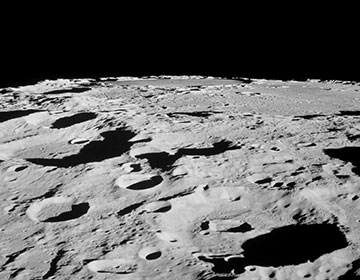
Dark craters on the moon’s surface, pictured here by the Apollo spacecraft, offer the perfect environment for an ultrastable laser. [Image: NASA]
An international group of physicists has suggested that the dark craters on the moon might be the perfect location to build a laser that is more stable than the best available terrestrial systems (Proc. Nat. Acad. Sci, doi: 10.1073/pnas.2604438123). Such a lunar laser could provide a master time signal and precise navigation for future space missions, while also offering new opportunities to detect and study exotic phenomena such as gravitational waves.
Just the right conditions
The critical component for such a lunar laser would be a silicon-based optical resonator, a technology that is widely used in metrology labs to generate precise reference frequencies. In these devices, two mirrored surfaces are separated by a spacer of monolithic silicon, producing laser light at a resonant frequency that is determined by the distance between the mirrors. On Earth these instruments must be kept under carefully controlled conditions to minimize environmental disturbances and thermal noise, which can cause the frequency to drift.
In contrast, the permanently shadowed craters on the moon’s south pole provide the ideal physical environment for an ultrastable optical resonator. The naturally high vacuum on the lunar surface would suppress vibrations and prevent any interactions with stray particles that could change the distance between the mirrors. The permanently shadowed craters are also extremely cold, varying between 20 and 60 K, which would dramatically reduce the random jitter of the mirrored surfaces.
Any residual heat from the cavity could also be radiated into outer space. A passive cooling system would be able to reduce the temperature of the cavity to around 17 K, at which point silicon no longer expands or contracts when exposed to small changes in temperature. “As soon as I understood what the permanently shadowed regions can offer, I felt that this would be the most ideal environment for a super-stable laser,” says lead author Jun Ye of JILA, a joint institute of the University of Colorado Boulder and the National Institute of Standards and Technology in the United States.
An ultrastable laser on the moon
According to Ye and colleagues, the unique physical conditions within the craters would enable the use of a longer cavity, potentially yielding a system with a thermal noise up to two orders of magnitude lower than state-of-the-art terrestrial devices. Such a lunar laser could also achieve a coherence time of more than a minute, compared with up to 10 seconds for Earth-based systems.
An ultrastable laser on the moon could be an important enabler for future lunar missions, such as those planned through the Artemis program. The south pole is a prime target for these lunar explorations, since the permanently shadowed craters harbor abundant water ice, while the rims of the craters are illuminated by the sun for most the year to provide a ready source of energy.
With these moon landings already planned, the researchers suggest that it should be possible to deploy an ultrastable laser on the lunar surface within the next five years. Once installed, it could form the basis of a navigation system, provide a precise timekeeping signal and enable stable optical signals to be distributed across networks of satellites. This networking capability could also be exploited to establish a long-baseline optical interferometer for deep-space imaging, detecting gravitational waves and testing other predictions of general relativity.
