

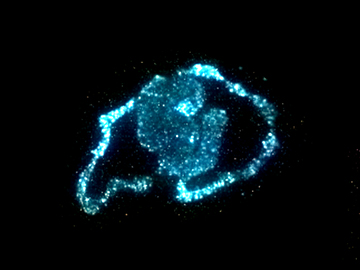
Living algae encapsulated within a printed hydrogel produce blue light when exposed to an acidic environment. [Image: Giulia Brachi/CU Boulder]
Researchers in the United States have created a 3D-printed platform that exploits simple chemical solutions to stimulate and sustain the light emitted by living algae (Sci. Adv., doi: 10.1126/sciadv.aee3907). The demonstration suggests that so-called “living light” could be harnessed in a new class of self-sustaining materials and devices, in particular for real-time sensing applications such as soft robotics and environmental monitoring.
Sustaining the algal glow
The study focused on a type of bioluminescent algae called Pyrocystis lunula that emit bright flashes of icy blue light when agitated by ocean waves or approaching predators. Their intrinsic response to mechanical motion has already been exploited in light-emitting sensors, but the bursts of light only last for a few milliseconds, and the application of mechanical stress causes many of these systems to degrade after a single use.
The researchers wondered whether chemical stimulation might be able to sustain the algal glow for longer. Inspired by experiments in the 1970s that showed that the algae’s bioluminescent response can be activated by different chemical compounds, they exposed the algae to an acidic solution with a pH of 4 and a basic solution with a slightly alkaline pH of 10.
Both environments were able to trigger light production from the algae, but with very different emission profiles. In the acidic solution, the algae produced bright and concentrated light for up to 25 minutes, while in the basic solution, the emission was weaker and more diffuse. These findings are consistent with the physiological preference of the algae to mildly acidic conditions.
Harnessing the bioluminescent response
To harness these light-emitting properties within a usable material, the researchers embedded the algae within a naturally derived hydrogel. This algae-laden gel could be extruded through a nozzle to create simple 3D structures, which were then exposed to the two different chemical solutions. In both environments, the algae were found to illuminate the structures with blue light, with the researchers confirming that their light-emitting behavior is not affected by the encapsulation process.
The algae within the 3D-printed structures remained alive and responsive over several weeks. The acidic condition produced the best results, with the algae retaining 75% of their original brightness after four weeks with repeated chemical activation. The team also found that the light emission could be amplified by combining chemical stimulation with a mechanical input, offering another mechanism for modulating the response from living-light systems.
The team is now exploring whether the algae might react to other chemicals. They might, for example, light up when toxins or contaminants are present in water, which would enable them to be used as living sensors for monitoring water quality. With no need for batteries, they could also provide a light source and key sensing functionalities for small-scale robots. “This discovery really paves the way for engineering other living-light materials and devices,” says team leader Wil Srubar, University of Colorado Boulder.
