

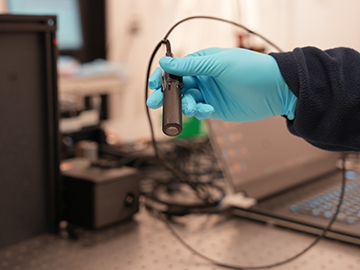
PrecisionView is a handheld endomicroscope that overcomes limitations in medical imaging by combining advanced optics with deep learning. [Image: Rice University]
Cancers of epithelial cells—a broad category that includes lesions of the mouth and cervix—have better outcomes if they are detected early. However, biopsies of suspicious tissue are invasive and painful for the patient, and existing imaging systems often don’t have enough depth of field to handle irregular surfaces and the underlying microvasculature.
Researchers from two US institutions recently designed a compact microscope that uses deep learning to optimize its imaging capability (Proc. Nat. Acad. Sci., doi:10.1073/pnas.2602705123). The device performs both fluorescence and reflectance imaging in vivo for studying the structure of suspicious cells and the tiny blood vessels that feed them.
Optical challenges
Histopathology—the process of removing cells from a patient, staining them and examining them under a full-sized laboratory microscope—has been the gold standard for cancer detection. However, the procedure is time-consuming and not always available in places with few medical resources. Scientists are pushing to expand the early-detection abilities of in vivo microscopes, but optical limitations on the field of view usually mean that such instruments can scan only a small section of a large, heterogeneous mass that might simultaneously harbor benign and malignant cells. Previous conventional microscopes have a depth of field less than half of the irregularities of many surface tissues.
Researchers Rebecca Richards-Kortum and Ashok Veeraraghavan, Rice University, USA, developed a handheld endomicroscope roughly the size of a pen, containing off-the-shelf achromatic optics that feed images to a reconstruction algorithm guided by a deep neural network.
The handheld device, dubbed PrecisionView, gets its illumination from 14 blue and green LEDs fed through optical fibers that spread the light evenly over the 5.2 × 3.9 mm field of view. Before fabricating an optimized phase mask, the research team trained the reconstruction algorithm on a dataset including many fluorescence and reflectance images.
High resolution, low cost
Together with scientists from the MD Anderson Cancer Center, USA, the team imaged specimens of pig tongue, postmortem human breast tissue, and sections of precancerous lesions from the human cervix. They also examined the oral cavities of live, healthy human volunteers. These tests showed that PrecisionView has a 500 μm depth of field with 4 μm resolution—eight times that of conventional in vivo microscopes.
The Rice and Anderrson researchers hope that the low cost of the device components, US$3,000, will lead to its adoption in a wide variety of clinical settings. “PrecisionView represents a future direction for medical imaging, one where artificial intelligence and optical design work together to improve outcomes,” Richards-Kortum said. “By designing hardware and algorithms together, we can unlock capabilities that simply weren’t possible before.”
