

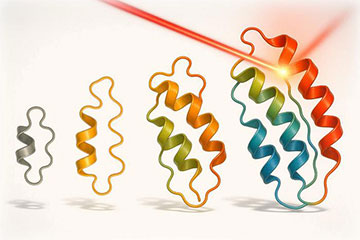
Activating genes with light. [Image: Sahand Rahi (EPFL)]
Directed evolution, which mimics the process of natural evolution in the laboratory to generate biomolecules of interest, is a powerful tool for protein engineering. However, current methods lack the ability to efficiently produce proteins that are more complex—such as those capable of turning on and off in response to a specific signal.
To this end, researchers based in Switzerland and Germany have developed a new approach that uses light to guide the evolution of proteins with dynamic, multi‑state and computational functionalities (Cell, doi: 10.1016/j.cell.2026.02.002). The technique, called optovolution, lays the groundwork for directed evolution to generate more sophisticated proteins in a simplified, scalable way.
Leveraging switchability
Over the past three decades, the field of directed evolution has expanded in scope, increasingly targeting more complex and diverse biomolecules and functional properties. A key limitation of current methods is that they optimize only one state of a protein at a time, often at the expense of being able to switch to other states. This constraint goes against biology, where signaling proteins and protein switches need to change states over time.
“When breeding animals for livestock, for example, farmers avoid improving one trait at the expense of other important traits—increasing muscle mass is not desirable if it significantly worsens an animal’s immune systems,” said study author Sahand Jamal Rahi, Ecole Polytechnique Fédérale de Lausanne, Switzerland. “At the molecular scale, analogously, we were interested in finding a way to efficiently evolve proteins with more than one function or state.”
Rahi and his colleagues devised optovolution to continuously evolve proteins that have different states. They genetically engineered budding yeast for optogenetic input to switch a protein of interest “on” and “off,” which is coupled to an oscillator that needs to run for cells to proliferate.
“An evolutionary solution that breaks the switchability of the protein is thus highly disadvantaged, because cells harboring such a corrupted version of the protein should in principle not grow and divide,” Rahi said. “At the same time, we put the protein under light control, which efficiently flips through the states of the protein, allowing us to apply selection pressure.”
Speeding up research
To demonstrate their technique, the researchers applied optovolution to three switchable multi-state systems, including a widely used light-controlled transcription factor called El222. They evolved 19 new variants of El222, including those that were more sensitive to light, less active in the dark, or responsive to green rather than only blue light. The team also evolved a red‑light optogenetic system that has greater ease of use in yeast for experiments.
“Controlling therapeutics and cells requires the ability to switch molecules. Multi-state proteins are ideal for implementing external control mechanisms, but their engineering has been hampered by the difficulty of evolving and screening them,” Rahi said. “We hope that optovolution, both technically and conceptually, will speed up research and development in this area.”
