

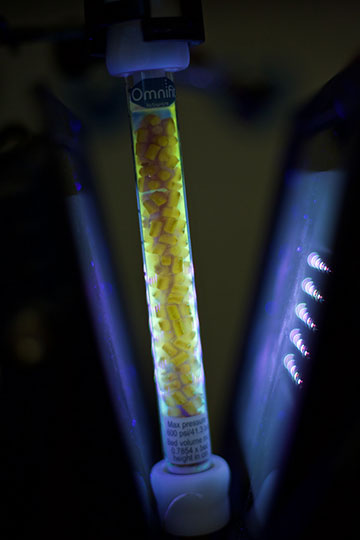
The photocatalytic reactor capable of selectively fragmenting lignin. [Image: University of Alicante Image Studio]
On the road to refining plant waste and extracting economically useful materials from it, one major stumbling block has been lignin. Lignin is the fibrous stuff that makes wood rigid, and breaking it down in a refinery has been daunting scientists.
Researchers at two universities in Spain have discovered a light-activated catalyst that breaks lignin down into molecular components that can be reused as 3D-printing materials or even as a flavoring agent (Nat. Commun., doi:10.1038/s41467-026-73706-9). “In this study, we present a technology that allows us to transform lignin into high-value products using nothing but light and ambient conditions,” said Néstor Guijarro, University of Alicante.
Lignin and biorefining
Chemically speaking, lignin is an organic polymer—a class of huge, heterogeneous molecules with formulas that vary depending on the plant of origin. Its presence makes cheap paper, like newspaper, turn yellow and brittle with age, so manufacturers of better-quality paper must remove as much lignin from wood pulp as possible.
What happens to the extracted lignin, which makes up almost 30% of plant biomass? Historically, paper mills have burned it to provide energy, but today’s focus on renewable energy and sustainable manufacturing processes has drawn attention to the chemical components of lignin and its possible reuse. Some of the components of lignin polymers, which chemists call “moieties,” have economic value, but traditional methods of breaking down the polymers, involving heat and catalysts, are energy-intensive and inefficient.
From vanilla to biodegradable tableware
The Alicante team found that carbon–carbon bonds between certain moieties break down when exposed to 365-nm light and anthraquinone, an aromatic organic compound used as the catalyst. Attaching the anthraquinone to silicon dioxide particles enhances the catalytic reaction. The photocatalytic flow reactor runs in ambient conditions without the need for added heat.
Notably, the scientists extracted vanillin—a high-value chemical that gives vanilla its characteristic scent—at a weight yield of 7.1%. The food and cosmetics industries make wide use of this substance.
What about the rest of the lignin? Researchers at the Polytechnic University of Valencia used it to make plasticizers for polylactic acid (PLA), a plastic material used in everything from surgical sutures and biodegradable tableware to the raw filament for 3D-printing. Indeed, the Valencia team 3D-printed a cellphone case from PLA containing the lignin byproducts.
"We repurposed the by-product to plasticize PLA, unlocking fascinating properties such as shape memory, enhanced flexibility, and seamless integration into additive manufacturing," said Rafael Balart, Polytechnic University of Valencia.
