

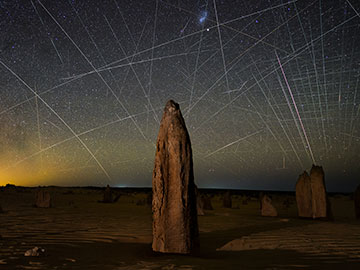
A photograph taken in the Australian desert illustrates the growing light pollution caused by artificial satellites. [Image: Joshua Rozells]
Researchers at the University of Surrey, UK, have shown that a new type of ultra-black coating could reduce the light pollution caused by satellites traveling in low-Earth orbits (Mon. Not. R. Astron. Soc., doi: https://doi.org/10.1093/mnras/stag1136). The coating, which can be sprayed onto the outer surfaces of spacecraft components, offers a practical way to mitigate the impact of future satellites on ground-based astronomical observations.
Dampening satellite glare
Studies have shown that artificial satellites and other small spaceborne objects account for around 10% of the overall brightness of the night sky, while sunlight reflected from individual spacecraft can create bright streaks and flares in astronomical images. With more than 60,000 satellites expected to be orbiting the Earth by 2030, practical solutions are needed to preserve the ability of terrestrial telescopes to image faint objects such as asteroids and distant galaxies at optical wavelengths.
Satellite operators have trialed various mitigation strategies, such as altering the orientation of reflective surfaces and coating the spacecraft with a dark material, but previous demonstrations have not reached the standard required by astronomers. In this new work, the researchers evaluated the performance of an ultra-black coating, called Vantablack 310, that has been developed for aerospace applications by spin-off company Surrey NanoSystems.
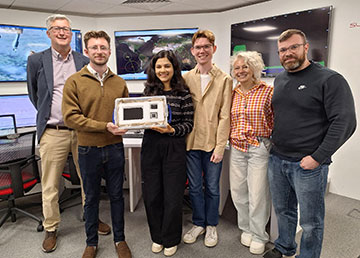
From left, Keith Ryden, James Whitfield, Astha Chaturvedi, Keiran Clifford, Noelia Noël and Luca Ferrian with the black coating Vantablack 310. [Image: University of Surrey]
This ultra-black material incorporates nanostructured black pigments into a polymer binder, providing a formulation that can be sprayed onto large surfaces to create a thin and durable layer. Once applied, structured optical cavities within the coral-like coating scatter and trap incident light to reduce the reflectivity of the surface.
Reduced reflectance
Laboratory tests by the researchers confirmed that the coating maintains a reflectance of just 2% at wavelengths ranging from the ultraviolet through to the near infrared. Measurements also show that any residual light is reflected fairly evenly across all directions, indicating that the coating would suppress the bright flashes that are produced by satellites in low-Earth orbit.
Using these laboratory measurements, the researchers simulated the appearance of a coated satellite from the ground. The simulations suggest that the coating would make satellites appear significantly fainter across a range of viewing geometries—including the twilight zone where satellites are particularly visible from Earth—with the brightness almost reaching the threshold recommended by the International Astronomical Union.
“Our results show that relatively simple material choices could make a meaningful difference to astronomical observations without requiring major changes to mission design,” said Astha Chaturvedi, lead author of the study. The team is now preparing to test the performance of the coating in space conditions using the Jovian-1 CubeSat, a student-led mission that is due for launch later this year.
