

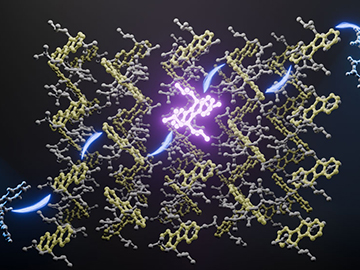
A new solid-state material turns visible light into high-energy UV radiation at sunlight intensity. [Image: Naoyuki Harada, Kyushu University]
Ultraviolet light has innumerable uses in science and manufacturing, yet such wavelengths constitute only 6% of the sunlight reaching Earth’s surface. A mere 3% of sunlight falls in the desirable 300- to 400-nm wavelength range.
Now, researchers in Japan have developed a solid-state material that converts visible rays of sunlight to UV photons with a conversion efficiency of 1.9% (Nat. Commun., doi:10.1038/s41467-026-73898-0 ). The organic semiconductor material also exhibits a threshold excitation intensity slightly below the solar irradiance near the peak excitation wavelength of 445 nm.
Liquids versus solids
Scientists have known about photon upconversion for decades. In one conversion method, known as triplet-triplet annihilation, two molecules in triplet excited states interact, eventually producing a singlet molecule and a ground-state molecule and emitting an excited photon. However, for that process to efficiently convert visible wavelengths to the UV regime, the donor and acceptor molecules must be dissolved in solution—and such liquids are volatile and prone to leakage. Thus, researchers have sought solid materials with uniform dispersion of donor molecules and high quantum yields regardless of crystalline defects.
A team at Kyushu University, Japan, achieved the goal by attaching alkyl chains to the carbon molecules of dihydroindenoindene, or DHI—a long name for a compound with the simple chemical formula C16H12. In DHI, the carbon atoms are arranged in the tetrahedral sp3 formation, and the alkyl chains extend perpendicular to the so-called π-plane of the DHI molecules. This arrangement controls the gaps between molecules and thus the quantum interactions between the molecules. It also increases the fluorescence quantum yield of the reactions.
The threshold excitation intensity of the upconversion process is 1.2 mW cm−2, whereas the sun’s irradiance at Earth’s surface is 1.4 mW cm−2. The method also achieves a fluorescence quantum yield above 60%, and with a donor molecule, it reaches an upconversion efficiency of 1.9%.
"This means roughly two UV photons are produced for every hundred visible-light photons absorbed,” lead researcher Yoichi Sasaki adds. “It may sound low, but it runs on natural sunlight alone. Most solid-state materials cannot realize this even at much higher light intensity.”
Real-world applications
According to the researchers, the DHI chromophores can be incorporated into thin films prepared by the usual spin-casting and drop-casting methods. The scientists have filed for a patent, and they envision such diverse potential applications as indoor air purification and low-intensity 3D printing as well as solar-driven photocatalysis.
