

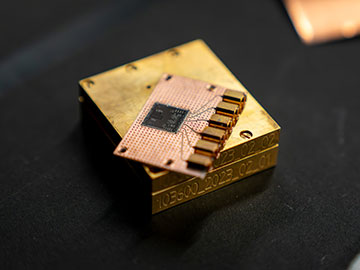
A “quantum bath” of correlated light particles synchronizes distant qubits. The quantum bath setup in which scientists from the Institute of Science and Technology can entangle two isolated qubits fully autonomously, without active control or repeated measurements. [Image: ISTA]
Scientists in Europe have demonstrated experimentally how a continuous-wave source of entangled states can be used to discretely entangle two distant quantum bits (qubits) without the complex control mechanisms of rival schemes (Phys. Rev. X, doi: 10.1103/r4jt-j39w). They reckon that their technique, once rendered more efficient, could serve as the basis for large-scale, multi-node quantum networks.
Achieving entanglement
Entanglement is an entirely quantum-mechanical phenomenon involving correlations between distant objects that defy the conventional principle of local causation. It is a key resource of quantum networks, potentially enabling coherent links over arbitrarily large distances. Distributed via devices known as quantum repeaters, it could extend the range over which classical data can be securely encrypted with quantum keys and might ultimately allow quantum data to be processed by computers linked to one another across a “quantum internet.”
Optically entangling two atoms—the qubits—located some distance from one another is often done in one of two different ways. The first option involves laser-induced emission of a photon from an atom sitting in an optical cavity and the subsequent absorption of that photon (after traveling along an optical fiber) by a second laser-driven atom in a cavity. Alternatively, both atoms can be driven by a laser simultaneously, such that a photon detected midway between the cavities causes the atoms to become entangled.
Leveraging squeezed light
Both such schemes, however, are quite tricky to carry out since they require the lasers to be turned on and off in very precise sequences. Back in 2003, Barbara Kraus and Ignacio Cirac at the Max Planck Institute for Quantum Optics, Germany, proposed instead to generate entanglement by combining two beams of squeezed light—radiation that beats the usual shot-noise limit by trading off amplitude and phase noise against one another.
Squeezed light produces what is known as continuous variable entanglement. Usually this is ill-suited to entangling qubits, which are discrete entities. But Kraus and Cirac showed how to transform continuous entanglement into its discrete counterpart by coupling qubits to what could be called a quantum bath—a broadband reservoir of correlated photonic states. An interference effect between the bath and the qubits forces the qubits to be either excited or de-excited at the same time, which results in entanglement. That entanglement is complete and does not require synchronized laser pulses.
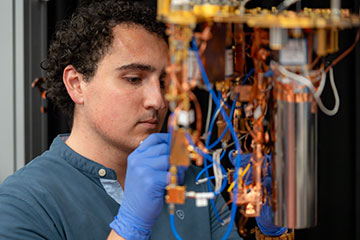
Alejandro Andrés-Juanes is shown working on the new experiment, which distributes entanglement autonomously by exploiting a source of correlated light particles known as a quantum bath. [Image: ISTA]
Tests and results
Demonstrating this scheme experimentally requires very careful coupling of atomic qubits to photons in waveguides. Until recently, that has not been technically possible. But now, more than two decades on, Johannes Fink and Alejandro Andrés-Juanes at the Institute of Science and Technology, Austria, together with colleagues in Austria, Germany and Spain, have shown how do it.
Their specific implementation involves using what is known as a Josephson parametric converter to place microwave photons into a two-mode squeezed state, which constitutes the correlated photonic reservoir. Each of the converter’s two (correlated) outputs is connected via some 50 cm of coaxial cable to a transmon qubit, a small superconducting circuit made from a capacitor and a Josephson junction. The squeezed state propagates to the qubits, driving them to something close to a maximally entangled Bell state.
Not only were the researchers able to achieve this state without having to carefully control the microwave source, they also found they could assess the performance of their scheme using quantum tomography. This involves reconstructing the qubits’ states by measuring their different expectation values over many experimental runs.
Fink and colleagues found they could preserve entanglement just as well as more conventional schemes, both continuous and discrete. But they say that by generating squeezing over a wide range of microwave frequencies—broader than the qubit linewidth—it should be easier to scale the technology up to span multi-mode, long-distance and high-speed networks.
They acknowledge that their experimentally generated concurrence, which is a measure of the degree of entanglement between two qubits, remains low, reaching no more than 10%. The researchers say they were limited by the still less than ideal waveguide couplings, losses in the fiber and an unexpectedly large disparity between the qubits’ decay rates. But they believe these problems can be overcome by coupling the qubits at the end of the transmission lines and improving the squeezing sources.
