

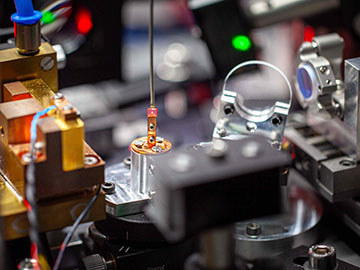
A magnetic sensor that integrates NV-doped diamond inside a laser cavity has set a new performance benchmark. [Image: Fraunhofer IAF]
An international team of researchers has created a laser-enhanced quantum sensor that can measure extremely weak magnetic signals, such as those produced by neural activity in the brain (Nat. Commun., doi 10.1038/s41467-026-78386-z). The device, which also offers the operating characteristics needed for deployment in real-world environments, opens up new prospects for medical diagnostics, satellite-free navigation and detecting anomalies in the Earth’s magnetic field.
Greater sensitivity
State-of-the-art magnetometers based on superconducting devices or vapor cells already offer high sensitivities, but their need for cryogenic cooling and magnetic shielding limits their practical use. A promising alternative is provided by nitrogen-vacancy (NV) centers in diamond, which have quantum spin states that respond to shifts in the magnetic field. One common approach is to measure the fluorescence generated by energy transitions between the spin states, which has yielded compact devices operating at room temperature. Their performance remains limited, however, by the low optical contrast between the signal and the background fluorescence.
To overcome this limitation, researchers have been investigating a different way to exploit the sensing capabilities of NV-doped diamond. In this technique, called laser-threshold magnetometry (LTM), the NV centers are directly integrated into a laser cavity, altering the output signal in a way that depends on the magnetic field. So far, however, the effect on the laser emission has been too weak to achieve high sensitivity over a wide operating range.
Tests confirm that this combined laser system responds strongly to an external magnetic field, achieving a measurement contrast of 100% for all three components of the magnetic field.
In this latest work, the researchers combined the NV-doped diamond with a separate semiconductor laser that generates more optical power inside the cavity. When this system is exposed to an external magnetic field, particular spin states in the NV centers absorb some of the light from the cavity field. The small loss of signal can be amplified by operating the laser system close to threshold, in which case the absorption of light by the NV centers can suppress the laser output entirely.
Best in class
Tests confirm that this combined laser system responds strongly to an external magnetic field, achieving a measurement contrast of 100% for all three components of the magnetic field. From these tests the researchers calculate the best possible sensitivity that can be achieved, which reaches a best-in-class figure of 127 fT/ÖHz for one orientation and below 400 fT/ÖHz for all three vector components.
This optimal sensitivity was achieved by limiting the system’s dynamic range, which reduces the range of magnetic fields that yield a linear measurement response. Overall, however, the laser system delivers the best combination of sensitivity and dynamic range yet recorded for any magnetometer, with the ratio between these two parameters almost 600 times higher than for other systems. “Our approach could resolve a trade-off that has long limited the development and application of magnetic-field sensors,” says first author Florian Schall of the Fraunhofer Institute for Applied Solid State Physics in Germany.
