

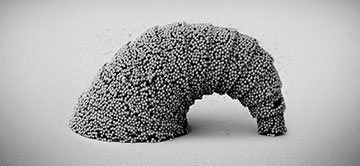
A light-driven fabrication process enabled this croissant-shaped microstructure to be assembled from microparticles of silica. [Image: Max Planck Institute for Intelligent Systems]
Researchers in Europe and Singapore have devised a laser-driven technique that allows 3D microstructures to be created from almost any type of solid material (Nature, doi: 10.1038/s41586-025-10033-x). Such small-scale objects could previously only be fabricated using two-photon polymerization, restricting the choice of materials, but this new strategy enables functional 3D structures to be formed from materials that include metals, diamond and silica.
3D microstructures from a template
The technique exploits optofluidic interactions, in which the heat generated by a laser induces localized fluid flow. Before the assembly process, a plastic template is fabricated by using two-photon polymerization to produce a hollow structure with the desired shape. This template, which includes a small opening on one side, is then immersed in a colloidal fluid containing micro- or nanoparticles of the chosen material.
To assemble the structure, a femtosecond laser is used to heat a small area close to the opening in the template. The steep thermal gradient generated at this hotspot creates fast and directed fluid flow, propelling the particles toward the hole and into the hollow structure. As the particles accumulate over time, they fill the available space to form the 3D shape defined by the template.
Once the assembly process is complete, the polymer template is removed to yield a free-standing 3D structure made entirely of the target material. The assembled nanoparticles are held together by strong van der Waals forces, ensuring that the finished objects are self-supporting and mechanically stable without the need for any additional processing.
A robust technique
To illustrate the robustness of the technique, the team used particles of silica to fabricate a curved croissant-shaped structure with a free-standing arch. The assembly speed is around 700 µm3 per second for particles with a diameter of 1 µm, about twice as fast as printing the structure using two-photon polymerization.
The team also used its universal method to fabricate a variety of miniature devices, including microvalves that could be used within a fluidic chip to sort particles by size. Microrobots were assembled from particles of different functional materials, enabling their motion to be controlled using several distinct mechanisms. In one example, an L-shaped robot made from gold, titania, platinum and iron oxide could be moved in three different ways: pulling by a magnetic field, counterclockwise rotation under ultraviolet light and clockwise rotation when placed in hydrogen peroxide.
“The ability to form tiny 3D objects from almost any material opens up new frontiers for multifunctional microrobots, microscale technology, and many other applications that still sound like science fiction today,” commented Metin Sitti of Koç University in Istanbul, who led the research.
