

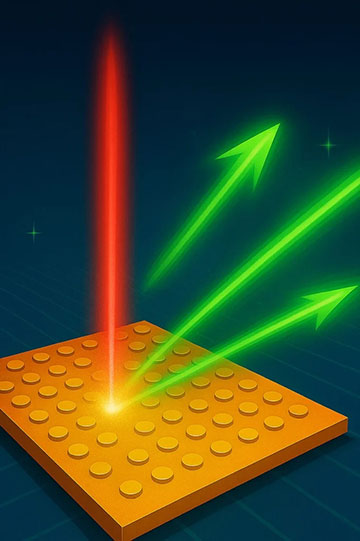
A rendering of the metasurface chip in action. When hit with an infrared laser, the microscopic device converts the incoming light to a higher frequency and sends it out as a narrow beam that can be precisely directed. [Image: T. Sun]
Demonstrations of nonlinear metasurfaces have relied on localized nanoscale resonances, with an inherent trade-off between the nonlinear enhancement, efficiency and control over the generated wavefront. However, metasurfaces supporting delocalized resonances suffer from high symmetry and therefore lack the necessary local degrees of freedom for wavefront shaping.
Now, researchers based in the United States and Italy have designed a nonlocal nonlinear metasurface that simultaneously leverages the best of both worlds (eLight, doi: 10.1186/s43593-025-00116-7). The device could lead to ultra-compact light sources and beam-steering elements for technologies like lidar, quantum light generation and optical signal processing.
“We bridge this gap by demonstrating the first nonlinear nonlocal metasurface platform capable of both large nonlinear enhancement and full subwavelength control of the emitted nonlinear wavefront,” said study author Andrea Alù, City University of New York, USA. “This opens the door to highly efficient, tunable and functionally rich nonlinear optical components, addressing both technological and physical limitations of prior work.”
The results establish a new pathway toward the development of nonlinear nanoscale devices with complete nanoscale control over the optical properties of the generated light.
Unique combination of properties
Alù and his colleagues created a metasurface design that leverages small perturbations in an otherwise periodic structure supporting a lattice resonance. The perturbations are suitably rotated to control a local geometric phase, while the metasurface as a whole supports a delocalized nonlocal resonance that dramatically enhances the nonlinear response—specifically, third-harmonic generation.
They also show experimentally that the metasurface can steer the generated light to different diffraction orders with high directionality as a function of the input polarization and that the emission direction can be switched simply by changing the chirality of the input pump. The novel device achieves a combination of properties that had not previously been demonstrated together: a high‑Q quasi-bound state in the continuum (qBIC), subwavelength phase engineering that enables wavefront shaping, directional and polarization-robust nonlinear emission, and pump-chirality-dependent beam steering.
“Together these features represent a fundamentally new class of nonlinear metasurfaces that blend nonlocal resonant enhancement with local control—something that neither localized nonlinear metasurfaces nor periodic qBIC structures could achieve on their own,” said Alù.
A new pathway
The results establish a new pathway toward the development of nonlinear nanoscale devices with complete nanoscale control over the optical properties of the generated light, applicable in both classical and quantum domains, without the requirement of phase matching.
“One major application area is compact, highly directional frequency converters, where a laser at one wavelength produces structured light at its third harmonic with precise control over angle and polarization,” Alù said. “The high Q-factor and enhanced efficiency make such devices suitable for low-power or chip-integrated light sources, wavelength converters and on-chip signal routing.”
Other potential applications include polarization-controlled routing or multiplexing at nanoscale dimensions for optical communication systems, nonlinear holography and imaging, and quantum light generation.
