

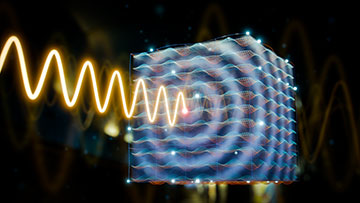
Artist’s impression showing how a terahertz wave can modulate the properties of what is known as a photonic time crystal, generating fluctuations that are both high amplitude and high frequency. [Image: B. Schröder/HZDR]
Physicists in France and Germany have built a photonic crystal that operates in time as well as space, using a plasmonic metamaterial to manipulate light at terahertz frequencies (Nature, doi: 10.1038/s41586-026-10825-9). They have shown that their “photonic time crystal” modulates incoming radiation at speeds comparable to those of the light cycle itself, arguing that it should be possible to transform the device into a terahertz laser source.
A closer look at PTCs
Photonic crystals consist of a wavelength-scale lattice made from two materials with different refractive indices and can enhance, guide or block light with certain frequencies. Naturally occurring examples include the structures found inside opal or some butterfly wings, and scientists have also manufactured them for use in exceptionally reflective mirrors and optical fiber.
While standard photonic crystals manipulate light via precise spatial periodicity, photonic time crystals (PTCs) instead rely on very rapid modulations in time. Viewed in reciprocal space, the repeating spatial pattern of the former creates replicas of nonperiodic band structure along the momentum axis, resulting in frequency gaps where the two types of band cross (see figure 1). A PTC, in contrast, generates replicas along the frequency axis, yielding momentum gaps as a consequence.
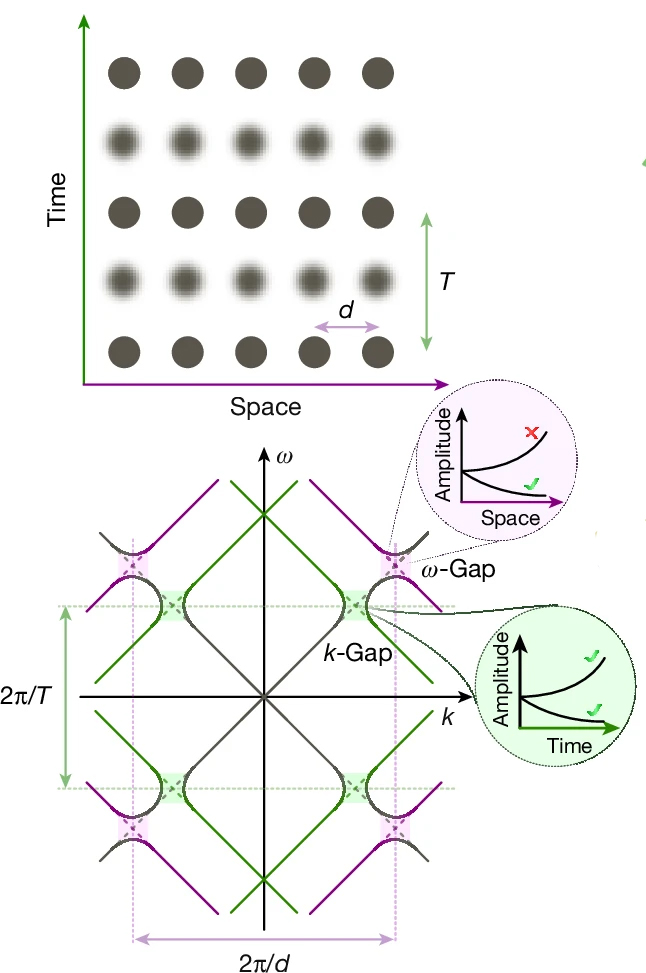
Conceptual representation of a combined SPC and PTC in real space (top) and reciprocal space (bottom). Periodicity in space generates replicas (purple lines) of the bare photonic band structure (dark grey lines) translated along the momentum axis, and periodicity in time generates replicas (green lines) of the bare photonic band structure translated along the frequency axis. Crossings between the bare dispersion and these replicas, as indicated by the dashed lines, open gaps in the resulting band structure (solid lines): frequency gaps in the case of the spatial periodicity and momentum gaps in the case of the temporal periodicity. [Image: T. Guo et al. “Plasmonic metamaterial time crystal” Nature (2026)]
This difference confers some unique characteristics to PTCs. Both types of gap constrain electromagnetic waves to grow or decay exponentially, but only waves modulated in time—those in PTCs—can grow while respecting the basic laws of physics (thanks to their existing out of equilibrium). This implies that PTCs can amplify light, so in principle they can operate as lasers.
Building time crystals
Building PTCs, however, is not easy. They must modulate optical properties both at a high amplitude—such as doubling then halving the crystals’ refractive index—and at very high speed, carrying out these modulations on timescales similar to that of the light wave’s cycle period. To date, these constraints have limited such devices to microwave frequencies, being made from electrical rather than optical components.
In the latest work, Yannis Laplace and colleagues at Ecole Polytechnique, France, working with researchers at Dresden University of Technology, Germany, have shown it is possible to build a PTC using a plasmonic metamaterial. A plasmonic metamaterial is an artificial material that manipulates light in unusual ways thanks to its generation of surface plasmons—collective oscillations of free electrons at the interface between a metal and an insulator. In this case, the researchers made the material by depositing a 3-µm-thick layer of insulating silicon nitride on top of a piece of the semiconductor indium antimonide, and then they used photolithography to engrave gold stripes on the insulator at roughly 60-µmintervals, creating a plasmonic cavity at the junction of the three materials.
Using the TELBE terahertz (THz) source at Helmholtz-Zentrum Dresden-Rossendorf, Germany, the researchers put their device through its paces in a pump–probe setup. They fired in a narrow-band, multi-cycle THz probe pulse and then measured its effect on the material using a broadband, more fleeting THz pulse in combination with an optical sampling beam.
Measuring the PTC’s reflectivity and the probe pulse’s phase, they found that the material modified the pulse at twice the driving frequency. They also established a shift in the pulse’s resonance, with the spectral peak in both reflectivity and phase being significantly red-shifted.
Using computer simulation to model the plasmonic resonance as a parametrically driven oscillator, the researchers found that the simulated results agreed well with those from the experiment. Then by fitting the measured line-shapes based on a theoretical analysis of this model, they established that one of the optical modes had 50% fewer losses compared with the equilibrium state.
Toward lasing
Looking ahead, Laplace and colleagues say that it should be possible to lase with such a device. They point out that lasing could occur when the gain generated by the driving pulse exceeds total losses. Although gain is currently only about 50% of losses, the scientists reckon that “plasmonic lasing with this platform is within experimental reach” so long as they can make the cavity smaller and fine-tune the drive parameters—detuning the beam slightly from resonance and achieving just the right driving strength.
If they are successful, the researchers believe that such lasers could be used for noninvasive medical imaging, given that many molecules resonate at terahertz wavelengths. They also say that pushing signal bandwidth up from gigahertz to terahertz frequencies could further extend mobile communications.
